Our verdict
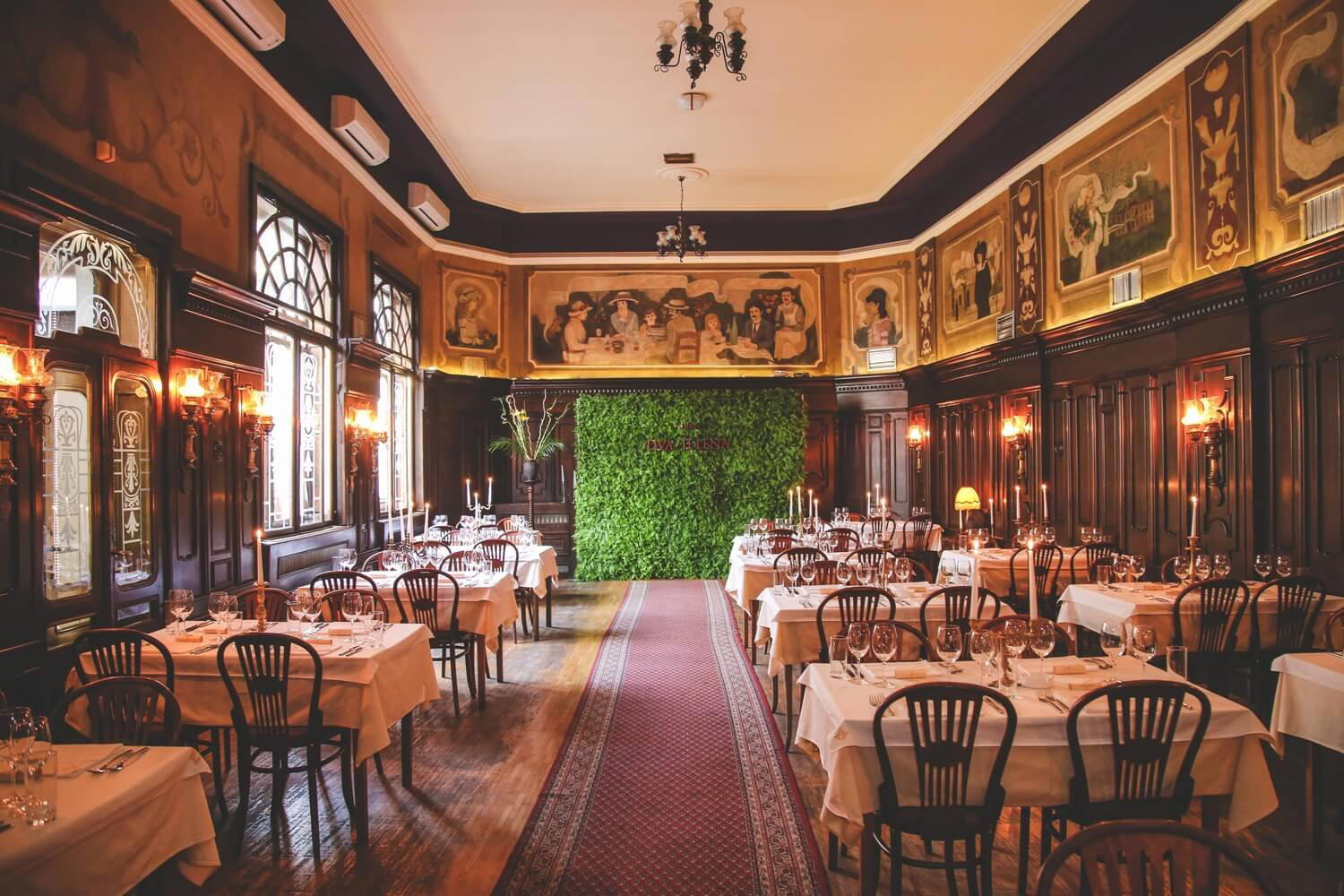
On Skadarlija, Belgrade's cobblestoned bohemian quarter, Dva Jelena has anchored Serbian traditional dining for generations. Where the street's other restaurants trend toward tourist spectacle, this address holds to the architecture of the klasična srpska trpeza: grilled meats, slow-cooked stews, and seasonal vegetables that read as a record of Balkan culinary history rather than a concession to modern tastes.

Pearl is the En Primeur Club membership app — saves, bookings, and concierge access live there. Same editors, same standards.
- Address
- Skadarska 32, Beograd 11000, Serbia
- Phone
- +381117234885
- Hours
- Daily 10 AM–1 AM
- Website
- dvajelena.rs
- Directions
- Get directions
- Booking
- Book on the venue's website
The menu
What to order
- Pljeskavica
- Sarma
- Roasted boneless veal ribs
- Noazete for two
Skadarlija and the Grammar of the Traditional Serbian Table
Skadarlija does not ease you in gently. The cobblestones, the accordion players moving between tables, the iron lanterns lit before the sun has fully dropped — Belgrade's bohemian quarter announces itself as a place where eating is understood as a collective, extended act rather than a transaction with a fixed endpoint. Within that street, Dva Jelena at Skadarska 32 occupies the position of institutional anchor. It is not the only restaurant on the strip, but it is the one that has most consistently been read as the definitive version of what Skadarlija is supposed to offer: the klasična srpska trpeza, the classical Serbian table, presented without significant concession to contemporary dining formats.
Understanding what Dva Jelena is requires understanding what Skadarlija represents in the broader structure of Belgrade's restaurant scene. The city has developed a credible fine-dining tier — venues like Langouste and The Square operate in a contemporary European register that would not look out of place in Vienna or Ljubljana. Further down the price curve, Ambar has packaged Balkan sharing plates into a format that travels well internationally. Skadarlija sits outside all of that. Its restaurants, Dva Jelena included, do not compete with the modern-cuisine tier because they are not making the same argument. The argument here is continuity, that the measure of a good meal is its faithfulness to a tradition, not its distance from one.
What the Menu Architecture Reveals
The structure of a traditional Serbian restaurant menu is itself a cultural document. It does not build toward a single climactic course in the French tasting-menu logic. Instead, it opens wide: cold mezze, warm starters, grilled meats, slow braises, and seasonal accompaniments arrive in a sequence that encourages the table to eat laterally rather than linearly. Spreads like ajvar and kajmak, roasted pepper relish and a clotted cream dairy product with no precise Western equivalent, appear at the beginning not as amuse-bouches but as substantive components of the meal. They are meant to be returned to, spread across bread, paired against whatever grilled meat comes later.
At Dva Jelena, that menu architecture has remained stable across decades, which is itself a form of editorial position. Contemporary Belgrade's restaurant scene rewards novelty and international reference: Avala and Barrel House represent a city experimenting with format. Dva Jelena's refusal to update the structure of its offering is not inertia, it is a claim that the original architecture works, and that the role of a restaurant in this tradition is to execute it faithfully rather than reinterpret it for a contemporary audience.
The grilled meat section carries the most interpretive weight. Serbian grilling culture, roštilj, centres on minced-meat preparations like ćevapčići and pljeskavica alongside whole cuts, and the charcoal technique involved is distinct from both the Turkish and Central European traditions it historically neighbours. A restaurant like Dva Jelena, operating for as long as it has on Skadarlija, is functioning as a kind of living record of how those preparations have been understood in Belgrade specifically: the seasoning ratios, the ratio of fat to lean in minced preparations, the timing of a veal chop over charcoal. This is granular, craft-level knowledge that accumulates across decades of kitchen practice and is not easily reconstructed from scratch.
Serbia's broader restaurant tradition extends well beyond Belgrade. Elsewhere in the country, restaurants like Fleur de Sel in Novi Slankamen and Aleksandar Gold in Uzice work within regional Serbian ingredients and techniques but with different structural formats. The Vojvodina tradition, represented by places like Ananda in Novi Sad and Borkovac in Ruma, introduces Hungarian and Central European inflections that soften and complicate the harder lines of Belgrade's roštilj-centred identity. Further out, addresses like Etno Kuća Dinar in Vrsac, ETNO PODRUM BRKA in Nis, and Etno Restoran Fijaker in Sombor each anchor their regions' versions of the traditional Serbian table, demonstrating how much variation exists beneath what from the outside can look like a single cuisine. Dva Jelena reads as the Belgrade version of that argument: metropolitan, slightly theatrical in setting, but grounded in the same pantry logic.
The Skadarlija Context: Atmosphere as Part of the Offer
It would be misleading to assess Dva Jelena purely as a food proposition, because the street itself is load-bearing. Skadarlija's character, bohemian in the specifically Serbian literary and artistic sense, invoking the writers and painters who made it their address in the 19th and early 20th centuries, shapes the eating experience before a single dish arrives. The live music that moves through the street in the evenings is not background ambience in the hotel-lobby sense; it is part of a hospitality tradition in which a meal is expected to become a social occasion that extends past the food itself.
This positions Dva Jelena differently from the comparison set of Belgrade's serious modern restaurants. A meal at Langouste or The Square is evaluated primarily on cooking precision and sourcing. A meal at Dva Jelena is evaluated on a broader set of criteria that includes setting, duration, and the degree to which the evening becomes something other than a dinner. That is not a lesser standard, it is a different one, and visitors who arrive expecting a quiet analytical meal are reading the venue incorrectly. The comparable international formats, the traditional trattoria in Rome's Trastevere, the old-guard brasserie in Lyon, the taverna in Athens's Monastiraki, are also leading understood as experiences in which the room, the tradition, and the cooking are weighted roughly equally.
For context on how that format plays at different scales of ambition internationally, it is worth noting that even destination restaurants celebrated for precision, places like Le Bernardin in New York City or Lazy Bear in San Francisco, are also making arguments about how a meal should feel as a complete experience. The difference is that Dva Jelena's argument has been made continuously for decades, and it is legible to anyone who has spent time with traditional Balkan hospitality culture.
Planning a Visit
Skadarska 32 is walkable from the city centre, sitting at the lower end of the Skadarlija pedestrian strip, which runs downhill from Trg republike toward Dorćol. The street's restaurant cluster is most active from late afternoon through late evening; arriving at or after 7 pm aligns with when the full social register of the street is operating. For those building a broader picture of Belgrade's restaurant scene, our full Belgrade restaurants guide maps the contemporary fine-dining tier alongside traditional addresses like this one. Visitors moving through Serbia more broadly might also consider stops at Burrito Madre Big Pančevo in Pancevo or Cafe Boem in Pirot and ČARDA ZLATNA KRUNA in Apatin to triangulate against the regional variety of Serbian dining traditions beyond the capital. Booking in advance is advisable for weekend evenings, when Skadarlija operates at full capacity and walk-in availability at established addresses is limited.
Frequently asked questions
What's Dva Jelena's location?
Dva Jelena is located at îSkadarska 32, Beograd 11000, Serbia, Belgrade.
How does Dva Jelena compare to other restaurants on Skadarlija?
Skadarlija hosts several kafanas of similar age and format, including Tri Šešira and Dva Bela Goluba, making the street itself the reference point rather than any single venue. Dva Jelena at Skadarska 32 is among the addresses most associated with the street's identity in Belgrade, drawing on a tradition rooted in the late 19th-century bohemian scene that made Skadarlija the gathering point for Serbian artists and writers. The distinction between venues on this strip is often one of atmosphere and table culture rather than divergent menus.
What's the must-try dish at Dva Jelena?
Dva Jelena sits on Skadarlija, Belgrade's historic restaurant strip, where the traditional Serbian table is built around grilled meats, slow-cooked stews, and shared cold starters. The menu architecture follows a kafana tradition rather than a single headline dish — expect roštilj cuts, ajvar, and hearty bean preparations to anchor the meal. Ordering broadly across the table reflects how this style of dining is meant to work.
Is Dva Jelena reservation-only?
Dva Jelena operates on Skadarska 32, a pedestrian strip that draws steady foot traffic from both locals and visitors, particularly in the evening when accordion players move between tables. Walk-ins are common at kafanas along Skadarlija, though tables on the terrace fill quickly on summer nights. Contacting the venue directly before a visit is the practical approach, especially for larger groups.
What is Dva Jelena known for?
Dva Jelena is one of the longest-established addresses on Skadarlija, Belgrade's cobblestoned bohemian quarter that has functioned as the city's social and artistic dining corridor for well over a century. The restaurant represents the kafana format — a Serbian institution combining food, live music, and extended table-sharing — rather than a contemporary fine-dining proposition. Its location at Skadarska 32 places it at the centre of that tradition.
The Short List
Comparable venues nearby, for context on price, style, and recognition.
| Venue | Cuisine | Price | Notes |
|---|---|---|---|
| Dva JelenaThis venue — the venue you are viewing | Traditional Serbian Grill & Tavern | $20–30 | Not listed |
| Panta Rei Restoran | Modern Mediterranean with International Influences | $30–50 | Dorćol, Modern Mediterranean with International Influences |
| RESTORAN RADNIČKI | Traditional Serbian Grill | $20–30 | Novi Beograd, Traditional Serbian Grill |
| Restoran Dedinje | Modern Serbian with International Influences | Not listed | Dedinje, Modern Serbian with International Influences |
| Dokolica Bistro Vračar | Mediterranean Bistro with Fusion Influences | Not listed | Vračar, Mediterranean Bistro with Fusion Influences |
| Cantina de Frida | Mexican and Spanish Tapas | $20–30 | Savamala, Mexican and Spanish Tapas |