Our verdict
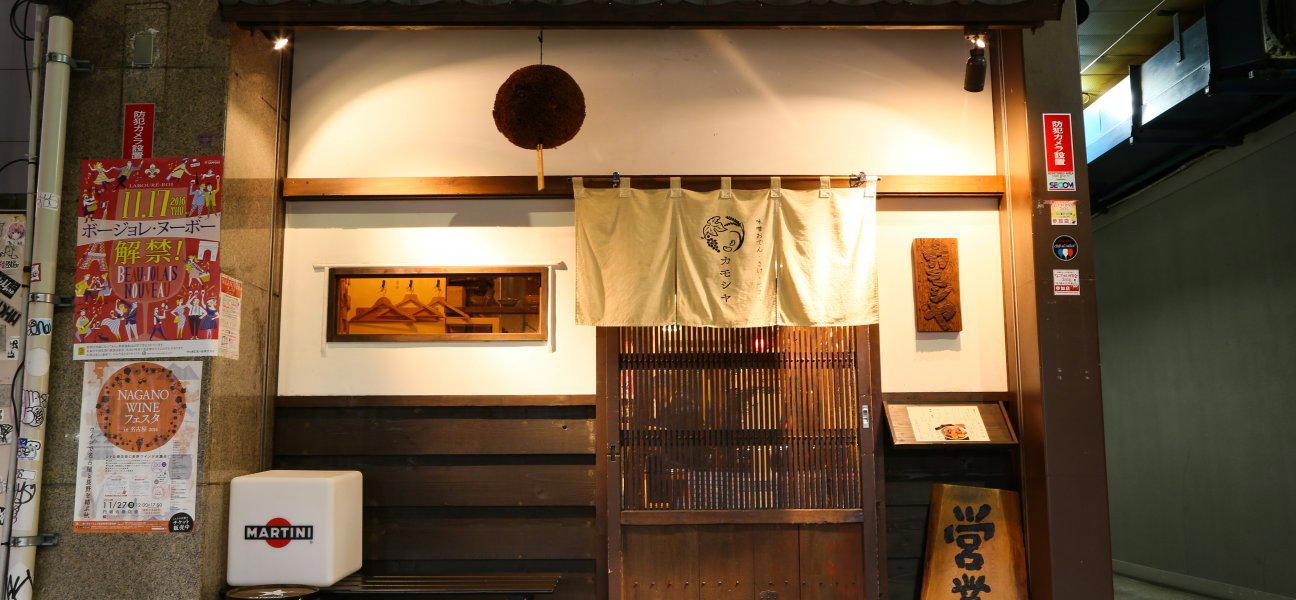
カモシヤ occupies a ground-floor address in Nagoya's Nishiki district, one of the city's more concentrated blocks for serious drinking and eating. The venue sits inside a category of Japanese bar-restaurants that pairs fermented and aged flavours with regional sake and shochu, placing it within a tradition that Nagoya's food scene has quietly cultivated alongside its more famous kushikatsu and hitsumabushi formats.

Pearl is the En Primeur Club membership app, where members save venues, book tables and use the concierge.
Nishiki After Dark: The Fermented-Drink Tradition Nagoya Does Quietly
Walk the Nishiki blocks of Naka Ward on any weekday evening and you pass two overlapping Nagoyas: the one built on izakaya chains and salaryman efficiency, and a quieter one expressed in small-format bars and drinking restaurants where the back wall is stacked with earthenware and the menu is hand-written in marker on card. カモシヤ belongs to the second category. The address, ground floor of the Moriman Building at 3-16-8 Nishiki, puts it inside a corridor that has gradually absorbed the kind of operator more interested in what fermentation can do than in moving volume. That positioning is less accidental than it looks. Nagoya has long supported a strand of drinking culture that treats the glass as seriously as the plate, and venues in this register tend to occupy low-profile rooms precisely because their audience already knows where to find them.
What the Kamoshiya Format Represents in Japanese Bar Culture
The name カモシヤ carries a deliberate signal. The verb kamosu (醸す) means to brew or ferment, sake, miso, soy sauce, the foundational chemistry of Japanese flavour, and establishments that front-load that word in their identity are making a claim about where their loyalties lie. Across Japan, the kamoshiya format sits between a sake specialist bar and a food-forward izakaya: the drink list typically privileges junmai and aged sake styles, and the kitchen orients around preserved, fermented, and seasonal ingredients that speak the same language as the beverages. It is a format with deeper roots in Kyoto and Osaka, where sake culture has always been more explicitly cultivated, but it has travelled well to cities like Nagoya, where the local palate for miso-forward and fermented flavour was already receptive.
For context, the range of serious drinking-focused restaurants across Japan's regional cities has expanded considerably over the past decade.
Nagoya's Miso Culture and the Fermented Palate
Understanding why a kamoshiya format takes hold in Nagoya requires a brief detour into local food identity. Aichi Prefecture produces Hatcho miso, one of Japan's most intensely fermented soybean pastes, aged in cedar barrels under stone weights for a minimum of two summers. The local palate was shaped around that depth of flavour long before kaiseki minimalism became the dominant export narrative for Japanese cuisine. Dishes like miso nikomi udon and doteni, offal braised in hatcho miso and sake, are not refinements of a simpler form; they are their own complete tradition, one that rewards rather than resists the kind of full-flavoured sake and shochu that a kamoshiya format would logically stock. In that sense, the venue type fits Nagoya more naturally than it might in cities where the dominant culinary register runs lighter.
That regional specificity is part of what separates Nagoya from the more photographed dining cities. While Harutaka in Tokyo or Atomix in New York City operate in markets where international press cycles constantly refresh the story, Nagoya venues like カモシヤ function within a local knowledge economy. Regulars carry the information, not algorithms. That insularity is a feature of the format, not a gap in its ambition.
Seasonal Timing and the Sake Calendar
The kamoshiya format is particularly coherent in autumn and winter, when new-season sake (shiboritate and arabashiri) arrives from breweries across Aichi and the broader Tokai region, and when the kitchen's repertoire of preserved and fermented ingredients reaches its annual depth. Visiting between October and February aligns the drink list and the food menu in ways that the shoulder seasons do not quite replicate. Summer visits are possible but the format, warm room, full-flavoured sake, preserved-ingredient cooking, sits more naturally in cold weather. Venues operating in this register rarely publicise seasonal schedules explicitly; the informed visitor works from the sake calendar rather than waiting for a press release.
Nagoya's position between Tokyo and Osaka on the Tokai region shinkansen corridor makes it accessible for a dedicated day trip or a one-night extension, and the Nishiki area requires no particular navigation: it is a walkable block from central Sakae. For those building a broader itinerary through Japan's regional dining scene, the EP Club guides to akordu in Nara and Goh in Fukuoka represent adjacent points on a circuit that takes seriously the idea that Japan's most interesting restaurants are not all in Tokyo. Our full Nagoya restaurants guide maps the broader scene.
Where カモシヤ Sits in Nagoya's Drinking-Restaurant Tier
Some, like the unagi-focused Atsuta Horaiken, operate as heritage institutions with long queues and tourist visibility. Others occupy a quieter register: the Italian direction at Bacio, the sushi-inflected menu at Cucina Italiana Gallura, the French framework at Chez Kobe. カモシヤ operates in a different register from all of these, it is not a destination cuisine restaurant in the Western-influenced mould, but a venue where the cultural logic is entirely Japanese, organised around fermentation and seasonality rather than around a named chef or a European framework.
That distinction matters for the reader deciding how to spend a limited evening in Nagoya. Venues built around a European cuisine concept, however well executed, deliver something available in other Japanese cities. A kamoshiya in the Nishiki corridor, grounded in the local miso tradition and stocked with Tokai-region sake, delivers something considerably harder to replicate elsewhere on the same trip. For the itinerary that already includes Le Bernardin in New York City or high-end Western restaurants in other cities, カモシヤ represents the counterpoint: low-profile, fermentation-focused, rooted in a local flavour tradition that Nagoya has been building for centuries without particular interest in outside validation. Further afield, venues like 一本木 細川製 in Nanao or 湖畔荘 in Takashima suggest how Japan's regional drinking-and-eating culture extends well beyond the three major cities for those willing to follow it.
Planning a Visit
カモシヤ sits at 3-16-8 Nishiki, Naka Ward, the Moriman Building, ground floor. The Nishiki area is walkable from Sakae station, which is served by both the Higashiyama and Meijo subway lines. The format typically suits parties of two to four. Given the sake-forward structure of venues in this category, the visit works well treated as a two to three hour session rather than a quick dinner stop.
Frequently asked questions
What dish is カモシヤ famous for?
The kamoshiya format across Japan typically anchors food choices around fermented, preserved, and seasonal ingredients, think pickled vegetables, aged proteins, and miso-based preparations, designed to pair with a sake-led drink list. Nagoya's own fermented-food tradition, rooted in Hatcho miso production, gives local venues in this category a regionally specific flavour profile that differs from equivalent bars in Kyoto or Tokyo.
Do they take walk-ins at カモシヤ?
In Nagoya's Nishiki district, small-format drinking restaurants in this tier operate across a spectrum, some run entirely on reservations, others keep seats available at the bar for walk-ins. Given the venue's ground-floor Nishiki address, a direct approach on the evening is possible, though an early arrival improves the odds considerably. For visits during peak autumn sake season (October through January), advance planning is worth the effort regardless of formal booking requirements.
What do critics highlight about カモシヤ?
Venues in the kamoshiya category across Japan tend to accumulate reputation through word-of-mouth and local editorial rather than the Michelin or 50 Best circuits, which historically favour either kaiseki formality or high-concept Western frameworks. That absence of formal recognition does not reflect quality; it reflects the format's deliberate distance from the infrastructure of international restaurant awards.
How does カモシヤ fit into Nagoya's sake-bar scene compared to other regional Japanese cities?
Nagoya's sake-drinking culture is shaped by proximity to Aichi Prefecture's miso and fermentation industries, giving venues in the kamoshiya register a regional specificity that distinguishes them from equivalent bars in Kyoto or Kanazawa. The local preference for full-flavoured, umami-forward food, anchored in Hatcho miso and dishes like doteni, aligns naturally with aged and junmai sake styles that kamoshiya formats typically stock. Within Japan's regional drinking-restaurant scene, Nagoya sits in an underrepresented tier: cities like Nanao (see 一本木 細川製) and Sapporo (see 大仙山乃) have their own fermentation-rooted traditions, but Nagoya's particular miso identity gives its leading drinking venues a flavour argument that belongs to this city specifically.
Same-City Peers
Comparable venues nearby, for context on price, style, and recognition.
| Venue | Cuisine | Price | Awards | Notes |
|---|---|---|---|---|
| カモシヤThis venue (the venue you are viewing) | Miso Oden & Wine Izakaya | $20–30 | Not listed | Not listed |
| Yakiniku Horumon Gensho | Traditional Wagyu Offal Yakiniku | Not listed | Tabelog 100 #38 | Kita |
| Tori Yakiniku Toriichi Sakae joshidai ten | Chicken yakiniku & izakaya | $30–50 | Tabelog 100 #27 | Naka |
| Yakiniku Tomiya | Japanese Yakiniku | $30–50 | Tabelog 100 #61 | Naka |
| Menya Shishimaru | Modern lobster-focused ramen | $10–20 | Tabelog 100 #51 | Nakamura |
| Tokugawa Cho Buta Fuku | Traditional Tonkatsu (Pork Cutlet) | $20–30 | Tabelog 100 #7 | Higashi |
Continue exploring
More in Nagoya
Restaurants in Nagoya
All restaurants in Nagoya →
Details
- Cozy
- Retro
- Intimate
- Trendy
- Date Night
- Casual Hangout
- After Work
- Solo
- Open Kitchen
- Sake Program
- A La Carte
- Small Plates
- Counter Dining
- Wine
Current opening hours
- Monday
- Closed
- Tuesday
- 4–11 PM
- Wednesday
- 4–11 PM
- Thursday
- 4–11 PM
- Friday
- 4–11 PM
- Saturday
- 4–11 PM
- Sunday
- 4–11 PM
Hours can change for holidays and private events. Hours as of .
Retro Kyoto townhouse-style exterior with compact, nostalgic interior lighting creating a relaxed, intimate vibe.