화목순대국
Our verdict
화목순대국 in Gwanghwamun sits inside Seoul's long tradition of soondubu and sundae-guk houses that anchor working-class neighbourhood eating. Against the city's ₩₩₩₩ contemporary Korean tier — venues like Mingles or Onjium — it occupies an opposite pole: a place where occasion and comfort arrive not through ceremony but through a bowl that has fed the same streets for decades.

Pearl is the En Primeur Club membership app — saves, bookings, and concierge access live there. Same editors, same standards.
- Address
- 종로구 새문안로5길 11 (광화문점), 사직동, 서울특별시, 서울특별시, 110-071
- Directions
- Get directions
The menu
What to order
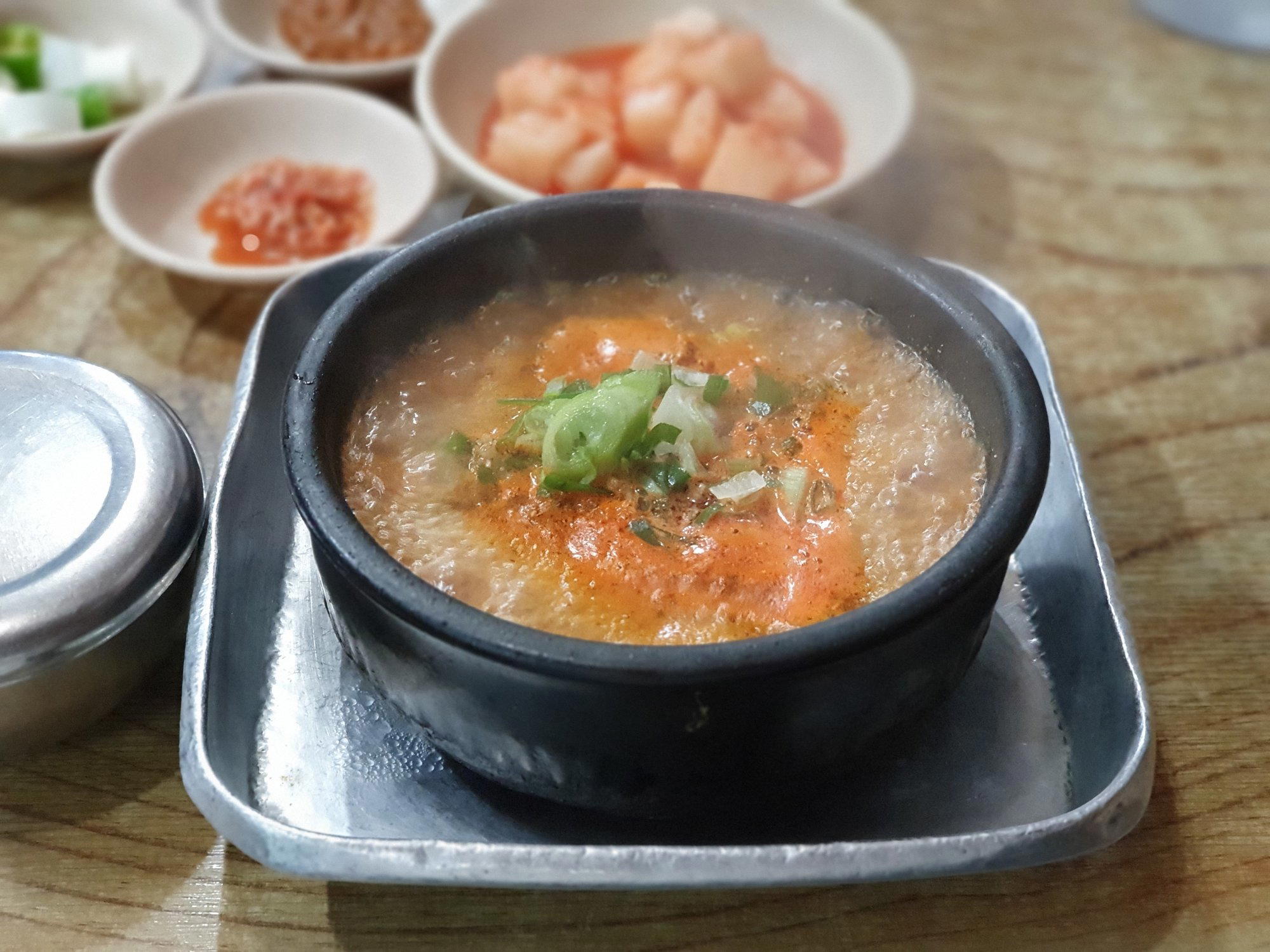
- Sundae-guk (blood sausage soup with large intestine)
- Nae-jang-tang (intestine soup)
- Modum Sundae (assorted blood sausage platter)
The Bowl That Anchors Gwanghwamun
In most major cities, the restaurants that matter most to locals are rarely the ones that appear in international award guides. Seoul is no exception. The stretch of Jongno-gu around Gwanghwamun and Sajik-dong runs parallel to the tourist-facing hanok lanes but operates on a different logic: lunch crowds from the nearby government ministries, evening regulars who treat a specific booth like reserved seating, and an eating culture built around soups that warm quickly, cost little, and ask nothing of the diner except appetite. 화목순대국 sits inside that tradition, on Saemoonan-ro 5-gil, a narrow corridor that positions it equidistant from the formality of Gyeongbokgung and the office density of Gwanghwamun Square.
Sundae-guk — blood sausage soup — is not occasion food in the way that, say, a Michelin-starred tasting menu at Mingles or a kaiseki-adjacent progression at Kwonsooksoo might be. But that framing misses something. In Korean eating culture, the bowl of soup shared at a low table after a long week carries its own ritual weight. It is the occasion meal for a different register of life: the promotion lunch, the after-work wind-down with a colleague, the birthday celebrated without ceremony. 화목순대국 operates in that register.
Sundae-Guk and Seoul's Soup Tradition
To understand where 화목순대국 fits in Seoul's food culture, it helps to understand what sundae-guk actually is and why the category commands fierce loyalty. Sundae, a sausage made primarily from glass noodles and pork blood stuffed into intestinal casing, has roots in Korean court cooking but became democratised as street and market food during the 20th century. When combined with pork bone broth and organ meats to form sundae-guk, the result is a soup that occupies the same cultural position as pho in Hanoi or menudo in Mexico City: deeply specific, intensely local, and leading eaten without asking too many questions.
The Gwanghwamun area has a cluster of these establishments, and the competition is particular. Regulars navigate between houses on criteria that can seem opaque to outsiders: the opacity of the broth, the ratio of sundae to offal, whether the kimchi arrives cold or at room temperature, how much of the seasoning work is done at the table versus in the kitchen. These distinctions matter in a category where prices are broadly uniform and the product is theoretically similar across kitchens. The fact that 화목순대국 draws a consistent local following in this densely contested micro-neighbourhood is its clearest credential.
For comparison, Seoul's fine-dining tier, venues like Jungsik, Soigné, or alla prima, frames Korean ingredients through tasting-menu architecture and charges accordingly. 화목순대국 represents the opposite pole: a single category executed with the discipline that comes from repetition rather than innovation. Neither is more Korean than the other; they serve different appetites and different moments.
The Occasion Logic of Budget Eating in Seoul
There is a specific sociology to soup houses in Korean cities. The meal is almost never solitary. Tables configured for two, four, or six are the norm, and the soup arrives quickly, within minutes of ordering, which means the social event of eating together is compressed into a tight, warm window. For the lunch crowd around Gwanghwamun, that speed is practical. For evening visitors, it creates a particular kind of intimacy: you are done before the conversation runs out, and the low price means ordering a second bowl or a side of extra sundae involves no calculation.
Across South Korea, this format repeats with regional variation. Mori in Busan works in a different category but the same logic of neighbourhood loyalty applies. In Jeju, establishments like Badang Lounge and Black Pork BBQ in Seogwipo anchor their respective areas through product specificity and repeat custom. And in Suwon, Doosoogobang operates in a similarly loyal local circuit. What connects them is not cuisine type but the role they play: reference points that locals measure other meals against. See also 88돼지 in Jeju, Gobojeong Galbi #1 in Suwon, and Hwangnam Bread and Busan Steamed Bun in Gyeongju for further examples of this regional loyalty pattern.
For visitors to Seoul who have already worked through the city's tasting-menu circuit, or who are building a trip around the kind of eating that doesn't appear in international press, a meal at a place like 화목순대국 offers something the higher end cannot: the experience of eating exactly what the surrounding neighbourhood eats, at the same price, in the same room. That is its own form of occasion.
What to Expect at the Table
The format at sundae-guk houses is standardised enough that first-timers can navigate without confusion. You order a base soup, the house typically offers variations by offal content or spice level, and the bowl arrives with the main components already assembled. Side dishes, most critically kimchi, come with the meal. Seasoning is done at the table using salted shrimp (saeujeot) or doenjang, depending on preference. The soup deepens as it sits in the pot, which means eating unhurriedly is an option rather than a liability.
For a fuller orientation to Seoul's eating options across price points and formats, including the city's contemporary Korean and innovative tiers, see our full Seoul restaurants guide. Additional regional context is available through venues like Hinode in Jeju, Dining Room in Busan, and Gyeongju Wonjo Kongguk, the last of which works in a parallel soup-house tradition. For Korean cuisine operating at the international end of the dial, Atomix in New York and Le Bernardin represent how Korean culinary thinking translates at the highest-budget tier abroad.
Know Before You Go
- Address: 종로구 새문안로5길 11 (광화문점), 사직동, 서울
- Area: Gwanghwamun / Sajik-dong, Jongno-gu
- Price level:Kwonsooksoo and Soigné operate in that register.
Why is 화목순대국 located in the Gwanghwamun area rather than a traditional market district?
Sundae-guk houses historically concentrated around large markets, Gwangjang and Sindang-dong being Seoul's most associated addresses for the category, but the Gwanghwamun and Jongno-gu corridor developed its own cluster independently, driven by high daytime foot traffic from government offices and the density of workers who eat lunch within walking distance of their desks. A location on Saemoonan-ro 5-gil places 화목순대국 in that office-adjacent eating circuit rather than the tourist-facing market trail. This geographic distinction partly explains why venues in the area, including 화목순대국, build their reputation through repeat local custom rather than destination visits, which in Seoul's soup-house category functions as the strongest available signal of quality.
Frequently asked questions
Where do I go for 화목순대국?
화목순대국 is located at 종로구 새문안로5길 11 (광화문점), 사직동, 서울특별시, 서울특별시, 110-071, Seoul.
Is 화목순대국 near Gwanghwamun Station, and what kind of meal does it suit?
The 광화문점 address at 종로구 새문안로5길 11 places the venue within walking distance of Gwanghwamun Square and its surrounding metro access. It suits a quick solo lunch or a small-group weekday meal — the soup-house format runs on rapid table turnover rather than extended dining. For visitors spending time around Gyeongbokgung Palace or the Sejong Cultural Centre, it offers a direct route into how the surrounding office and residential population actually eats.
What do regulars order at 화목순대국?
At sundae-guk houses of this type, regulars anchor their order around the house soup — a pork-based broth served with sundae (blood sausage), offal cuts, or a combination of both. Most tables in Seoul soup houses of this format add a side of rice and a round of soju. The Gwanghwamun location draws an office-hour crowd from the surrounding Jongno-gu district, which tends to dictate a fast, deliberate ordering rhythm.
Is 화목순대국 reservation-only?
Sundae-guk houses in Seoul operate on a walk-in basis as a category rule — no booking infrastructure, no waitlist system. 화목순대국 at 종로구 새문안로5길 11 follows this format. Peak pressure hits at weekday lunch, when the Gwanghwamun office population moves in volume. Arriving before noon or after 1:30 pm clears most of the queue.
What's the signature at 화목순대국?
The signature is the soup itself: a milky, pork-bone broth ladled over sundae and assorted innards, seasoned at the table with doenjang or saeujeot to the diner's preference. This self-seasoning ritual is a defining feature of the Korean soup-house format and separates it from set-seasoned broths found elsewhere in Seoul's restaurant spectrum. The Gwanghwamun branch serves the Sajik-dong neighbourhood's working population, which places a premium on consistency over variation.
A Tight Comparison
Comparable venues nearby, for context on price, style, and recognition.
| Venue | Cuisine | Price | Notes |
|---|---|---|---|
| 화목순대국This venue — the venue you are viewing | Traditional Korean Sundae & Offal Soup | $1–10 | Not listed |
| 진옥화할매 원조닭한마리 (陳玉華ハルメ元祖タッカンマリ) (진옥화할매 원조닭한마리) | Traditional Korean Dakhanmari (Whole Chicken Soup) | $20–30 | Jongno-gu, Jongno 5-ga (Dongdaemun), Traditional Korean Dakhanmari (Whole Chicken Soup) |
| Park's Mung Bean Pancake | Traditional Korean Mung Bean Pancakes | $1–10 | Jongno-gu, Traditional Korean Mung Bean Pancakes |
| Wangbijib (왕비집) | Traditional Korean BBQ | $20–30 | Myeongdong, Traditional Korean BBQ |
| Han Chu Fried Chicken | Korean Fried Chicken | $10–20 | Sinsa-dong, Korean Fried Chicken |
| Seasons Table buffet | Korean | Not listed | 가회동, Seasonal Korean Buffet |