
Michelin Selected
Aloft Osaka Dojima sits along the Dojima River in Kita-ku, carrying a Michelin Selected designation for 2025 that places it in a recognised tier of Osaka stays. The property's design language follows the Aloft brand's signature urban-industrial aesthetic, positioning it as an alternative to the full-service luxury towers that define the surrounding Nakanoshima corridor. A practical base for both the Umeda transport hub and Osaka's Namba dining belt.

Pearl is the En Primeur Club membership app — saves, bookings, and concierge access live there. Same editors, same standards.
- Address
- 2 Chome-1-31 Dojimahama, Kita Ward, Osaka, 530-0004, Japan
- Phone
- +81 6-4796-6662
- Website
- marriott.com
- Directions
- Get directions
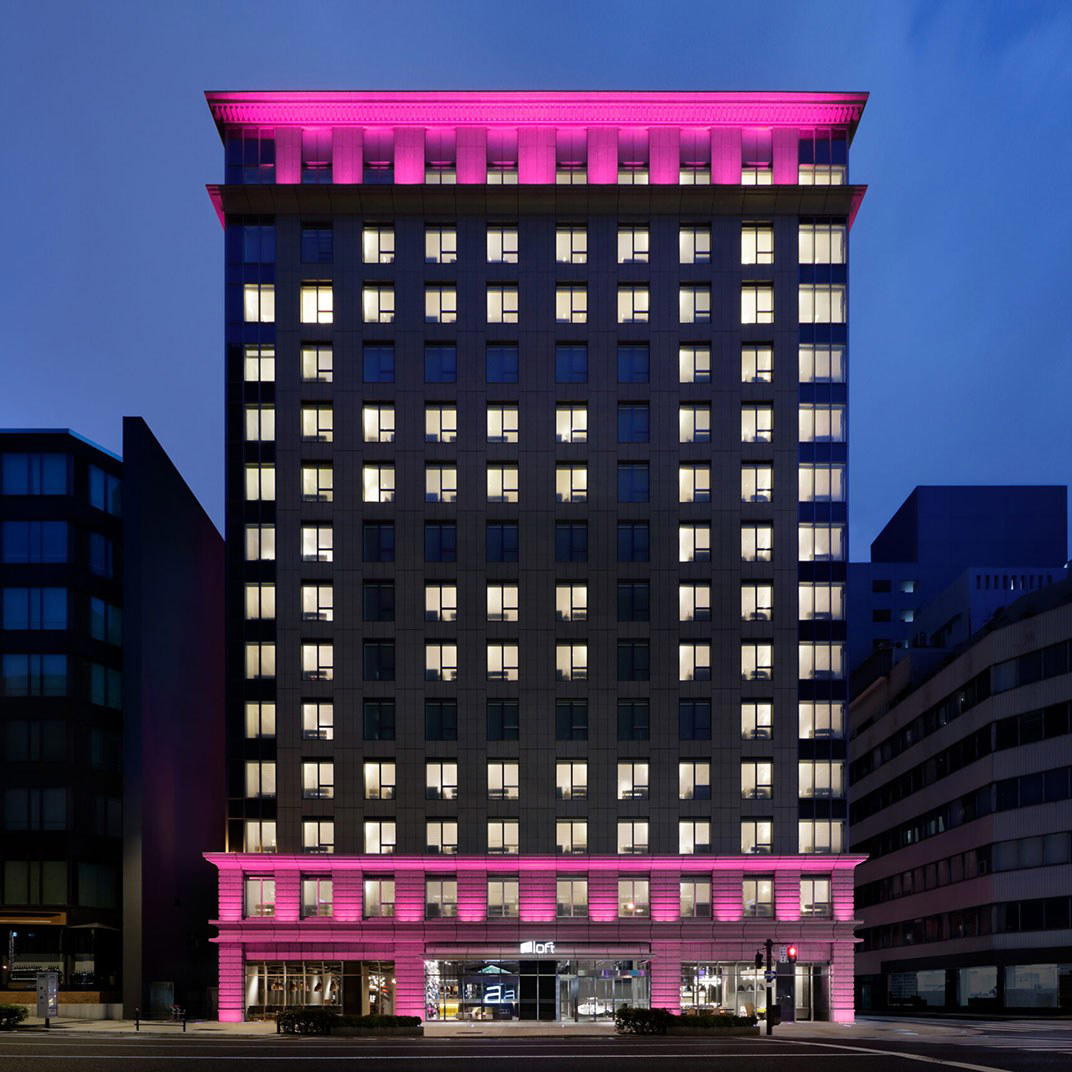
Design Identity in a District Already Dense with Architecture
Kita-ku's Dojimahama strip is not short of considered buildings. The Nakanoshima corridor, which runs between the Dojima and Tosabori rivers, has spent the better part of two decades accumulating towers that each make an argument about what contemporary Osaka hospitality looks like. Into that conversation, Aloft Osaka Dojima inserts the brand's globally legible design formula: exposed structural elements, open-plan public areas, and a colour palette that reads as deliberately contemporary rather than warmly traditional. This is a hotel that positions itself through contrast rather than context, a calculated move in a neighbourhood where properties like Conrad Osaka and InterContinental Osaka anchor the upper tier of full-service luxury.
The Aloft format, developed as a design-forward counterpoint within the Marriott portfolio, trades on a specific aesthetic logic: social spaces treated as the primary design investment, with guestrooms that are functional and well-specified but deliberately compact. That logic plays differently depending on the city, and in Osaka, where the street-level energy of Dotonbori and the commuter density of Umeda are both close, a hotel that front-loads its public areas over room scale makes a defensible calculation. Travellers spending their days outside, returning for sleep and a drink, are the hotel's implied guest.
The Michelin Selected Signal and What It Means for Placement
Aloft Osaka Dojima holds a Michelin Selected designation for 2025, the entry-level recognition in the Michelin Guide's hotels programme. In practice, Michelin Selected identifies properties that meet a quality threshold without reaching the higher Clé tiers, and it is a meaningful credential in a market where the guide carries real authority. The designation places this hotel in a peer bracket that includes a wide range of Osaka stays, from boutique independents through to chain properties with strong operational consistency.
What the award signals, above all, is that the fundamentals are in order: cleanliness, service reliability, and physical condition meet a documented standard. For a brand-format hotel like Aloft, where the design proposition is set at the brand level rather than the individual property level, that kind of third-party verification carries more weight than it might at a fully independent property where the design programme is already a differentiator. In the context of Osaka's hotel market, which spans everything from The Ritz-Carlton, Osaka and Four Seasons Hotel Osaka at the leading end through to the dense cluster of business hotels around Shin-Osaka station, Michelin Selected is a floor, not a ceiling.
Dojimahama as a Base: What the Address Actually Delivers
The address at 2-1-31 Dojimahama puts the hotel on the south bank of the Dojima River, in a part of Kita-ku that functions as a business district by day and clears out faster than Namba or Shinsaibashi after dark. That has practical implications. Proximity to the Umeda transport nexus, Osaka's primary rail interchange, is genuine: Kitashinchi and Higashi-Umeda stations are walkable, giving access to the Hankyu, Hanshin, Osaka Metro, and JR networks that connect to Namba, Tennoji, Shin-Osaka (shinkansen), and Itami airport. For travellers moving between Osaka and Kyoto, or routing through on a wider Kansai itinerary that might include HOTEL THE MITSUI KYOTO, the rail access is a meaningful asset.
The riverfront setting adds a degree of visual relief. Dojimahama's low-rise development along the water creates sight lines that the tighter blocks of Namba or Shinsaibashi do not offer. Early mornings by the river are quiet in a way that is harder to find in the denser southern wards, and that quietude is part of what a Kita-ku address is selling. For dining and nightlife, the expectation is that guests will move: Osaka's eating culture, the one that sustains the city's density of Michelin-starred restaurants and the raucous izakaya rows of Namba, is not concentrated around Dojimahama. Check our full Osaka restaurants guide for where the city's serious eating actually happens.
How the Aloft Sits Against the Osaka Hotel Tier
Osaka's upper-mid and luxury hotel supply has expanded considerably over the past five years. The arrival of W Osaka added a design-led luxury option in Shinsaibashi. Cuvée J2 Hôtel Osaka by Onko Chishin represents the city's growing interest in wine-focused boutique formats. Centara Life Namba Hotel Osaka addresses the budget-conscious end of the Namba market. The Aloft sits in neither the luxury nor the budget bracket: it occupies the upper-mid space where brand consistency, a recognisable design language, and loyalty programme integration matter more than individual property distinctiveness.
That positioning works well for a specific traveller profile: frequent visitors to Japan who move between cities on business or multi-city leisure itineraries, use Marriott Bonvoy points, and want reliable quality without the service formality of a Ritz-Carlton or a Hotel Granvia Osaka. For travellers whose priority is deep immersion in Japanese hospitality traditions, the ryokan properties in the wider Kansai region and beyond, such as Gora Kadan in Hakone, Nishimuraya Honkan in Kinosaki-cho, or Asaba in Izu, represent a fundamentally different kind of accommodation experience. The Aloft makes no argument in that direction.
Planning a Stay
Aloft Osaka Dojima is located at 2-1-31 Dojimahama, Kita-ku, with Kitashinchi station the most convenient Metro access point. Room rates fluctuate with Osaka's increasingly busy event and conference calendar, particularly around the Expo 2025 period, which has compressed availability across the city's mid-range supply. Booking through the Marriott Bonvoy platform will apply points and rate benefits for members. For comparison with the wider Osaka luxury market before confirming a booking, the EP Club hotel listings cover InterContinental Osaka and Four Seasons Hotel Osaka in full.
At-a-Glance Comparison
Comparable venues nearby, for context on price, style, and recognition.
| Venue | Cuisine | Price | Awards | Notes |
|---|---|---|---|---|
| Aloft Osaka DojimaThis venue — the venue you are viewing | Lifestyle hotel blending history and modernity in Umeda. | $100–200 | Michelin Selected | Not listed |
| Hotel Granvia Osaka (ホテルグランヴィア大阪) | Contemporary urban tower hotel with direct train station access | $100–200 | Not listed | Umeda |
| Candeo Hotels Osaka Shinsaibashi | Modern high-rise blending contemporary design with traditional Japanese temple elements | $100–200 | Michelin Selected | Chūō |
| Osaka Excel Hotel Tokyu | Osaka Kaleidoscope concept blending lively opulence with city night views | $100–200 | Preferred Hotels Member | Chūō |
| Candeo Hotels Osaka The Tower | High-rise tower hotel with sky spa focus | Not listed | Michelin Selected | Kita |
| voco Osaka Central | Design-oriented IHG sub-brand emphasizing contemporary aesthetics with cultural heritage integration | $200–300 | Michelin Selected | Kyomachibori, Nishi-ku |
Recognition history
Dated appearances from independent guides and award organizations, with the underlying list record or original source where available.
Michelin Selected
Michelin
Continue exploring
More in Osaka
Hotels in Osaka
Browse all →




Bars in Osaka
Browse all →



Restaurants in Osaka
Browse all →




Wineries in Osaka
Browse all →
Details
- Modern
- Trendy
- Lively
- Energetic
- Business Trip
- Weekend Escape
- Design Destination
- Wi Fi
- Fitness Center
- Restaurant
- Business Center
- Laundry Service
- Street Scene
- Wheelchair Accessible
- Elevator
Bright, casual, and lively atmosphere with live music at the bar and open-concept spaces filled with natural light.