
Michelin Selected
Hotel Indigo Tokyo Shibuya carries a 2025 Michelin Selected distinction and sits at the centre of one of Tokyo's most commercially charged and culturally layered districts. Positioned on Dogenzaka in Shibuya-ku, the property occupies territory where neighbourhood energy is constant and the pace rarely slackens — a deliberate contrast to the quieter, imperial-adjacent hotels clustered further north around the Imperial Palace.

Pearl is the En Primeur Club membership app — saves, bookings, and concierge access live there. Same editors, same standards.
- Address
- 2 Chome-25-12 Dogenzaka, Shibuya, Tokyo 150-0043, Japan
- Phone
- +81 3-6712-7470
- Website
- ihg.com
- Directions
- Get directions
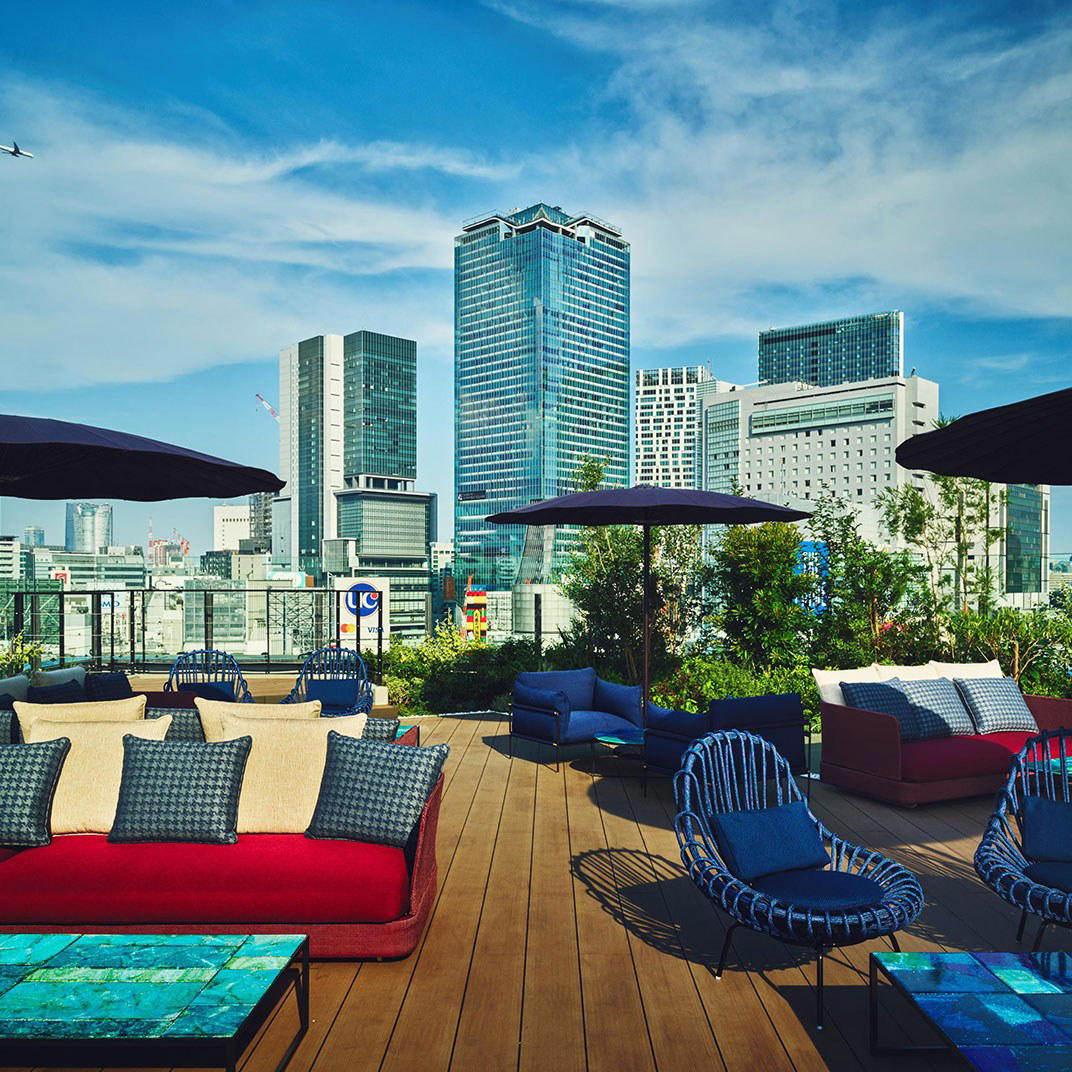
Shibuya as a Setting: What the District Demands of Its Hotels
Hotels in Shibuya operate in a different register from those in Marunouchi or Akasaka. The neighbourhood runs on commercial density and cultural friction — fashion, youth subculture, tech, and nightlife compress into a few square kilometres around one of the world's most photographed intersections. Properties here do not compete on quietude or ceremonial remove. They compete on how well they read and interpret the district for a guest who wants proximity to that energy without being consumed by it.
Hotel Indigo Tokyo Shibuya, addressed at 2-25-12 Dogenzaka in Shibuya-ku, occupies that interpretive role. The IHG Hotels and Resorts brand positions Indigo properties as neighbourhood-led rather than globally standardised — each location is intended to reflect its specific postcode rather than a house template. In Shibuya, that postcode is one of Tokyo's most contested and interesting, which raises the stakes considerably for what the property is asked to do. Its 2025 Michelin Selected distinction signals that the execution clears a credible threshold.
The Guest Experience: Service Calibration in a High-Traffic District
In Tokyo's hotel tier that carries Michelin recognition, the editorial conversation often centres on anticipatory service, staff who read a guest's state on arrival and calibrate accordingly rather than delivering a scripted welcome. The mechanics of this vary between hotel categories. At properties like Aman Tokyo or Bvlgari Hotel Tokyo, anticipatory service is supported by low guest-to-staff ratios and a resident profile that skews toward repeat, high-spend visitors. The guest arrives knowing exactly what tier they have entered.
A neighbourhood-led property in Shibuya manages a different kind of guest mix: business travellers, design-conscious leisure visitors, international visitors drawn specifically to the district, and shorter-stay guests transiting through Tokyo's itinerary. The service challenge is reading which mode a guest is in and responding to that, offering local direction with genuine specificity rather than a printed sheet, knowing when a guest wants the district explained and when they want to be left to it. In a hotel category that earns Michelin recognition at the Selected level, that local intelligence is the differentiator. The award does not go to properties that simply function efficiently; it attaches to properties where something more deliberate is happening.
For a guest arriving from a longer-stay at a property like Four Seasons Hotel Tokyo at Otemachi or Palace Hotel Tokyo, Hotel Indigo Shibuya represents a deliberate downshift in formality and a deliberate upshift in neighbourhood immersion. That is a legitimate itinerary choice rather than a compromise.
The Dogenzaka Position: Neighbourhood Specificity
Dogenzaka is one of Shibuya's steeper streets, running south-west from the station district toward the Love Hotel Hill area and backing into the quieter residential pockets of Daikanyama and Nakameguro a ten-to-fifteen minute walk further on. The immediate surroundings are active, entertainment, dining, and retail at street level, but Dogenzaka sits slightly off the main crossing axis, which means the property avoids the most concentrated pedestrian pressure of the Scramble Crossing vicinity.
This positioning matters for a hotel that needs to offer genuine rest as well as district access. Shibuya-station itself connects directly to the Yamanote Line, the Ginza Line, the Hanzomon Line, the Fukutoshin Line, and the Den-en-toshi Line, arguably the most transport-connected major station in Tokyo. From this base, a guest can reach Shinjuku in under five minutes, Harajuku in two stops, Ginza in roughly fifteen minutes, and Narita Airport via the Narita Express in approximately ninety minutes. For a visitor whose Tokyo itinerary spans multiple neighbourhoods, Shibuya is close to the optimal hub.
Readers planning broader Japan travel can reference properties across very different registers: the ryokan-led experience at Gora Kadan in Hakone sits about ninety minutes from Shibuya by Romancecar; HOTEL THE MITSUI KYOTO in Kyoto is around two hours and fifteen minutes by shinkansen from Shin-Osaka, reachable the same day from Tokyo. For further reach, Amanemu in Mie, Zaborin in Kutchan, and Halekulani Okinawa in Okinawa represent distinct regional formats that pair well with a Shibuya base for the first or last nights of a Japan routing.
Positioning Within Tokyo's Broader Hotel Tier
Tokyo's Michelin Selected hotel tier sits below the star-level properties, Andaz Tokyo, JANU Tokyo, Bellustar Tokyo, A Pan Pacific Hotel, The Capitol Hotel Tokyu, and is defined by editorial recognition rather than the deeper physical opulence or historical weight of the market's top tier. Within that Selected cohort, differentiation comes from district identity, design coherence, and the precision of the neighbourhood experience on offer.
Hotel Indigo as a brand competes within this tier internationally, The Fifth Avenue Hotel in New York City and properties at the level of Badrutt's Palace Hotel in St. Moritz or Hôtel de Paris Monte-Carlo in Monte Carlo represent the ceiling of what the independent-personality segment can achieve. The Tokyo Shibuya property is being held to a local standard that includes some of the city's most precisely executed hospitality. The Michelin selection is the marker that it is clearing that standard.
For readers interested in other Japan properties at the ryokan and smaller-format end, Asaba in Izu, Nishimuraya Honkan in Kinosaki-cho, Kamenoi Besso in Yufu, Fufu Nikko in Nikko, Fufu Kawaguchiko in Fujikawaguchiko, Sekitei in Hatsukaichi-shi, Benesse House in Naoshima, and Jusandi in Ishigaki each represent a radically different format, traditional hospitality codes, immersive landscape settings, and the slower tempo that ryokan culture enforces. A Tokyo-first itinerary that opens in Shibuya and moves toward one of these properties is one of the more coherent Japan routings for a first or second visit.
Planning Your Stay
Shibuya hotels at the Michelin Selected level book with meaningful advance notice during peak Tokyo periods: cherry blossom season in late March and early April, the Golden Week window in late April and early May, and the autumn foliage period in November each compress demand significantly. Booking four to six weeks ahead at minimum for these windows is not excessive. Outside those periods, Shibuya's commercial hotel supply is large enough that last-minute availability is more common than at the smaller-key properties in Kyoto or the major ryokan. Travellers with firm dates should still confirm early, particularly if specific room categories matter. For dining context across the city, our full Tokyo restaurants guide covers the neighbourhood-by-neighbourhood picture from Shibuya outward.
Style and Standing
| Venue | Cuisine | Price | Awards |
|---|---|---|---|
| Hotel Indigo Tokyo ShibuyaThis venue — the venue you are viewing | This venue | $100–200 | Michelin Selected |
| Bvlgari Hotel Tokyo | Michelin 3 Key, World's 50 Best | Not listed | 3 Michelin Keys · World's 50 Best #24 |
| Aman Tokyo | Michelin 2 Key, World's 50 Best | Not listed | 2 Michelin Keys · World's 50 Best #11 |
| Palace Hotel Tokyo | Michelin 3 Key | Not listed | 3 Michelin Keys · World's 50 Best #73 |
| Four Seasons Hotel Tokyo at Otemachi | Michelin 3 Key | Not listed | 3 Michelin Keys · La Liste Top Hotels |
| Andaz Tokyo | Michelin 1 Key | $300–500 | 1 Michelin Key |
Recognition history
Dated appearances from independent guides and award organizations, with the underlying list record or original source where available.
Michelin Selected
Michelin












Details
- Modern
- Trendy
- Lively
- Sophisticated
- Business Trip
- Weekend Escape
- Family Vacation
- Design Destination
- Panoramic View
- Terrace
- Wi Fi
- Fitness Center
- Bar
- Concierge
- Business Center
- Restaurant
- Room Service
- Skyline
- Street Scene
- Wheelchair Accessible
- Elevator
- Step Free Entrance
Lively, design-forward, and energetic, with a fashion-and-music-inspired atmosphere that reflects Shibuya’s lively street culture.