
A small Samukawa ramen counter with Tabelog 100 Ramen Kanagawa selections in 2024 and 2025, Yokohama Iekei Ramen Tennoya Samukawa souhon ten belongs to the everyday-price end of Kanagawa’s serious ramen culture. The appeal is not luxury framing but the discipline of Iekei ramen: pork-and-soy depth, firm noodles, rice-friendly seasoning, and a room built for quick, focused eating.
Pearl is the En Primeur Club membership app — saves, bookings, and concierge access live there. Same editors, same standards.
- Address
- 1 Chome-1-43 Koyato, Samukawa, Koza District, Kanagawa 253-0103, Japan
- Phone
- +81 467-75-0855
- Website
- lin.ee
- Directions
- Get directions
 Saves & bookings on Pearl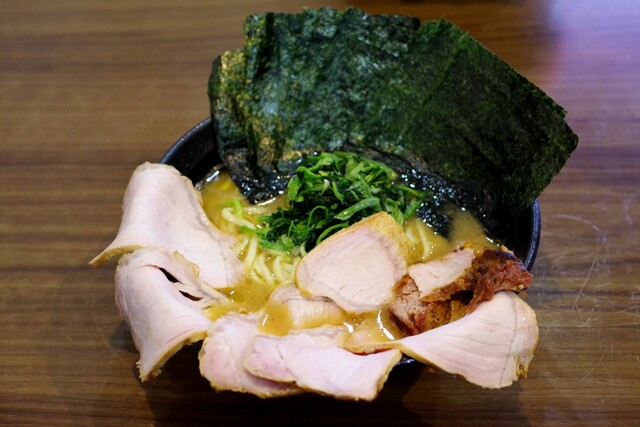
Approaching a suburban ramen shop in Samukawa is a different proposition from chasing counter seats in central Tokyo. The cues are practical rather than theatrical: a compact room, counter seating, tables for small groups, and the steady churn of diners who treat ramen as lunch, dinner, and habit rather than occasion. In Kanagawa, that matters. Yokohama Iekei ramen was born from a hybrid grammar of tonkotsu richness and soy-sauce authority, and its better shops tend to be judged less by novelty than by consistency: broth weight, noodle grip, seasoning balance, and how well the bowl holds up beside rice.
Yokohama Iekei Ramen Tennoya Samukawa souhon ten sits inside that tradition with a 15-seat format, a Tabelog score of 3.72, and selection for Tabelog 100 Ramen Kanagawa in both 2024 and 2025. Those signals place it in a narrower Kanagawa ramen conversation than the casual price point might suggest. The shop is not competing with tasting-menu restaurants or destination sushi counters; it is competing with other disciplined ramen rooms where a low-ticket meal can still be judged with serious precision.
Kanagawa Iekei ramen judged by broth discipline, not spectacle
Iekei ramen is one of Kanagawa’s defining contributions to Japanese noodle culture. The style’s core appeal lies in controlled excess: pork-bone depth, soy seasoning, thick noodles, and a structure designed to carry fat, salt, and starch without collapsing into blunt heaviness. Ingredient sourcing matters here because the bowl depends on a small set of inputs doing repeated work. Noodles need enough density to resist the broth. The tare has to push flavor forward without turning the final spoonful harsh. Greens, seaweed, and rice are not garnish in the loose Western sense; they are part of the eating system.
That is why recognition in a prefectural ramen list carries weight. Tabelog’s Kanagawa ramen selections are not built around luxury cues. They sort through a field where many shops operate at accessible prices, and where differences come down to execution rather than decor. Tennoya’s inclusion in the 2024 and 2025 Tabelog 100 Ramen Kanagawa list marks it as part of that serious everyday tier: a place where the craft is visible through repetition, not ceremony.
The Samukawa setting sharpens the point. Koza-gun is not a dining district that trades on international foot traffic, so the ramen has to make sense to local routines. Compared with toki, another Koza-gun listing at a slightly higher everyday bracket, Tennoya belongs to the lower-cost ramen lane. Out-of-metro peers such as Ramen Matsuya, Ramen Wara, and MEGURI occupy similar accessible pricing territory, which makes the Tabelog selection the differentiating signal rather than the tariff.
A small-room format built for solo bowls and family tables
The room’s structure explains the experience as much as the category does. Five counter seats give solo diners the direct ramen-shop rhythm: order, eat, move on. Ten table seats broaden the audience, and children are explicitly welcomed. That combination is common in suburban Japan but less common in prestige dining, where counter culture can sometimes read as exclusionary. Here, the format supports both the solitary bowl and the family stop, which is part of why ramen remains one of Japan’s more democratic food forms.
Absence of reservations also suits the genre. Ramen loses some of its logic when forced into the calendar habits of luxury dining. A shop like this works on immediacy and turnover, and the practical friction sits elsewhere: payment is cash-only, private rooms are not part of the setup, and the venue is non-smoking. Parking is specified rather than vague, which is useful in a car-oriented part of Kanagawa, though the surrounding lot rules need to be followed closely. These details may sound prosaic, but they shape the meal more than a chef biography would.
For readers building a wider food itinerary, the distinction is useful. Koza-gun dining does not have the density of Tokyo or Yokohama, so individual stops need a clear role. This is the ramen stop, not the long lunch. For a broader local map, see Our full Koza-gun restaurants guide, alongside Our full Koza-gun hotels guide, Our full Koza-gun bars guide, Our full Koza-gun wineries guide, and Our full Koza-gun experiences guide.
Where this bowl fits in a Japan-wide eating plan
Serious travel eating in Japan often swings between two poles: high-control formats and everyday specialists. A ramen shop selected for a prefectural Tabelog 100 list belongs to the second camp, which can be more revealing for visitors who want to understand how Japanese dining quality operates outside luxury categories. The benchmark is not linen, cellar depth, or theatrical plating. It is whether a narrow format has enough internal discipline to earn repeat attention.
That lens also helps when comparing across regions and genres. A beef-focused meal at -Grilled beef Sukiyaki- KAMAKURA TANUKIAN 鎌倉 たぬき庵 in Kamakura, seafood and charcoal at . 鮪と炭火焼き うお炭 秋葉原店 in Tokyo, or a compact specialist stop like .cafe in Osaka each answers a different travel question. The same applies to.know in Kumamoto, (Shoku) Vietnam in Kawasaki, [Curry Senmon Ten] Maruyama Kyoju. in Sapporo, [ki:] in Kyoto, #肉といえば松田 奈良本店 in Kashihara, 1/3 HAMBURGER FACTORY in Kanazawa, and 1000 in Yokohama: the point is matching format to appetite rather than forcing every meal into the same hierarchy.
For international readers, that same logic extends beyond Japan. Jōdo Saké Bar in Los Angeles and Onigiri Time in Pasadena show how Japanese drinking and rice-based formats travel abroad, but the source culture is clearest in places like Samukawa, where a low-cost bowl can carry the full weight of regional identity. Tennoya is worth reading through that frame: not as a grand dining event, but as evidence that Kanagawa’s ramen culture remains exacting at everyday scale.
How It Stacks Up
Comparable venues by cuisine and price in the same metro.
| Venue | Cuisine | Price | Notes |
|---|---|---|---|
| Yokohama Iekei Ramen Tennoya Samukawa souhon tenThis venue — the venue you are viewing | Yokohama iekei ramen | $ | Not listed |
| toki | Modern Japanese ramen shop | $ | Samukawa Town, Koza District |
| Ippudo (一風堂) | Tonkotsu Ramen | $ | Narita International Airport |
| 京ゆば工房 | Kyoto Yuba Workshop | $ | Higashiyama |
| G Men 7 | Classic Yokohama ramen shop | $ | Kōnan |
| Sakurai Chuka Soba Ten | Classic Japanese ramen & tsukemen | $ | Hodogaya |
Recognition history
Dated appearances from independent guides and award organizations, with the underlying list record or original source where available.
Tabelog 100 #90 · No. 90
Tabelog · Tabelog 100 - Ramen - KANAGAWA - 2025










At a Glance
- Lively
- Casual
- Cozy
- Solo
- Casual Hangout
- After Work
- Family
- Group Dining
- Standalone
Current opening hours
- Monday
- Closed
- Tuesday
- 11 AM–7:30 PM
- Wednesday
- 11 AM–7:30 PM
- Thursday
- 11 AM–7:30 PM
- Friday
- 11 AM–7:30 PM
- Saturday
- 11 AM–7:30 PM
- Sunday
- 11 AM–7:30 PM
Hours can change for holidays and private events. Last verified .
Casual, no-frills ramen-ya with a small mix of counter and table seating, likely bright and bustling during meal times and oriented toward quick, comfortable dining rather than lingering.