At Hoher Markt, one of Vienna's oldest squares, the Würstelstand is not a detour from the city's food culture, it is part of its foundation. The pavement sausage stand occupies a tier of Viennese street eating that predates the fine-dining circuit by centuries, offering a direct, unpretentious read on how the city actually feeds itself between the grand occasions.
Pearl is the En Primeur Club membership app — saves, bookings, and concierge access live there. Same editors, same standards.
- Address
- Hoher Markt ggü 8, 1010 Wien, Austria
- Phone
- +436766673464
- Website
- zumhohenmarkt.at
- Directions
- Get directions
 Saves & bookings on Pearl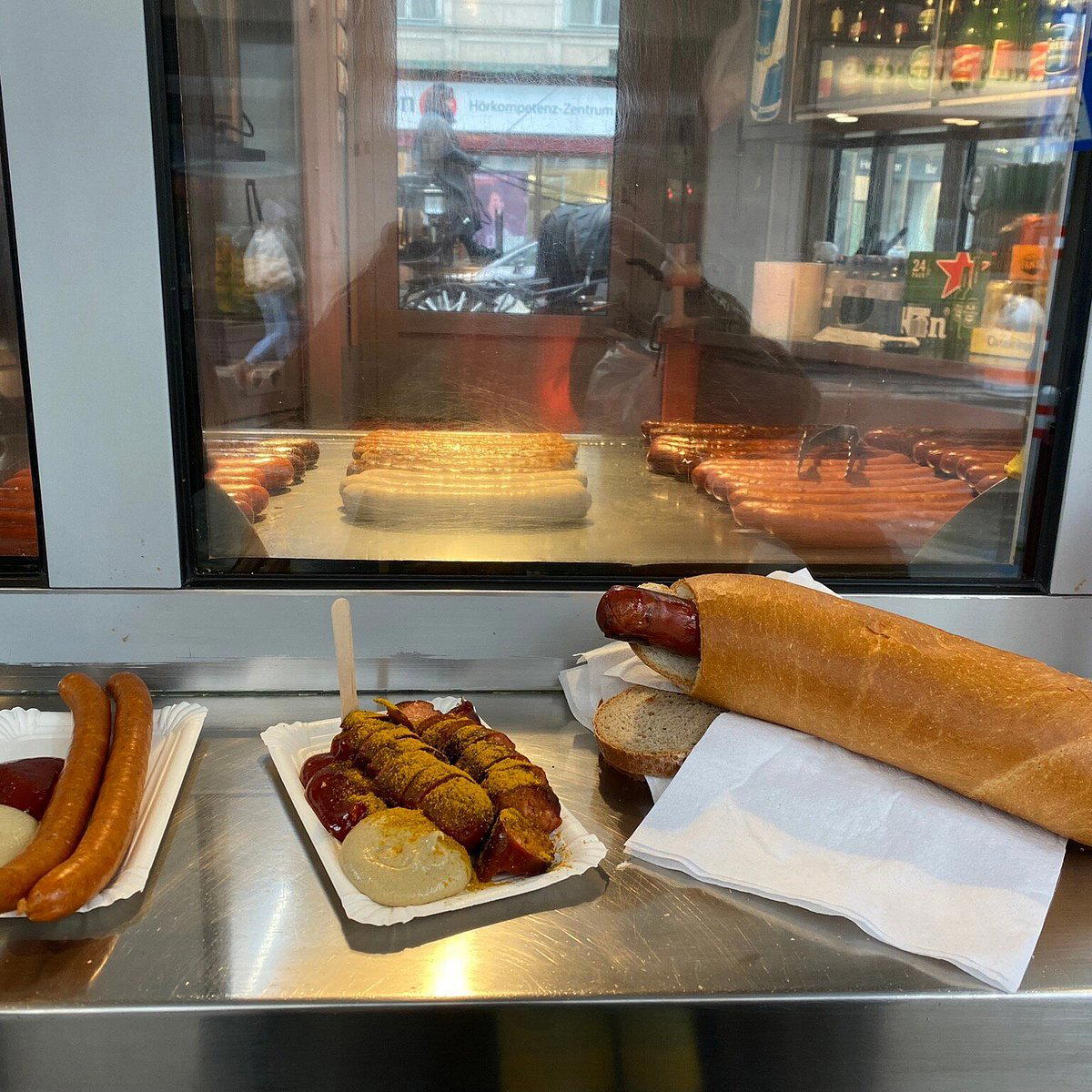
The Square Before the Restaurant
Hoher Markt is one of Vienna's oldest continuously used public spaces, sitting above the ruins of a Roman military camp and framed by the mechanical theatre of the Anker Clock. The square has hosted markets, courts, and daily commerce for the better part of two millennia. The Würstelstand positioned here belongs to that long continuum of public provisioning, a fixed point for workers, tourists, and late-night commuters who want something hot and immediate rather than a reservation and a tasting menu. It is a casual Austrian street food stand in Vienna's first district, rated 4.5 on Google, and priced at about $10 per person.
Vienna's relationship with the sausage stand is not incidental. The Würstelstand is a civic institution in the same category as the Kaffeehaus: a format with its own codes, vocabulary, and social logic. You stand at a counter, you order by number or by name, and the transaction is direct. No theatre, no service script. That directness is the point, and Hoher Markt's central position makes this particular stand a functional crossroads in the city's daily rhythm.
What the Würstelstand Actually Sells
The Austrian sausage canon is more specific than it appears from the outside. The Käsekrainer, a pork sausage with cheese pockets distributed through the meat, is the benchmark order at most Vienna stands. It is cooked on a roller grill until the casing blisters, served with a bread roll and a condiment of your choice. The Burenwurst, a coarser, more heavily smoked option, is the choice for those who want something with more structural weight. The Frankfurter, thinner and milder, is the international reference point, though Viennese versions are typically higher quality than the export product most people encounter abroad.
The editorial angle that applies across the city's sausage culture is the tension between a technically simple product and a highly specific local standard. Vienna's sausage tradition uses techniques, smoking, fermentation, and fat distribution that have been refined over generations, and the output differs from German or Czech equivalents in ways that are legible once you have a reference point.
Street Food in the City's Broader Dining Architecture
Vienna's fine-dining tier is well-documented. Steirereck im Stadtpark operates at the creative apex of Austrian cuisine, placing Austria in the same conversation as the Nordic and French establishments that dominate global rankings. Konstantin Filippou and Mraz & Sohn work modern European registers with serious technical programs. Amador and Doubek extend that creative range further. These venues are the internationally visible face of Viennese gastronomy.
The Würstelstand operates below all of that, and that gap is informative rather than embarrassing. Cities with coherent food cultures tend to have strong foundations at every price point, and the street level sustains the same basic commitment to ingredient quality and preparation discipline that characterises the fine-dining floor above it.
Outside Vienna, the same regional seriousness applies. Döllerer in Golling an der Salzach has built its reputation on Alpine produce handled with precision. Obauer in Werfen is one of Austria's most consistent long-form culinary addresses. Ikarus in Salzburg operates a rotating guest chef format that brings international technique into direct contact with Austrian hospitality. Kräuterreich by Vitus Winkler and Landhaus Bacher in Mautern an der Donau each anchor their regional positions with similar specificity. Even in the mountain resort tier, venues like Griggeler Stuba in Lech, Gourmetrestaurant Tannenhof in Sankt Anton am Arlberg, and Schwarzer Adler in Hall in Tirol hold the line on Austrian produce credentials. Ois in Neufelden and Restaurant 141 by Joachim Jaud in Mieming operate in smaller markets with the same seriousness. That national consistency makes Vienna's street food more legible, it is not an outlier but part of a pattern.
For readers tracking the global street food conversation, the comparison point is instructive. Cities like New York, where something like Le Bernardin or Atomix represents the technical ceiling, also sustain strong street and counter food cultures. The difference in Vienna is historical depth: the Würstelstand format has been a fixed feature of the city's social infrastructure since at least the nineteenth century, and the products it serves have not been substantially simplified for mass consumption.
How to Approach It
Hoher Markt is in the first district, within walking distance of the Stephansdom and a short walk from the Schwedenplatz U-Bahn stops (U1, U4). The stand is the kind of operation that works well approached with low ceremony: you are there for a sausage, a roll, and a beer from a can or bottle. The experience is measured in minutes, not hours.
For visitors working through Vienna's broader food programme, the Würstelstand is a reasonable orientation stop early in a trip, it calibrates your expectations for Austrian ingredient quality before you move into the city's more structured dining. It is also a sensible late-night option after an evening at a Heuriger or a concert at the Musikverein, when the alternative is a long walk back to a hotel with nothing open.
Know Before You Go
- Address: Hoher Markt ggü 8, 1010 Wien, Austria
- Nearest transit: Schwedenplatz (U1, U4), short walk
- Format: Pavement sausage stand, counter service, no seating
- Booking: Walk-in only
- Dress code: None
- Hours: Mon to Wed and Sun, 10 AM to 2 AM; Thu, 10 AM to 4 AM; Fri and Sat, 10 AM to 5 AM
- What to order: Käsekrainer is the reference point; Burenwurst for a heavier, smokier option
Price and Positioning
Comparable venues nearby, for context on price, style, and recognition.
| Venue | Cuisine | Price | Notes |
|---|---|---|---|
| Würstelstand am Hohen MarktThis venue — the venue you are viewing | Not listed | $ | Not listed |
| Duran | Not listed | $ | Favoriten, Austrian Open-Faced Sandwiches |
| Würstelstand Christian Lange | Rudolfsheim, Austrian Sausage Stand | $ | Not listed |
| Zum Goldenen Würstel II | Innere Stadt, Viennese Sausage Stand | $ | Not listed |
| Kaiserzeit | Not listed | $ | Inner City, Traditional Viennese Sausage Stand |
| Gasthaus Haller | Not listed | $ | Brigittenau, Traditional Viennese & Hungarian |
At a Glance
- Lively
- Well Known
- Energetic
- Casual Hangout
- Late Night
- After Work
- Historic Building
- Standalone
- Beer Program
- Street Scene
Current opening hours
- Monday
- 10 AM–2 AM
- Tuesday
- 10 AM–2 AM
- Wednesday
- 10 AM–2 AM
- Thursday
- 10 AM–4 AM
- Friday
- 10 AM–5 AM
- Saturday
- 10 AM–5 AM
- Sunday
- 10 AM–2 AM
Hours can change for holidays and private events. Last verified .