


Michelin Plate · Star Wine List · Falstaff Restaurant - 86 Falstaff Points
Our verdict
A Michelin Plate-recognised wine restaurant in Hamburg's Eimsbüttel district, Witwenball pairs a frequently rotating modern menu with a list of over 300 wines weighted toward organic producers. Star Wine List ranked it #1 in Hamburg for both 2023 and 2024. The mid-range price point makes it one of the more compelling value cases in the city's serious wine-dining circuit.

Pearl is the En Primeur Club membership app, where members save venues, book tables and use the concierge.
The menu
What to order
- Jerusalem artichoke
- Fish soup
- Wiener schnitzel
Eimsbüttel's Wine-First Dining Model
Hamburg's serious wine-restaurant tier has historically concentrated in the centre and Hafencity, where expense-account clientele and tourist footfall underwrite long wine lists and tasting menus priced accordingly. The picture in Eimsbüttel has developed along different lines. The neighbourhood's character, dense residential blocks, independent retail, a local-first culture, shapes what succeeds there. Witwenball, on Weidenallee, fits that logic: a former dancing bar converted into a bistro-format wine restaurant where the list runs to over 300 labels and the food menu rotates on a cycle of a few weeks rather than a fixed season.
That model is worth pausing on. In a city where formal tasting menus at the leading end, The Table Kevin Fehling operating at €€€€, Restaurant Haerlin similarly positioned, absorb most of the critical oxygen, there's a structural gap in the mid-range for places that take wine seriously without requiring the full tasting-menu commitment. Witwenball operates in that gap, and does it in a neighbourhood that doesn't default to formal dining as its cultural register.
The Room and What It Says
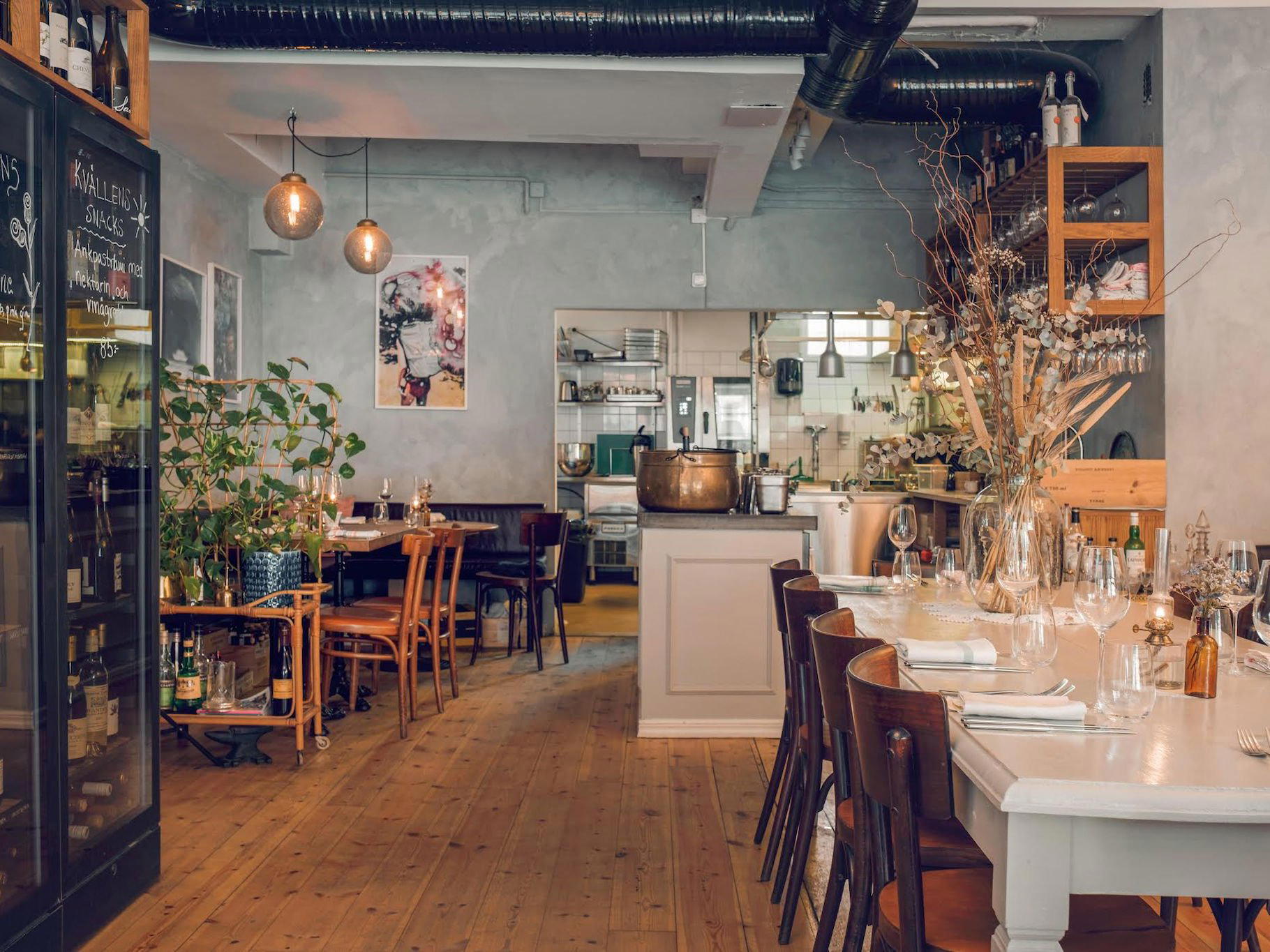
The interior signals something about the venue's priorities. Pale green chairs and azure blue bench seats read as considered without being precious. The shining marble tables and white marble counter give the room a material quality that punches above its price bracket, while decorative wine shelving keeps the program's central focus visible throughout the space. This is not the stripped-back minimalism that has become a shorthand for seriousness in European wine bars, nor the maximalist clutter of a traditional Weinstube. It occupies a middle register, relaxed and legible, designed with evident intention.
That interior confidence matters at the €€ price point. Across Hamburg's mid-range, the quality gap between a room that has been designed and one that has simply been furnished is often larger than the price gap between venues. Here, the physical environment signals that attention to detail extends beyond the list.
The Wine List as the Actual Offer
Star Wine List ranked Witwenball the number-one wine restaurant in Hamburg in both 2023 and 2024. That's a specific, externally verified claim, and it reframes how the 300-label list should be read. This isn't a restaurant that has a good wine list. It's a wine operation that also serves food, a meaningful distinction in how the experience is structured and what you're paying for.
The emphasis on organic viticulture is worth noting as a curatorial position rather than a marketing point. Organic-weighted lists involve sourcing discipline and producer relationships that most mid-range restaurants don't invest in. The 300-bottle depth at the €€ price tier suggests margin management that prioritises the list's quality over cover charge revenue. By comparison, restaurants at the €€€€ tier in Hamburg, and at comparably positioned operations in other German cities, from JAN in Munich to Aqua in Wolfsburg, absorb wine investment costs into a higher headline price. Witwenball's position means the list value is passed directly to the guest.
A Menu Built Around the Wine Program
The rotating menu format, changing every few weeks rather than seasonally, is an approach that keeps the kitchen's relationship with the wine list active rather than fixed. When a food menu is static for months, pairings calcify. A short-cycle rotation forces ongoing curation, which at a wine-led venue is closer to how the pairing logic should work in theory. The Michelin Plate recognition in 2024 confirms that the food meets a baseline of execution quality, even if the venue isn't operating as a destination kitchen in the way that, say, 100/200 Kitchen or haebel do at the higher end of Hamburg's creative cooking tier.
Desserts have drawn specific attention in observer notes, an unusual signal in this format, where pastry work is often the weakest part of a wine-bar menu. It suggests the kitchen is operating with some intentionality across the full meal rather than concentrating effort on savoury courses alone. Compare that to CODA Dessert Dining in Berlin, which has built an entire reputation on the dessert-forward format: Witwenball's approach is less radical but points in a similar direction in its relative seriousness about the final course.
Value Framing at This Price Point
Editorial angle here is direct: what Witwenball delivers at €€ is not a budget approximation of serious wine dining. It's a version that has been built from the wine list outward, with food that earns Michelin recognition and a room that holds up as a destination in its own right. The Hamburg venues at €€€€, The Table Kevin Fehling, Haerlin, are operating in a different mode, built around kitchen ambition and chef-profile dining. Klinker and Heimatjuwel occupy different parts of the Hamburg mid-range. Witwenball's specific position, wine-restaurant primacy, organic list, Michelin-recognised food, Eimsbüttel address, has few direct comparators in the city.
For guests who arrive with wine interest as the primary driver, the 300-label organic-weighted list at this price tier represents one of Hamburg's more compelling propositions. For guests arriving food-first, the Michelin Plate and rotating menu structure provide sufficient grounding, with the wine list as a significant upside. Few venues in Germany's mid-range tier outside major capitals can claim dual Star Wine List rankings at consecutive years; Witwenball's position in Eimsbüttel rather than a premium central address makes that achievement more notable, not less.
Germany's serious wine-dining circuit tends to concentrate its critical recognition on higher-priced operations: Schwarzwaldstube in Baiersbronn, Vendôme in Bergisch Gladbach, ES:SENZ in Grassau. The international frame stretches further: Frantzén in Stockholm and FZN by Björn Frantzén in Dubai represent the global tier at which food-and-wine parity operates at the highest price brackets. Witwenball's case is that the same parity is achievable at a fraction of the spend, within a neighbourhood format that Hamburg's dining culture is well positioned to support.
Know Before You Go
- Address: Weidenallee 20, 20357 Hamburg, Germany
- Neighbourhood: Eimsbüttel
- Price range: €€ (mid-range)
- Cuisine: Modern Cuisine, wine-restaurant format
- Wine list: 300+ labels; emphasis on organic producers
- Awards: Michelin Plate (2024); Star Wine List #1 Hamburg (2023 and 2024)
- Menu format: Rotating menu, changes every few weeks
For broader Hamburg planning, see our full Hamburg restaurants guide, Hamburg hotels guide, Hamburg bars guide, Hamburg wineries guide, and Hamburg experiences guide.
Frequently asked questions
What dish is Witwenball famous for?
Witwenball is a wine restaurant before it's a destination kitchen, and the menu rotates every few weeks, which means no single dish defines the experience in the way that a signature course might at a tasting-menu-led venue. The food holds Michelin Plate recognition, confirmation that execution meets a consistent standard, and the desserts have attracted specific notice in observer accounts, an unusual distinction for this format. The more consistent through-line is the wine program: Star Wine List #1 in Hamburg two years running, with over 300 labels weighted toward organic producers. Guests who arrive focused on a specific dish will be disappointed; guests who arrive with wine as the primary interest, and food as a serious accompaniment, will find the offer well calibrated to that priority.
Price and Recognition
| Venue | Cuisine | Price | Awards | Notes |
|---|---|---|---|---|
| WitwenballThis venue (the venue you are viewing) | Modern German Bistro with International Influences | $50–100 | Michelin Plate · Star Wine List | Not listed |
| The Table Kevin Fehling | Avant-Garde Fusion Fine Dining | $200–300 | 3 Michelin Stars · La Liste Top Restaurants | Creative |
| bianc | Modern Mediterranean Fine Dining | $200–300 | 2 Michelin Stars · La Liste Top Restaurants | Modern Mediterranean, Mediterranean Cuisine |
| Lakeside | Modern European Fine Dining | $200–300 | 2 Michelin Stars · La Liste Top Restaurants | German Lakeside |
| Landhaus Scherrer | Michelin-Starred North German Fine Dining | $150–200 | 1 Michelin Star · Star Wine List | Modern European, Classic Cuisine |
| Heimatjuwel | Modern Regional German Vegetarian Fine Dining | Not listed | 1 Michelin Star · We're Smart World 3 Radishes | German, Creative |
Recognition history
Dated appearances from independent guides and award organizations, with the underlying list record or original source where available.
Michelin Plate
Michelin · 2026 Michelin Plate
Star Wine List
Star Wine List
Falstaff Restaurant - 86 Falstaff Points
Falstaff
Full recognition history (7 entries)
Michelin Plate
Michelin
Michelin Plate
Michelin
Star Wine List
Star Wine List
Star Wine List
Star Wine List
Continue exploring
More in Hamburg
Restaurants in Hamburg
All restaurants in Hamburg →
Bars in Hamburg
All bars in Hamburg →
Hotels in Hamburg
All hotels in Hamburg →
Wineries in Hamburg
Browse all →
Details
- Sophisticated
- Elegant
- Trendy
- Cozy
- Date Night
- Special Occasion
- Group Dining
- Open Kitchen
- Terrace
- Extensive Wine List
- Local Sourcing
- A La Carte
- Prix Fixe
- Wine
- Cocktails
- Vegetarian Friendly
Current opening hours
- Monday
- 6–11 PM
- Tuesday
- Closed
- Wednesday
- 6–11 PM
- Thursday
- 6 PM–12 AM
- Friday
- 6 PM–1 AM
- Saturday
- 5:30 PM–1 AM
- Sunday
- 5–11 PM
Hours can change for holidays and private events. Last verified .
Laid-back yet lively with chic decor featuring marble counters, wine racks, modern chandeliers, wood elements, and dark green upholstery under cozy lighting.