
Whole Spice Curry Seiran puts Koenji’s independent curry culture into a compact counter format, with whole spices sautéed after ordering rather than treated as background seasoning. Its Tabelog Curry TOKYO 100 selection in 2024 places it among Tokyo’s recognized curry specialists, while the modest format keeps the focus on spice handling, plate economy, and neighbourhood rhythm rather than ceremony.
Pearl is the En Primeur Club membership app — saves, bookings, and concierge access live there. Same editors, same standards.
- Address
- 2 Chome-41-15 Koenjikita, Suginami City, Tokyo 166-0002, Japan
- Phone
- +81 3-5327-8342
- Website
- seiran-curry.tokyo
 Saves & bookings on Pearl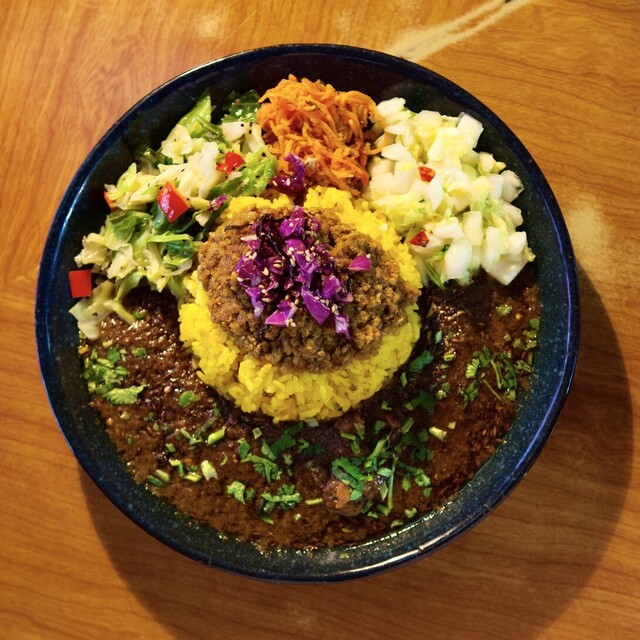
Koenji’s north side feels like a Tokyo neighbourhood resisting polish: narrow shopfronts, railway energy, small counters, and food businesses built for repeat locals rather than occasion dining. Curry fits: affordable, quick enough for lunch, expressive enough for specialists, and able to carry a cook’s view through spice, rice, heat, and garnish. Whole Spice Curry Seiran sits in that independent Tokyo curry tier, where the room is compact, the exchange direct, and the plate must justify itself without theatre.
Tokyo curry is not one tradition. The city spans old-school yoshoku curry, Indian and Nepali canteens, soup curry, Osaka-influenced spice-curry shops, and newer counters treating whole spices with the care given to ramen broth or sushi rice. The useful distinction is not authenticity versus invention, but whether spice is handled as pre-mixed paste or live ingredient. Here, the signal is post-order sautéing of spices for its Aromatic Curry Rice: aroma generated in the moment, not merely stored in sauce.
Koenji curry culture rewards small rooms and precise spice work
Tokyo’s serious curry scene often sits outside the luxury dining script. It is not built on long tasting menus, imported tableware, or formal wine service. Recognition comes from consistency, queue discipline, and making a low-cost plate feel authored. Whole Spice Curry Seiran’s selection for Tabelog Curry TOKYO 100 in 2024 places it among visible curry specialists, apart from Koenji’s higher-spend rooms such as kouenji yakiniku kokochi Honten or Sushi Hayashi, where price architecture and guest expectations differ.
That matters because curry has become one of Tokyo’s sharper value categories. At its leading, it compresses technique into one plate: spice blooming, rice management, texture contrast, heat control, and everyday portioning. The format keeps waste pressure visible. A small counter, limited service windows, take-out availability, and the possibility of selling through items suggest controlled output rather than excess choice. Sustainability here is practical: restrained scale, cooked-to-order spice handling, and a menu style avoiding the overproduction common to broader, all-day operations.
The environmental story is not certification or farm-led sourcing. It is modest and credible. Curry counters can run lean because the core product is concentrated: rice, sauce, spice, and toppings moving through a short service cycle. When identity depends on aroma released after the order, freshness is tied to process rather than abundance. In a city where premium dining often equates scarcity with luxury, this model offers another discipline: fewer seats, fewer distractions, and less distance between preparation and consumption.
Aromatic curry, not ceremony, is the central argument
The house language around Aromatic Curry Rice and a Spicy Chicken Curry Set explains the kitchen’s lane without a menu tour. The point is whole-spice expression on one plate, with vegetables part of the composition rather than a side flourish. That places the restaurant closer to Tokyo’s modern spice-curry movement than to the thick, sweet, roux-heavy style many travelers associate with Japanese curry. The appeal is not heat for its own sake, but clarity when spice is handled as structure.
That clarity makes the counter format important. Thirteen counter seats keep the meal close to observation, without omakase choreography. The diner sees a small operation solve practical problems in real time: pacing, plate assembly, payment, take-out, and turnover. Counter seating also changes the sustainability equation. A room this size cannot hide behind scale. If demand spikes, the kitchen manages the line or runs out. In Tokyo, that can frustrate; it can also show a restaurant refusing to dilute process for volume.
Koenji adds another layer. The neighbourhood has long been linked with live music, second-hand shops, casual drinking, and independent food addresses rather than corporate dining. A curry specialist fits that ecology better than a heavily staged restaurant. Nearby categories tell the story: bakeries, ramen shops such as Hayashi, patisserie counters such as Patisserie l’abricotier, and casual restaurants form a map of small, purpose-specific stops. Whole Spice Curry Seiran reads as part of that fabric, not an outlier parachuted in for destination traffic.
How to place it within a Tokyo food itinerary
For travelers building a Tokyo dining plan, this corrects the city’s reservation-heavy narrative. Not every serious meal needs a concierge, deposit, or long dinner. Curry can carry equal cultural information at lower spend and shorter duration, especially where everyday rhythms remain legible. A day moving from Koenji curry to a bar-led evening or more formal counter elsewhere will teach more about Tokyo than stacking only prestige rooms.
The better comparison is with other single-category specialists, not fine-dining restaurants. A curry counter and a yakitori counter both rely on repetition, heat control, and the confidence to narrow the offer. Readers mapping that side of the city can place this address alongside Tokyo restaurant entries such as 3 Chome no Curry Ya San, 124. KAGURAZAKA (Yakitori), 12/10 Shinjuku ten, . 鮪と炭火焼き うお炭 秋葉原店, and 2D Cafe. The range is broad, but the editorial question is constant: what does a narrow format reveal about the city that a generic meal cannot?
For wider planning, use Our full Tokyo restaurants guide for dining, then cross-check the city through Our full Tokyo hotels guide, Our full Tokyo bars guide, Our full Tokyo wineries guide, and Our full Tokyo experiences guide. Regional and international comparisons can sharpen the reading: [Curry Senmon Ten] Maruyama Kyoju. in Sapporo for another curry specialist, [ki:] in Kyoto, -Grilled beef Sukiyaki- KAMAKURA TANUKIAN 鎌倉 たぬき庵 in Kamakura.cafe in Osaka.know in Kumamoto, (Shoku) Vietnam in Kawasaki, Jōdo Saké Bar in Los Angeles, and Onigiri Time in Pasadena.
The case for the restaurant is not that it replaces Tokyo’s formal dining rooms. It does something more specific: it shows how a low-cost, small-footprint curry counter can earn serious attention through process. The 2024 Tabelog Curry TOKYO 100 recognition supplies the external signal; the stronger reason to go is how Koenji’s independent food culture, whole-spice technique, and restrained operating model meet in a format that wastes little motion.
How It Stacks Up
Comparable venues at the same tier for side-by-side context.
| Venue | Cuisine | Price | Notes |
|---|---|---|---|
| Whole Spice Curry SeiranThis venue — the venue you are viewing | Whole-spice Japanese curry | $ | Not listed |
| Shina Soba Tantantei | Classic Tokyo Shina Soba & Wonton Ramen | $ | Suginami |
| Shotaro Udon | Traditional Musashino Udon | $ | Nerima |
| Curry Rice Senmon Ten Brother | Japanese Curry Counter | $ | Shinjuku |
| Hishida Ya | Japanese teishoku cafeteria | $ | Meguro |
| UCHOUTEN | Yoshoku (Japanese-style Western) hamburger steak | $ | Toshima |
Recognition history
Dated appearances from independent guides and award organizations, with the underlying list record or original source where available.
Tabelog 100 #20 · No. 20
Tabelog · Tabelog 100 - Curry - TOKYO - 2024













At a Glance
- Cozy
- Lively
- Solo
- Casual Hangout
- After Work
- Standalone
Current opening hours
- Monday
- Closed
- Tuesday
- Closed
- Wednesday
- Closed
- Thursday
- 11:30 AM–2 PM
- Friday
- Closed
- Saturday
- 11:30 AM–2 PM, 5:20–7:30 PM
- Sunday
- 11:30 AM–2 PM, 5:20–7:30 PM
Hours can change for holidays and private events. Last verified .