
Shotaro Udon puts Tokyo’s everyday noodle culture in a compact Nerima counter format: nine seats, udon and curry udon, take-out, and pricing under JPY 999. Its Tabelog 100 Udon EAST selections in 2020, 2022, and 2024 place it in the city’s serious low-cost noodle conversation rather than the luxury-dining circuit.
Pearl is the En Primeur Club membership app — saves, bookings, and concierge access live there. Same editors, same standards.
- Address
- 東京都練馬区下石神井5-1-36
- Website
- marushok.jp
 Saves & bookings on Pearl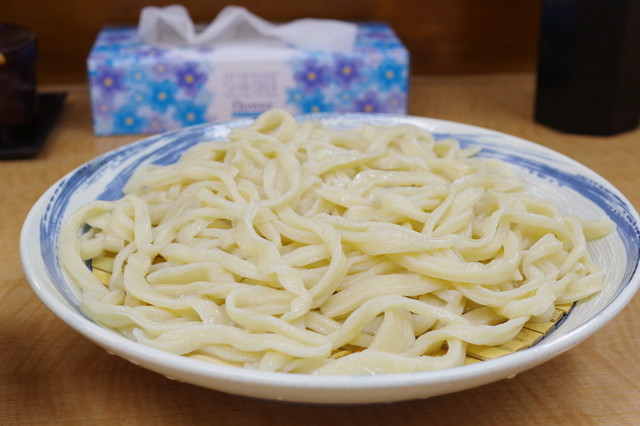
Approaching a suburban udon counter in Nerima is a different Tokyo rhythm from Ginza omakase or hotel dining: fewer theatrical cues, tighter rooms, and a clearer contract between kitchen and customer. The format rewards speed, restraint, and repetition. At Shotaro Udon, the dining room is built around nine counter seats, a scale that keeps the experience closer to workshop than restaurant floor.
That matters because udon in Tokyo is not only a comfort category. It is also a study in daily infrastructure: wheat noodles, broth, curry variations, quick turnover, and prices that keep the meal in ordinary circulation. The premium signal here is not luxury. It is recognition within a craft category that usually lives below the expense-account radar.
Nerima's counter udon model prizes efficiency over spectacle
Tokyo’s serious noodle culture has always split across two tracks. Ramen attracts international attention through regional styles, chef personalities, and late-night mythology. Udon is quieter, often more practical, and less dependent on decoration. The category asks sharper questions: how much can a small kitchen express through noodle texture, broth discipline, curry structure, and service rhythm without moving into tasting-menu territory?
Shotaro Udon belongs to that second track. Its categories are udon and curry udon, with take-out also part of the format. The counter-only setup limits sprawl and keeps staffing, storage, and service patterns compact. From a sustainability angle, that small footprint has editorial weight. Low-seat-count noodle shops often operate with narrower menus and faster cycles than larger casual restaurants, reducing the pressure to maintain broad inventories for every possible order.
The venue’s practical details reinforce the point. Fresh udon noodles and edible chili oil are available for take-away, which extends production beyond the seat count without turning the room into a delivery-first operation. There is also a house rule that keeps rear seats near the register clear so kitchen movement is not blocked. That kind of operational note says more about the genre than any decorative language could: the room is planned around flow, not lingering performance.
Recognition gives the format its evidence. Shotaro Udon was selected for Tabelog 100 Udon EAST in 2024, with earlier selections in 2022 and 2020. In a city where high-end dining often absorbs the international gaze, repeated selection in an udon-specific list points to a different hierarchy, one measured by category consistency rather than luxury signals.
Low-cost noodle craft sits outside Tokyo's usual luxury grammar
The price bracket also changes the reader’s expectation. A meal listed under JPY 999 sits far from Tokyo’s expensive counter culture, where scarcity and ceremony often drive demand. Here, the value proposition is narrower and more demanding: a small udon shop has to justify attention through execution, not access theater. Compared with Musashino Enza in Tokyo, listed at JPY 1,000 to JPY 1,999, the restaurant occupies an even leaner bracket. Butaya and Blondir sit in different casual-price bands, while PIZZERIA GTALIA DA FILIPPO DA FILIPPO moves into a higher spend category. Those comparisons are not about cuisine overlap; they show how Tokyo’s outer-neighbourhood dining can range from daily meals to destination spending within a few price steps.
There is an environmental logic to that affordability. Udon is made from common staples, served in direct formats, and often consumed without the heavy packaging, imported-luxury ingredients, or long multi-course pacing associated with higher-ticket dining. That does not automatically make every noodle shop sustainable, and no sourcing claim should be assumed without evidence. But the format itself is relatively disciplined: short service windows, compact seating, take-out built around core products, and a cuisine that can function without excess.
The location in Shimoshakujii, Nerima, also places the meal outside Tokyo’s better-known tourist dining circuits. This is not the Tokyo of skyline dining rooms or branded hotel restaurants. It is a ward-level food culture where small specialists serve residents, solo diners, friends, and families. Children are welcome, private rooms are unavailable, and the counter setting keeps the meal close to the kitchen’s pace. That combination is common in Tokyo’s neighbourhood dining, but it becomes more interesting when paired with category-level recognition.
Payment and booking expectations belong to the same no-frills universe. Credit cards, electronic money, and QR code payments are not accepted, and reservations are unavailable. Those facts shape the editorial read: this is not a concierge-driven table. It is a compact, cash-based noodle counter whose seriousness comes from repetition and category standing.
Where it fits in a Tokyo food itinerary
For visitors building a Tokyo itinerary, the restaurant makes sense as a counterpoint to the city’s reservation-heavy meals. It offers a view of Tokyo dining that is inexpensive, local, and structurally efficient. The appeal is not breadth. It is a narrow format doing one category with enough consistency to earn Tabelog 100 Udon EAST recognition across multiple years.
The smarter way to place it is not as a substitute for sushi, kaiseki, or yakitori, but as a corrective to an itinerary overloaded with luxury counters. Tokyo’s food culture is not fully legible through expensive reservations alone. A nine-seat udon shop in Nerima teaches a different lesson: small rooms, short menus, low prices, and repeatable craft still form a major part of the city’s dining identity.
Use broader Tokyo planning to balance the meal around neighbourhood, category, and pace. For more restaurant context, see Our full Tokyo restaurants guide, alongside Tokyo listings such as . 鮪と炭火焼き うお炭 秋葉原店, 12/10 Shinjuku ten, 124. KAGURAZAKA (Yakitori), 2D Cafe, and 3 Chome no Curry Ya San. For the rest of the city, pair meals with Our full Tokyo hotels guide, Our full Tokyo bars guide, Our full Tokyo wineries guide, and Our full Tokyo experiences guide.
For Japan and wider dining reference points, compare how casual formats shift across -Grilled beef Sukiyaki- KAMAKURA TANUKIAN 鎌倉 たぬき庵 in Kamakura.cafe in Osaka.know in Kumamoto, (Shoku) Vietnam in Kawasaki, [Curry Senmon Ten] Maruyama Kyoju. in Sapporo, [ki:] in Kyoto, Jōdo Saké Bar in Los Angeles, and Onigiri Time in Pasadena.
Peers in This Market
Comparable venues to anchor price and recognition.
| Venue | Cuisine | Price | Notes |
|---|---|---|---|
| Shotaro UdonThis venue — the venue you are viewing | Traditional Musashino Udon | $ | Not listed |
| Musashino Enza | Traditional Musashino Udon | $ | Nerima |
| Chonan Hosono Takashi | Tsukemen & ramen | $ | Nerima |
| Anya | Japanese Wagashi Shop | $ | Setagaya |
| Sanuki Udon Iwai | Sanuki udon noodle shop | $ | Kita |
| Kitchen Taka | Japanese yoshoku (Western-style comfort food) counter | $ | Shinjuku |
Recognition history
Dated appearances from independent guides and award organizations, with the underlying list record or original source where available.
Tabelog 100 #89 · No. 89
Tabelog · Tabelog 100 - Udon - EAST - 2024









At a Glance
- Classic
- Cozy
- Solo
- Casual Hangout
- After Work
- Family
- Standalone
Simple, no-frills neighborhood udon counter with a classic feel—bright but modestly lit, focused on speedy meals and the hearty texture of Musashino-style noodles rather than décor.