At Schottenring 1 on Vienna's First District ring road, Vienna Sausage occupies a position at the intersection of street-food tradition and the city's enduring appetite for Würstelstand culture. The address alone signals proximity to the Ringstrasse's civic grandeur, placing this spot within reach of both daily commuters and visitors working through the city's architectural heritage.
Pearl is the En Primeur Club membership app — saves, bookings, and concierge access live there. Same editors, same standards.
- Address
- Schottenring 1, 1010 Wien, Austria
- Website
- viennasausage.at
- Directions
- Get directions
 Saves & bookings on Pearl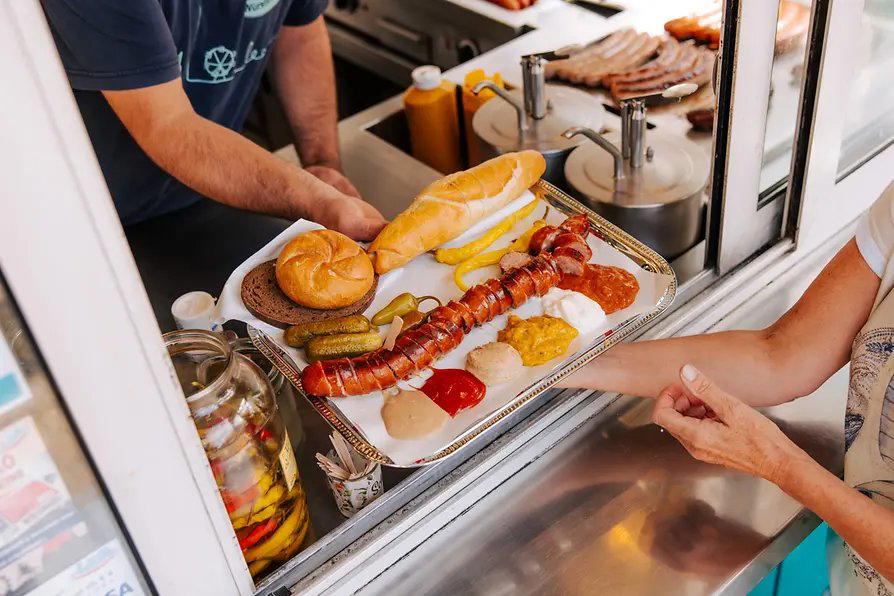
Where the Würstelstand Tradition Meets the Ringstrasse
The Würstelstand, the street-side sausage counter that functions simultaneously as snack stop, late-night refuge, and neighbourhood social node, has been embedded in Viennese daily life for well over a century, operating at a remove from the fine-dining conversation that surrounds places like Steirereck im Stadtpark or Amador yet no less central to how the city eats. Vienna Sausage, positioned at Schottenring 1 in the 1st District, sits on among the more trafficked stretches of the Ringstrasse, the 19th-century boulevard that Emperor Franz Joseph I commissioned to project imperial ambition through urban planning. That address is not incidental: the Schottenring end of the ring connects the financial district to the university quarter and drops pedestrians directly at the Schottentor U-Bahn junction, meaning the footfall here is less tourist-bubble and more genuinely mixed, office workers, students, tram commuters, and the occasional visitor who knows to look beyond the Naschmarkt for the city's street-food pulse.
The Loyal Clientele and What Actually Keeps Them Coming Back
In the street-food tier of any serious food city, regulars define the offer more honestly than any written menu. The Würstelstand format rewards consistency above experimentation: the person who stops at the same counter three mornings a week or after every late shift is not looking for seasonal reinvention. They are looking for the same thing to be exactly right every time, the snap of a Käsekrainer casing, the precise heat of a Debreziner, the ratio of mustard to roll. This is the logic that separates street-food regulars from restaurant regulars, and it explains why a well-positioned stand on a high-footfall ring-road corner can build a loyal constituency that self-selects out of the city's more discussed dining tier. The circuit of Viennese diners who engage seriously with tasting menus at Konstantin Filippou or Mraz & Sohn and equally hold opinions about which stand does the Käsekrainer correctly is a specific and real demographic in this city, and it is that overlap that makes street sausage culture worth taking seriously as an editorial subject.
The unwritten menu at any Würstelstand is largely unwritten because it barely changes. You know what you want before you arrive. The negotiation is small: grob or fein mustard, roll or bread slice, with or without pickle. The speed of that transaction is part of the value proposition. At a corner like Schottenring 1, where pedestrian rhythms are dictated by tram and U-Bahn timetables, that efficiency is not a convenience feature, it is the product. Austrian street-food tradition has never fetishised slowness in this format; the stand exists to slot into the gaps between the rest of the day.
Vienna's Sausage Geography and Where Schottenring Fits
Across Austria, the regional variation in sausage culture is meaningful. Further west, in Salzburg's orbit, you find the alpine-inflected charcuterie traditions that inform the kitchen at Ikarus or the produce sourcing at Obauer in Werfen. In the valleys and market towns, operations like Landhaus Bacher in Mautern an der Donau and Döllerer in Golling an der Salzach translate regional meat traditions into fine-dining register. Vienna's version is more urban and more democratic: the Würstelstand is the great equaliser of the city's food culture, the format that survives precisely because it does not distinguish between a civil servant on lunch break and a tourist who has just come from the Burgtheater. The Schottenring location, immediately adjacent to the outer ring of the 1st District, places Vienna Sausage in the commercial-civic overlap zone rather than the deep tourist corridor of the Innere Stadt's pedestrian grid, which tends to produce a more functional, less performative clientele.
Austria's restaurant scene at the summit tier has continued to attract international attention, with properties across the country earning consistent recognition. The contrast between that fine-dining tier and the Würstelstand tradition is less a gap than a spectrum, one that Viennese diners move across comfortably, in the way that a city like New York's most serious eaters hold opinions about both a three-star kitchen like Le Bernardin and the leading chopped-cheese counter in their borough. Vienna operates the same way, and any honest account of the city's food culture requires both ends of that spectrum to be present.
Planning a Visit: What the Address Tells You
Schottenring 1 is directly accessible from the Schottentor U-Bahn stop, served by U2 and U4 lines, making it one of the more transit-connected addresses on the ring. The location at the junction of the Ringstrasse and the canal-side Schottenring means it catches foot traffic from the university district to the north and the financial and legal quarter to the south. For visitors staying in or near the 1st District, this is a natural stop on any circuit that includes the Votivkirche, the University of Vienna buildings, or the Museum of Fine Arts corridor. The practical rhythm of a Würstelstand means there is no booking requirement, no dress code to consider, and no window of service that penalises the uncommitted visitor: the format is walk-up by design. Those building a broader Austrian dining itinerary alongside Vienna visits might also consider the alpine register represented by Griggeler Stuba in Lech, Gourmetrestaurant Tannenhof in Sankt Anton am Arlberg, or the herb-driven approach at Kräuterreich by Vitus Winkler, all of which represent the country's other major sausage and charcuterie traditions in fine-dining form. Regionally, Ois in Neufelden, Schwarzer Adler in Hall in Tirol, and Restaurant 141 by Joachim Jaud in Mieming extend the picture further across the country's culinary geography. Vienna's own creative dining tier, represented by Doubek, completes the local picture for those wanting to move between registers in a single city visit.
Awards and Standing
Comparable venues nearby, for context on price, style, and recognition.
| Venue | Cuisine | Price | Notes |
|---|---|---|---|
| Vienna SausageThis venue — the venue you are viewing | Austrian Hot Dogs & Sausages | $ | Not listed |
| Schönscharf | Authentic Thai Curries | $ | Innere Stadt |
| Zum Scharfen René | Spicy Austrian Sausage Stand | $ | Staatsoper |
| Casino Kulinarium | Modern Viennese Cuisine | $$$ | Doebling |
| Würstel Boutique | Austrian Sausage Stand | $ | Favoriten |
| Porzellan | Modern Austrian Lounge | $$ | Inner City |
Continue exploring
More in Vienna
Restaurants in Vienna
Browse all →
Bars in Vienna
Browse all →
Hotels in Vienna
Browse all →

At a Glance
- Lively
- Casual
- Casual Hangout
- Standalone
Current opening hours
- Monday
- Closed
- Tuesday
- Closed
- Wednesday
- Closed
- Thursday
- Closed
- Friday
- Closed
- Saturday
- Closed
- Sunday
- Closed
Hours can change for holidays and private events. Last verified .
Casual fast food atmosphere typical of a sausage stand with quick service and street food energy.