At the edge of Vienna's Hauptbahnhof precinct, Würstel Boutique occupies a format that sits somewhere between the city's deep-rooted Würstelstand tradition and a more considered, sit-down interpretation of sausage culture. It is a reference point for how Vienna's transit-adjacent dining has shifted from pure convenience toward something more deliberately crafted, without abandoning the democratic accessibility that defines the genre.
Pearl is the En Primeur Club membership app — saves, bookings, and concierge access live there. Same editors, same standards.
- Address
- Am Hbf 1, 1100 Wien, Austria
- Phone
- +436766109411
- Website
- wuerstelboutique.at
- Directions
- Get directions
 Saves & bookings on Pearl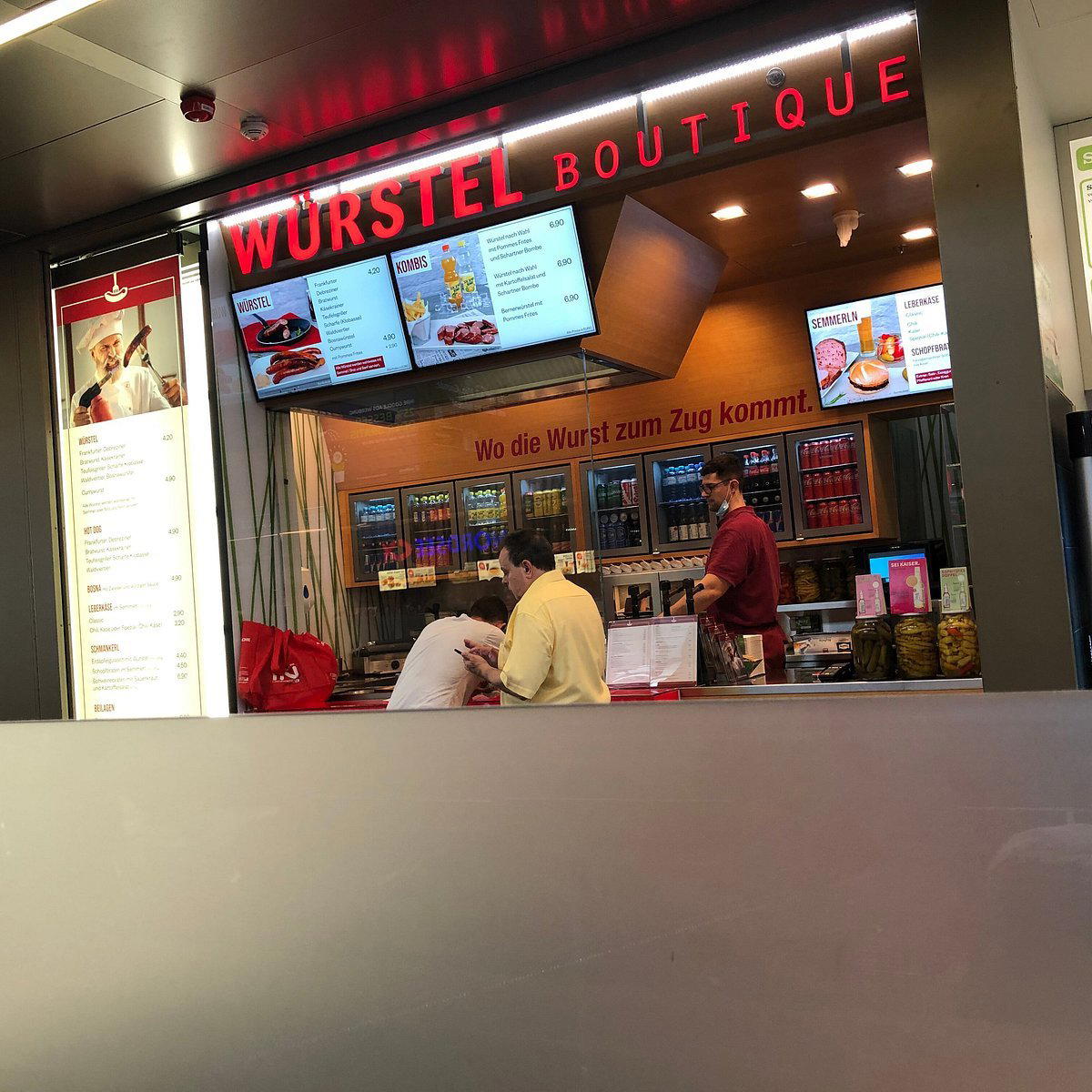
The Würstelstand Tradition, Reconsidered
Vienna's relationship with the sausage stand is older than most of its restaurant institutions. The Würstelstand is not street food in the imported sense; it is a civic fixture, present at tram stops, U-Bahn entrances, and stadium perimeters, operating as a social equalizer across income brackets and neighbourhoods. What has changed in recent years is the emergence of a smaller tier of operations that take the sausage seriously not as nostalgia but as craft, applying sourcing rigour, considered accompaniments, and deliberate service formats to a format that was historically defined by speed and convenience. Würstel Boutique, located at Am Hbf 1 in the 1100 district, sits at the edge of that shift, positioned within the Hauptbahnhof development zone where commuter volume meets an increasingly residential neighbourhood.
Where the 10th District Meets Transit Vienna
The Hauptbahnhof quarter is one of Vienna's newest urban layers. Built atop the former Südbahnhof site, it brought with it a different kind of diner, not the tourist traffic of the First District, nor the established neighbourhood regulars of Ottakring or Margareten, but a mobile population of commuters, business travellers, and the growing residential density of Favoriten. Dining concepts that work here must operate across multiple modes: quick for the 7am rail connection, substantive enough for a midday stop, accessible by price for a district that remains one of Vienna's more affordable. The Würstelstand format is, structurally, well-suited to this environment, and the boutique interpretation adds a layer of intention to a format that usually asks nothing of the kitchen beyond consistency.
Vienna's premium dining tier, the Steirereck im Stadtpark and Konstantin Filippou bracket, alongside creative operators like Amador, Mraz & Sohn, and Doubek, occupies a distinct and separate world from the Würstelstand. But the craft-casual movement that has reshaped butcher shops, bakeries, and coffee in Vienna over the past decade has created space for sausage operations that reference the same sourcing logic without reaching for Michelin territory. That is the middle ground Würstel Boutique occupies.
The Front-of-House and the Format Question
In a category defined by counter speed and minimal ceremony, the team dynamic matters differently than it does in a tasting-menu restaurant. There is no sommelier pairing, no brigade in the classical sense. What distinguishes a considered Würstelstand operation from its standard peers is whether the team behind the counter operates with consistent knowledge of what they are serving, provenance, preparation method, recommended accompaniments, and whether that knowledge reaches the customer in the thirty seconds the interaction typically allows. The editorial angle assigned to this venue is the team dynamic, and in this format, that means asking whether the service model is trained or transactional.
Austria's broader restaurant culture has made significant strides on front-of-house intelligence at the fine-dining level. At operations like Ikarus in Salzburg or Griggeler Stuba in Lech, the floor team functions as a curatorial layer between kitchen and guest. The question of whether that intelligence can be scaled to a counter-service sausage format is genuinely interesting, and it is the operational test that separates boutique positioning from boutique branding.
The Sausage as Austrian Culinary Shorthand
Austria's food culture is not defined only by its fine-dining tier. The same country that produces tasting menus at Döllerer in Golling an der Salzach and the alpine precision of Gourmetrestaurant Tannenhof in Sankt Anton am Arlberg also has a deep, unironic attachment to charcuterie, cured pork, and grilled sausage as everyday food. The Käsekrainer, a cheese-filled pork sausage specific to Vienna, is as much a cultural marker as the Wiener Schnitzel, and more democratic in distribution. Regional producers across Styria, Carinthia, and Lower Austria supply Vienna's butchers and stands with product that reflects genuine craft at the production level, even when the point of sale offers no particular narrative about it.
What the boutique interpretation of this format attempts is to make that production narrative visible at point of sale, to tell the story of the pig, the spice blend, the smoking process, in a setting that does not require the customer to sit down for two hours. Whether that attempt holds at a transit-adjacent address in Favoriten is a function of both the product and the team delivering it. Operations like Landhaus Bacher in Mautern an der Donau or Obauer in Werfen have demonstrated that Austrian culinary rigour is not restricted to metropolitan addresses, but the counter-service format presents its own set of constraints that are independent of geography.
Placing Würstel Boutique in Vienna's Casual Dining Shift
Vienna's casual dining tier has expanded considerably since 2015. The city has added credible ramen, natural wine bars, and farm-to-counter sandwich operations to a scene that was historically bifurcated between Beisl comfort food and formal fine dining. The boutique sausage format fits within that expansion, addressing the gap between the traditional Würstelstand and the sit-down Austrian restaurant with a proposition that is faster, cheaper, and more explicit about ingredient sourcing. For visitors oriented toward the full Vienna restaurants guide, Würstel Boutique represents the casual, transit-accessible end of a broader spectrum that runs up through neighbourhood Beisl to the city's decorated tasting-menu houses.
For comparative reference outside Austria, the craft-sausage boutique format has analogues in cities like New York, where counter-service operations have increasingly applied fine-dining sourcing logic to fast-food formats. Venues like Le Bernardin and Atomix represent the opposite end of that spectrum, tightly controlled, reservation-driven experiences where team coordination is a central product feature. The restaurant format sits at the other pole, but the underlying question of team competence and product knowledge is the same, just expressed differently. See also the regional Austrian context at Kräuterreich by Vitus Winkler in Sankt Veit im Pongau, Schwarzer Adler in Hall in Tirol, Ois in Neufelden, and Restaurant 141 by Joachim Jaud in Mieming.
Know Before You Go
- Address: Am Hbf 1, 1100 Wien, Austria
- District: Favoriten (10th), adjacent to Vienna Hauptbahnhof
- Access: Vienna Hauptbahnhof is served by the S-Bahn, U1 line, and regional/international rail, among the more connected transit nodes in the city
- Price range: about $10 per person
- Reservations: walk-in friendly
- Hours: Mon to Sun, 9:30 AM to 11 PM
Standing Among Peers
Comparable venues nearby, for context on price, style, and recognition.
| Venue | Cuisine | Price | Notes |
|---|---|---|---|
| Würstel BoutiqueThis venue — the venue you are viewing | Austrian Sausage Stand | $ | Not listed |
| Zum Wiener Würstl | Viennese Sausage Stand | $ | Mariahilf |
| Würstelstand am Hohen Markt | Austrian Street Food Sausages | $ | Stephansdom |
| Ghörig | Vorarlberg Street Food | $ | Josefstadt |
| Big Mama | Austrian Sausage Stand | $ | Grossfeldsiedlung |
| Leberkas-Pepi | Traditional Austrian Leberkäse | $ | Favoriten |
Continue exploring
More in Vienna
Restaurants in Vienna
Browse all →
Bars in Vienna
Browse all →
Hotels in Vienna
Browse all →
At a Glance
- Trendy
- Casual Hangout
- After Work
- Standalone
Current opening hours
- Monday
- 9:30 AM–11 PM
- Tuesday
- 9:30 AM–11 PM
- Wednesday
- 9:30 AM–11 PM
- Thursday
- 9:30 AM–11 PM
- Friday
- 9:30 AM–11 PM
- Saturday
- 9:30 AM–11 PM
- Sunday
- 9:30 AM–11 PM
Hours can change for holidays and private events. Last verified .
Casual and bustling station atmosphere with quick service.