Tsubasa


Tabelog Bronze #481
Our verdict
An eight-seat omakase counter in Kitakyushu's Kokura district, Tsubasa holds a Tabelog score of 4.06, four Tabelog Bronze Awards (2019, 2020, 2025, 2026), and three consecutive Tabelog Sushi WEST 100 selections. Priced at JPY 20,000–29,999 for both lunch and dinner, it operates on a reservation-only basis through Pocket Concierge and sits among Kyushu's most consistently recognised nigiri counters.

Pearl is the En Primeur Club membership app — saves, bookings, and concierge access live there. Same editors, same standards.
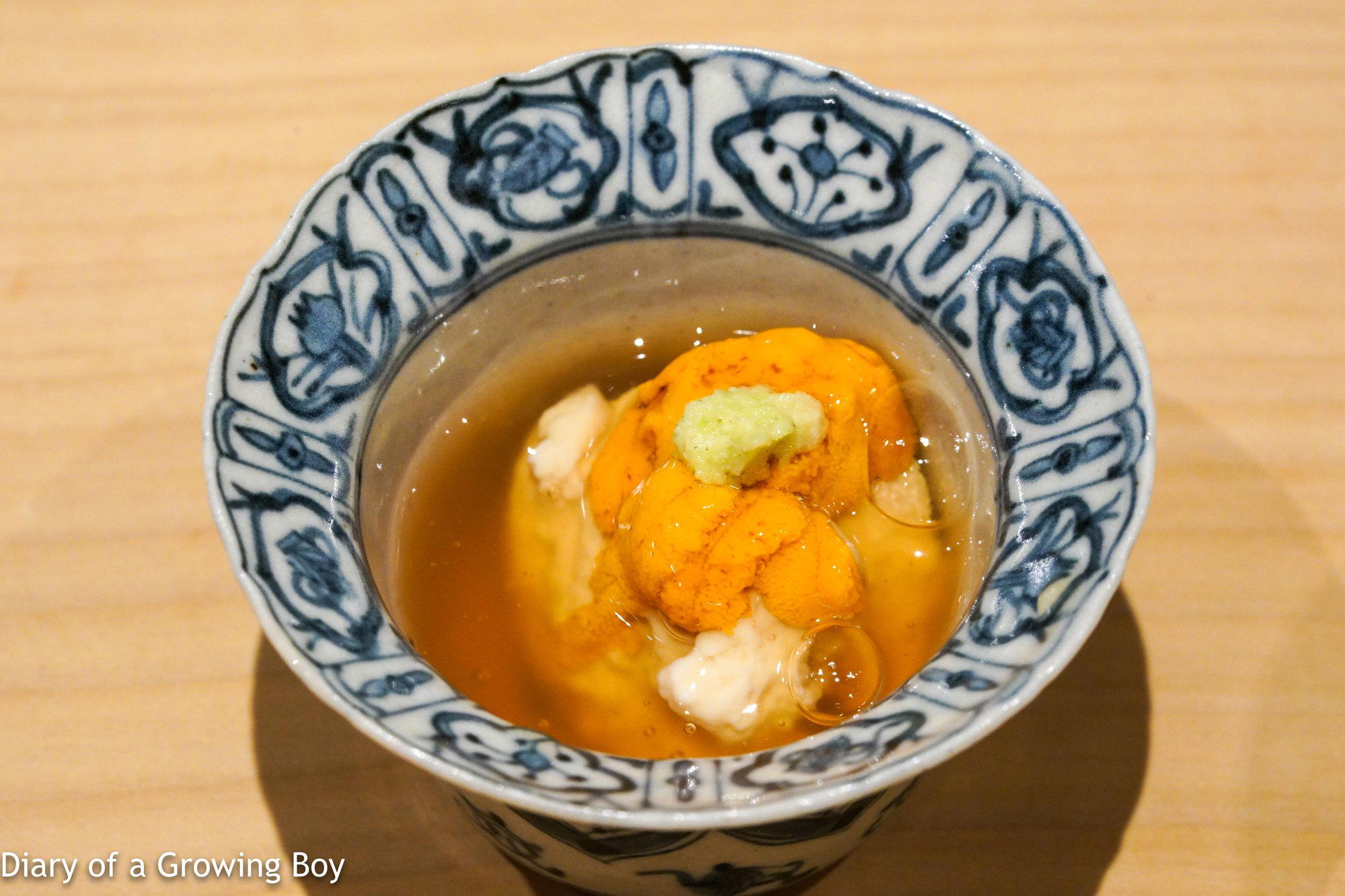
The menu
What to order
- Kokura-style squid nigiri
- Seasonal nigiri selection
A Counter in Kokura, and the Logic of Surrender
The second floor of a low-rise building on Uomachi's side streets is not where most international visitors expect to find one of Kyushu's most persistently decorated sushi counters. Kokura, the commercial hub of Kitakyushu, earns less culinary press than Fukuoka City to the south, yet the recognition attached to this address has been building for years. Tsubasa holds a Tabelog score of 4.06 — a threshold that places it inside the upper tier of Japan's most exacting peer-reviewed dining database — and has received the Tabelog Bronze Award in four separate years: 2019, 2020, 2025, and 2026. It has also been selected for the Tabelog Sushi WEST 100 list in 2021, 2022, and 2025. The Opinionated About Dining ranking placed it at No. 397 among Japan's leading restaurants in 2024. These are not single-cycle anomalies; the pattern across seven years of recognition describes a counter that has maintained standards through changes in the wider dining market.
Understanding what that consistency means requires thinking about what omakase actually asks of a diner. The format is built on a transfer of authority: you arrive, you sit, and the chef determines what you eat, in what order, at what pace. There is no menu to negotiate, no substitutions to engineer, no personal curation. What you receive reflects the chef's reading of the season, the market, and the individual service. That contract demands trust, and trust at this level demands a track record. At Tsubasa, the award history and Tabelog scoring function as that record made visible.
Eight Seats, Two Services, One Standard
The counter runs to eight seats at dinner and six at lunch, a configuration common among serious omakase operations in Japan, where the chef's direct oversight of every plate depends on keeping the room small enough to manage without delegation. This is not a stylistic choice in the boutique-hotel sense; it is a practical constraint that defines the product. At counters of this size, the pacing of the meal, the temperature of the rice, and the sequencing of courses from lighter to more intensely flavoured pieces all sit within the chef's direct control. Scale beyond a certain point and that control erodes.
Service runs Monday, Friday, Saturday, and Sunday for both lunch (12:00–14:00) and dinner (18:00–22:00). Thursday is dinner-only. The counter is closed Tuesday and Wednesday, a schedule adjustment that took effect in April 2024 and also brought the return of Thursday dinner service. Reservations are accepted exclusively through Pocket Concierge, which allows online booking around the clock. Credit cards are accepted (VISA, Mastercard, JCB, AMEX, Diners); electronic money and QR code payments are not. The counter is non-smoking throughout the main dining space, with a separate smoking room available.
Both the lunch and dinner omakase are priced in the JPY 20,000–29,999 range per person according to Tabelog review data, a band that positions Tsubasa firmly within the mid-to-upper tier of Japan's omakase market, below the rarefied JPY 40,000-plus counters that define Tokyo's most expensive sushi rooms but well above the entry-level omakase that populates the JPY 8,000–15,000 bracket. Within Kyushu, that price point signals serious intent. It is consistent with what comparable counters in Fukuoka City and across western Japan charge for premium nigiri with provenance-focused ingredient sourcing.
The pricing is also notable for its parity between lunch and dinner, a pattern that reflects how omakase counters of this calibre operate. Unlike kaiseki restaurants, where lunch is often a trimmed version of the evening menu offered at a discount, premium sushi counters frequently charge equivalently for both services because the core product, chef time, the leading fish available that day, and a structured sequence of nigiri, does not substantially change with the hour. Diners who find evening reservations difficult to secure will not receive a lesser experience at lunch; the seat count (six versus eight) is actually smaller, making the midday service, in some respects, more concentrated.
For regional comparison within the Kitakyushu sushi scene, Teruzushi represents another highly recognised counter in the city. Further afield, the Kyushu dining circuit connects to the broader western Japan scene through counters in Fukuoka such as Goh in Fukuoka, and the national reference points for sushi at this level include Harutaka in Tokyo, Sushi Shikon, Sushi in Hong Kong, and Shoukouwa, Sushi in Singapore, all of which occupy the upper register of omakase pricing and recognition in their respective cities.
Sake, Wine, and Bringing Your Own
The drinks list reflects priorities common among serious omakase counters: sake is the primary pairing vehicle, and the house takes a considered approach to nihonshu selection. Shochu and wine are also available. The counter allows guests to bring wine not available on the list, with a corkage fee starting at JPY 5,500 per bottle, with the caveat that red wine is not permitted. This is worth noting for guests who travel with a specific white or sparkling bottle in mind: the policy is accommodating, but the parameters should be confirmed by phone in advance, particularly if bringing multiple bottles, as fees vary accordingly.
The restriction on red wine is not unusual at sushi counters of this style. Tannins in red wine are widely considered to conflict with the delicate flavour profile of high-grade fish, and chefs who have built their menus around nigiri sequence and rice temperature tend to be particular about what sits alongside the food. White Burgundy, grower Champagne, and structured German Rieslings are the most common guest-supplied pairings at comparable operations.
Getting There and Booking Logistics
Counter occupies the second floor of Shinmaitani Building in Uomachi, Kokurakita Ward, an address described as an eight-minute walk from Kokura Station and approximately 128 metres from Heiwa Dori. Kokura Station connects directly to Hakata (Fukuoka City) on the Sanyo Shinkansen in under twenty minutes, making this counter accessible as a day-trip or evening destination for guests based in Fukuoka. There is no parking at the venue. Reservations must be made through Pocket Concierge; no walk-ins are accommodated, and the reservation-only format means availability, particularly at weekends, moves quickly. Planning several weeks ahead is standard practice at counters with this level of consistent recognition.
Kitakyushu's dining scene extends well beyond sushi. For those building a full itinerary, the city's broader restaurant landscape includes Nikaku, Terasawa, Terroir Aitoibukuro, and TOBIUME. For a fuller picture of the city's food, drink, and accommodation options, see [our full Kitakyushu restaurants guide](), [our full Kitakyushu hotels guide](), [our full Kitakyushu bars guide](), [our full Kitakyushu wineries guide](), and our full Kitakyushu experiences guide. Western Japan's broader fine dining circuit also includes HAJIME in Osaka, Gion Sasaki in Kyoto, akordu in Nara, and 1000 in Yokohama.
Frequently asked questions
Who is the chef or culinary lead at Tsubasa?
The chef associated with Tsubasa is Tsubasa Otan.
Where is Tsubasa in Kitakyushu?
Tsubasa is located at Japan, 〒802-0006 Fukuoka, Kitakyushu, Kokurakita Ward, Uomachi, 3 Chome−3−24 新米谷 2階, Kitakyushu.
What's the best thing to order at Tsubasa?
The question doesn't apply in the conventional sense: Tsubasa operates as a reservation-only omakase counter, meaning the chef determines the full sequence for every guest. Both lunch and dinner are priced in the JPY 20,000–29,999 range per person according to Tabelog review data.
What are the opening hours for Tsubasa?
Hours at Tsubasa: Mon, Thu, Fri, Sat, Sun 12:00 - 14:00 18:00 - 22:00.
Peers Worth Knowing
| Venue | Cuisine | Price | Awards | Notes |
|---|---|---|---|---|
| TsubasaThis venue (the venue you are viewing) | Kokura-Style Sushi | $50–100 | Tabelog Bronze #481 | Not listed |
| Teruzushi | Entertainment Sushi | $300–500 | Tabelog Bronze #459 · The Best Chef One Knife | Sushi |
| Nikaku | Edomae Sushi | $150–200 | Tabelog 100 #73 | Not listed |
| Terasawa | Traditional Japanese Fine Dining | Not listed | Tabelog Bronze #457 | Not listed |
| Terroir Aitoibukuro | Modern Japanese Tasting Menu | Not listed | Tabelog Bronze #458 | Not listed |
| TOBIUME | Modern Kaiseki | Not listed | Tabelog Silver #142 | Not listed |
Recognition history
Dated appearances from independent guides and award organizations, with the underlying list record or original source where available.
Opinionated About Dining Top Restaurants in Japan Recommended
Opinionated About Dining
Tabelog Bronze #481
Tabelog
Full recognition history (5 entries)
Tabelog 100 #52 · No. 52
Tabelog · Tabelog 100 - Sushi - WEST - 2025
Tabelog Bronze
Tabelog
Opinionated About Dining Top Restaurants in Japan Ranked #397
Opinionated About Dining
Tsubasa
Featured Guides
Continue exploring
More in Kitakyushu
Restaurants in Kitakyushu
All restaurants in Kitakyushu →
Bars in Kitakyushu
Browse all →
Details
- Elegant
- Intimate
- Quiet
- Sophisticated
- Special Occasion
- Solo
- Date Night
- Chefs Counter
- Open Kitchen
- Sake Program
- Local Sourcing
- Sustainable Seafood
- Omakase
- Counter Dining
- Sake
- Wine
- Pescatarian Friendly
Current opening hours
- Monday
- 12–3 PM, 6–10 PM
- Tuesday
- Closed
- Wednesday
- Closed
- Thursday
- 12–3 PM, 6–10 PM
- Friday
- 12–3 PM, 6–10 PM
- Saturday
- 12–3 PM, 6–10 PM
- Sunday
- 12–3 PM, 6–10 PM
Hours can change for holidays and private events. Last verified .
Soft lighting in a sukiya-style space designed by a Kyoto-trained tea-house carpenter, featuring natural materials like wood and woven mats that create a warm, intentional atmosphere focused on the food.