At Porta Romana's edge, Trippaio Albergucci Mario occupies a specific and shrinking tier in Florence's street food culture: the working tripperia, where offal is the point and the audience is local. Florence's tradition of lampredotto and tripe sandwiches has few remaining practitioners at this level of neighbourhood authenticity, placing this address in a comparable set defined by geography and habit rather than awards or reservation systems.
Pearl is the En Primeur Club membership app — saves, bookings, and concierge access live there. Same editors, same standards.
- Address
- Piazzale di Porta Romana, 50124 Firenze FI, Italy
- Directions
- Get directions
 Saves & bookings on Pearl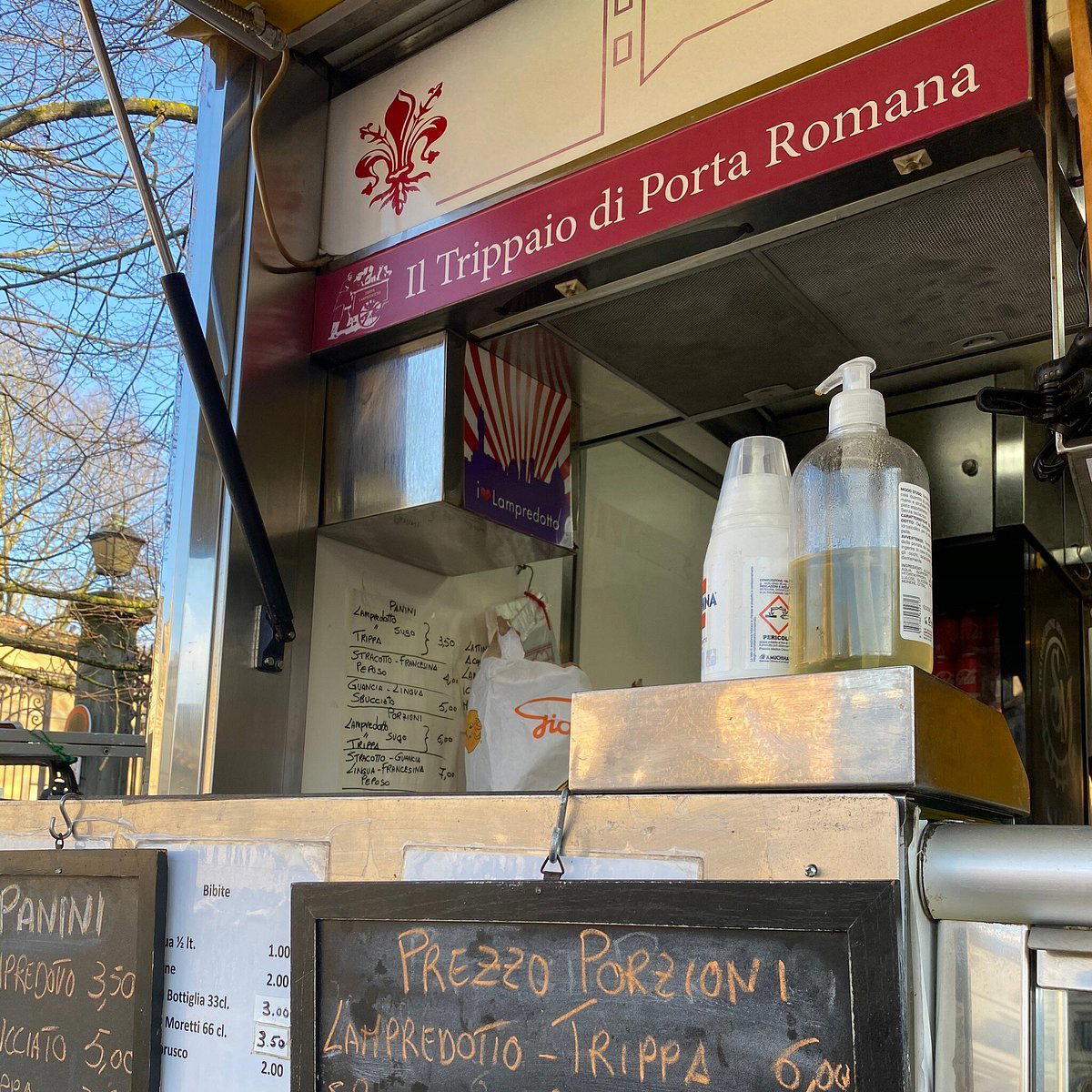
Where Florence's Offal Tradition Still Has a Street Corner
Piazzale di Porta Romana sits at one of Florence's old city gates, where the Oltrarno quarter meets the southern road out toward Siena. The piazzale is functional rather than scenic: tram lines cross it, morning commuters move through it, and the market energy here is nothing like the curated tourism of Piazza della Repubblica or the gold-merchant gravity of the Ponte Vecchio end of the river. This is one of the reasons a tripperia survives here when so many have closed across the city centre. The clientele at addresses like Trippaio Albergucci Mario is drawn from the neighbourhood's daily rhythm, not from the itinerary of a weekend visitor.
Florence's relationship with offal is among the more specific in Italian regional cooking. Lampredotto, the fourth stomach of the cow, slow-cooked in broth and served in a bread roll with salsa verde or a spicy pepper sauce, is a dish that exists almost nowhere outside Florence with any seriousness. Tripe, in its Florentine preparation, is braised with tomato and often finished with Parmigiano. These are not dishes that travel well into fine-dining menus, and they are not dishes that survive well without a committed local audience. The tripperia format, typically a street cart or a small standing counter with no seats and a short menu, is the only context in which they make complete sense. It is a format under pressure in the historic centre, where commercial rents and tourist throughput have pushed several long-running carts into closure or relocation.
The Booking Question (Which Does Not Apply Here)
The editorial angle that governs much of Florence's higher-end dining simply inverts at a place like Trippaio Albergucci Mario. The difficulty is not getting in; it is knowing when to arrive. Trippe and lampredotto operations run on the rhythm of the product: the cooking starts early, the supply is finite, and when it is gone, service ends. There is no reservation system, no website to cross-reference, and no phone number that connects you to a booking interface. The planning required is of a different kind: knowing the neighbourhood, knowing the format, and arriving with enough morning or lunchtime to catch what is being served.
This is, in its own way, a more demanding form of logistics than the three-month forward-booking window that governs the counter at a Michelin-starred omakase or the seasonal allocation system at a high-end winery. At venues like Enoteca Pinchiorri or Santa Elisabetta, the planning is calendar-based and confirmable. Here it is situational. The reader who wants to eat well at this tier of Florentine food culture needs to understand the city's street food operating logic, not its restaurant reservation infrastructure.
The Tripperia Within Florence's Dining Spread
Florence's dining scene in the €€€€ bracket includes several prominent addresses. Atto di Vito Mollica, Borgo San Jacopo, and Gucci Osteria da Massimo Bottura all operate in a city where the premium dining tier has consolidated around a handful of addresses with strong international recognition. What that concentration makes visible is the contrast at the other end of the register: the informal, cash-transacted, stand-and-eat operations that predate the city's gastronomic prestige economy by centuries.
Its peers are not restaurants; they are the other remaining street-food formats in Florence's edgier and more residential quarters, the mercato operators, the schiacciata sellers, and the few surviving lampredotto carts that have not yet been displaced into obscurity. The reference frame for evaluating a tripperia is consistency, neighbourhood embeddedness, and whether the product itself holds up. Italy's fine-dining tradition is documented across addresses like Osteria Francescana in Modena, Piazza Duomo in Alba, and Le Calandre in Rubano, but the working tripperia belongs to a parallel and older lineage that those venues consciously reference rather than replace.
Porta Romana as a Frame
The address at Piazzale di Porta Romana places Trippaio Albergucci Mario at one of Florence's natural transitions. South of the Arno, the Oltrarno has attracted sustained attention for its workshops, its less-visited museum holdings, and its more residential commercial strips, but Porta Romana itself is a functional threshold rather than a destination. Addresses that operate here do so because the neighbourhood supports them, not because the location draws passing visitor trade. That dynamic is part of what sustains a working tripperia: the customer base is returning, not discovering.
For a visitor planning to eat at this address, the practical implications are real. Porta Romana is reachable on foot from the historic centre in roughly fifteen to twenty minutes from the south bank of the Arno, or via tram connection. The timing of any visit should account for the likelihood that service concludes when the day's supply is exhausted. There is no advance booking mechanism. The format requires presence, not planning, but the presence needs to be timed.
What This Format Teaches About Italian Regional Food
The tripperia format is one of the clearest examples in Italian food culture of a dish that resists migration. Lampredotto does not translate easily onto a tasting menu without losing the character that makes it worth eating. It is a street food in the structural sense: it was developed for quick service, consumed standing or walking, and priced for daily repetition by working people. The few times it has appeared in more formal contexts, including at addresses referencing cucina povera in the tradition of Reale in Castel di Sangro or Uliassi in Senigallia, it tends to appear as a reference or a riff rather than in its working form.
Eating at a place like Trippaio Albergucci Mario is not a substitute for Florence's high-end dining, nor is it in competition with it. The two categories operate on different terms and serve different purposes in the city's food culture. Visitors who understand both registers will find that Florence rewards that range more than most Italian cities. The full picture of what the city eats spans formal dining rooms and street-level formats that define the city's working food identity. Dal Pescatore in Runate and Quattro Passi in Marina del Cantone to Atelier Moessmer Norbert Niederkofler in Brunico and Enrico Bartolini in Milan, with the full international comparison available through Le Bernardin in New York and Lazy Bear in San Francisco.
Same-City Peers
Comparable venues nearby, for context on price, style, and recognition.
| Venue | Cuisine | Price | Notes |
|---|---|---|---|
| Trippaio Albergucci MarioThis venue — the venue you are viewing | Florentine Tripe and Lampredotto Street Food | $ | Not listed |
| Trattoria Sabatino | Authentic Tuscan Trattoria | $ | San Frediano |
| Ristorante Ricchi | Traditional Tuscan Italian | $$ | Santo Spirito |
| Trattoria Sergio Gozzi | Traditional Tuscan Trattoria | $$ | Santo Spirito |
| Ino | Tuscan Artisanal Panini | $ | San Niccolo |
| Gustapizza | Neapolitan Pizza | $ | Santo Spirito |
Continue exploring
More in Florence
Restaurants in Florence
Browse all →
Bars in Florence
Browse all →
Hotels in Florence
Browse all →
At a Glance
- Rustic
- Lively
- Casual Hangout
- Standalone
- Street Scene
Current opening hours
- Monday
- 9 AM–3 PM
- Tuesday
- 9 AM–3 PM
- Wednesday
- 9 AM–3 PM
- Thursday
- 9 AM–3 PM
- Friday
- 9 AM–3 PM
- Saturday
- 9 AM–3 PM
- Sunday
- Closed
Hours can change for holidays and private events. Last verified .