

1 Michelin Star · Michelin Guide 2 Stars · La Liste Top Restaurants
Our verdict
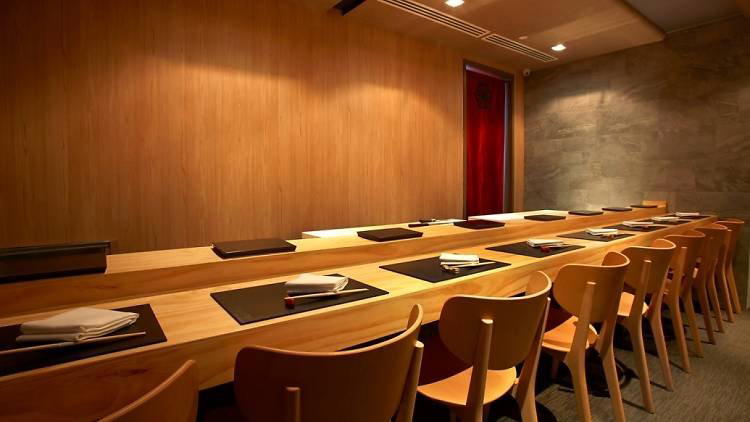
Sushi Sakuta holds a Michelin star and a La Liste Top Restaurants score of 75 points, placing it firmly within Singapore's serious omakase tier. The counter sits inside Millenia Walk at Marina Bay, a neighbourhood that has quietly become one of the city's more concentrated addresses for high-calibre Japanese dining. For those tracking the transmission of Edomae discipline outside Japan, it is a substantive stop.

Pearl is the En Primeur Club membership app, where members save venues, book tables and use the concierge.
The menu
What to order
- Snow Crab Chawanmushi
- Steamed Abalone with Abalone Liver Sauce
- Sea Urchin Nigiri
- Torotaku Handroll
Where the Shokunin Tradition Lands in Singapore
Singapore's omakase circuit has matured considerably over the past decade. What began as a handful of Japanese-chef-led counters serving an expatriate clientele has become a layered, competitive tier with real depth, Michelin recognition, La Liste placement, and a local dining public that understands the difference between a competent nigiri and one shaped by years of apprenticeship under a demanding master. Shoukouwa, Hamamoto, and Sushi Ichi occupy the upper reaches of that tier; Sushi Sakuta sits in the same bracket, holding one Michelin star since 2024 and a La Liste Leading Restaurants score of 75 points for 2026.
The address, 9 Raffles Boulevard, inside Millenia Walk, places the counter in the Marina Bay precinct, a district that functions as something of a proxy for Singapore's premium hospitality ambitions. The surroundings are polished rather than intimate, but the counter itself operates on the logic of contraction rather than spectacle: a focused format, a fixed menu, and the kind of measured pace that demands the diner's full attention rather than competing for it.
The Shokunin Inheritance: Why Lineage Still Matters
In Edomae sushi, the apprenticeship model is not merely biographical detail. It is the mechanism through which a specific technical vocabulary, the angle of the knife through yellowtail, the precise temperature at which rice is pressed, the duration of marination for kohada, gets transmitted intact across generations. Counters that carry credible lineage from named Tokyo houses do not simply carry prestige; they carry a working method that has been pressure-tested across decades and thousands of services.
That tradition runs deep in Tokyo's top tier. Sushi Kanesaka and Sukiyabashi Jiro Roppongiten represent the kind of institutional mastery from which many of Asia's serious omakase practitioners have drawn their formation. Edomae Sushi Hanabusa and Harutaka extend that lineage further into Tokyo's current top tier. The point is that Edomae is not a style applied decoratively; it is a discipline absorbed slowly, corrected repeatedly, and expressed through consistency rather than creativity for its own sake.
When a counter outside Japan achieves Michelin recognition in this category, the implicit endorsement is of that transmission, that what arrives on the hinoki before the diner in Singapore is not an approximation of the Tokyo experience but a genuine extension of it. Sushi Sakuta's 2024 star is, in that context, a claim about technical fidelity as much as palatability.
Singapore's Omakase Tier: Where Sushi Sakuta Sits
Sushi Ashino and Sushi Hare operate in related territory; across the region, Sushi Shikon in Hong Kong and HANE in Seoul represent the broader Asian-city tier that serious Edomae counters now occupy. Even Sushi Sho in New York demonstrates how the form travels when executed with sufficient seriousness. Sushi Harasho in Osaka anchors the Kansai end of the comparison set.
Against that field, Sushi Sakuta's dual recognition, Michelin star alongside La Liste placement, signals something more durable than a single guide's endorsement. La Liste aggregates critical opinion across multiple sources; a 75-point score in 2026 places the counter among establishments that sustain quality over time rather than spike into visibility and fade. Singapore's dining scene tends to reward that consistency, particularly at the $$$$ price point where diners are comparing against the full regional competitive set on every booking decision.
The Marina Bay location is worth considering in context. Singapore's premium dining does not cluster in a single neighbourhood the way Tokyo's does in Ginza, but Millenia Walk has developed a quiet density of Japanese-led fine dining that makes the precinct a logical starting point for a serious evening. The address lacks the residential intimacy of a converted shophouse in Tanjong Pagar, but it compensates with logistics: proximity to major hotels, easy transit access, and the kind of commercial-grade infrastructure that supports smooth, high-volume service without visible friction.
What the Format Asks of the Diner
Omakase at this level operates as a contract between the counter and the guest. The chef sequences the meal; the diner surrenders the menu. That dynamic works well when the pacing is calibrated and the dialogue between the two sides of the counter is natural rather than performative. Singapore's better counters have become accomplished at this, less theatrical than some Tokyo originals, more conversational than a strict Ginza template would allow, reflecting a local dining culture that is technically knowledgeable but sociable rather than reverential.
At the $$$$ price tier, the practical expectation is a multi-course omakase in which each piece arrives individually, rice temperature is managed actively, and the sequence moves through lighter preparations toward richer cuts before resolving in tamago and something sweet. They do it through reliability at a level where guests are predisposed to apply high standards.
Planning Your Visit
Sushi Sakuta is located at 9 Raffles Boulevard, #01-06/07/08 Millenia Walk, Singapore 039596, in the Marina Bay precinct, accessible from Promenade MRT. Reservations: At this price point and recognition level, advance booking is standard practice for Singapore's starred omakase counters; contact the restaurant directly or through available reservation platforms, and expect to plan several weeks ahead, particularly for weekend sittings. Budget: $$$$, position alongside the city's top-tier omakase counters; per-head spend will reflect a full multi-course format with optional beverage pairing. Awards: Michelin 1 Star (2024); La Liste Leading Restaurants 75 points (2026). Dress: Smart casual is the working standard across Singapore's $$$$ Japanese counters; the Marina Bay location skews toward business-adjacent presentation.
For broader planning, see our full Singapore restaurants guide, our full Singapore hotels guide, our full Singapore bars guide, our full Singapore wineries guide, and our full Singapore experiences guide.
Frequently asked questions
What distinctions does Sushi Sakuta have?
Sushi Sakuta has received recognition including: La Liste Top Restaurants (2026): 75pts; Michelin 1 Star (2024).
What dish is Sushi Sakuta famous for?
Sushi Sakuta operates as an omakase counter, meaning the chef sequences every course and no single dish anchors the menu by design. The Edomae tradition that underpins the format places nigiri craftsmanship at the centre of each sitting. Michelin awarded the counter a star in 2024, and La Liste placed it in their Top Restaurants list for 2026 with 75 points, both recognitions tied to the overall counter experience rather than any one plate.
What should I budget for a meal at Sushi Sakuta?
Pricing at Sushi Sakuta is listed as $$$$.
What's the address for Sushi Sakuta?
Sushi Sakuta is located at 9 Raffles Blvd, #01-06/07/08 Millenia Walk, Singapore 039596, Singapore.
Is Sushi Sakuta reservation-only?
Omakase counters at this tier in Singapore, Michelin-starred, with La Liste recognition, operate on reservations as a practical necessity: the chef sequences a fixed number of covers per service and ingredient orders are placed accordingly. Walk-in availability at Sushi Sakuta is not documented, so booking ahead is the reliable approach. The restaurant is located at 9 Raffles Boulevard, #01-06/07/08 Millenia Walk, Singapore 039596.
What makes Sushi Sakuta worth seeking out?
The Edomae format places technical discipline, not spectacle, at the centre of the meal. At the $$$$ price point, it sits alongside the city's most demanding omakase commitments, but the credentials justify that bracket.
Cuisine and Recognition
| Venue | Cuisine | Price | Awards | Notes |
|---|---|---|---|---|
| Sushi SakutaThis venue (the venue you are viewing) | Edomae-style Omakase | $500+ | 1 Michelin Star · Michelin Guide 2 Stars | Not listed |
| Zén | Yakitori & Japanese Izakaya | $50–100 | Tabelog 100 #92 | European Contemporary |
| Jaan by Kirk Westaway | Modern British Fine Dining | $200–300 | 2 Michelin Stars · Michelin Guide 2 Stars | British Contemporary |
| Burnt Ends | Modern Australian Barbecue | $100–150 | 1 Michelin Star · Michelin Guide 1 Star | Australian Barbecue, Barbecue |
| Summer Pavilion | Michelin-Starred Cantonese | $100–150 | 1 Michelin Star · Michelin Guide 1 Star | Cantonese |
| Born | Contemporary Fusion Fine Dining | $200–300 | 1 Michelin Star · Michelin Guide 1 Star | Creative Cuisine, Innovative |
Recognition history
Dated appearances from independent guides and award organizations, with the underlying list record or original source where available.
Michelin 1 Star
Michelin
Michelin Guide 2 Stars
Michelin Guide
La Liste Top Restaurants
La Liste