
Black Pearl 1 Diamond
Our verdict
Sushi Ryu holds a Black Pearl 1 Diamond (2025) in Beijing's Wudaokou district, placing it among a small tier of Japanese counter-dining addresses the city's recognition guides consider award-worthy. Located on Chengfu Road in Haidian, it operates in a neighbourhood better known for universities than omakase, which makes its critical standing more pointed. For precision Japanese dining outside the central CBD cluster, it represents a deliberate alternative.

Pearl is the En Primeur Club membership app, where members save venues, book tables and use the concierge.
The menu
What to order
- Edomae-style nigiri
- Seasonal sashimi platter
- Chu-toro
Japanese Counter Dining in Beijing: Where Sushi Ryu Fits
Beijing's Japanese restaurant scene has split into two legible tiers over the past decade. The first occupies the central hotel corridors and Sanlitun high-rises, where Japanese cuisine is packaged for corporate expense accounts and serviced-apartment clientele. The second, smaller tier has pushed outward, into residential and academic neighbourhoods, where the format tends to be tighter, the seating more limited, and the critical recognition harder-won. Sushi Ryu, on Chengfu Road in Wudaokou, belongs to that second category. Its 2025 Black Pearl 1 Diamond award places it on a recognised tier of Chinese fine-dining certification that is applied across cuisine types, and its presence in Haidian rather than Chaoyang says something specific about where serious Japanese dining in Beijing is now finding ground.
The Black Pearl Guide, published by Meituan and now in its seventh year, functions as China's most widely read domestic fine-dining reference, covering Chinese and international cuisines with a structure that runs from 1 Diamond through 3 Diamond. For a Japanese counter in a district not traditionally associated with premium dining, that recognition carries more weight than the tier number alone suggests.
Wudaokou and the Meaning of Location
Wudaokou's identity is shaped by its proximity to Peking University, Tsinghua University, and a cluster of international student populations that have made it one of Beijing's more culturally layered neighbourhoods. Korean restaurants, ramen counters, and casual izakayas dominate street level here. A destination-grade sushi counter operating in that context is not making a commercial calculation toward volume; the surrounding foot traffic does not naturally produce omakase clientele. That positioning implies a deliberate draw model, one where the guest travels to the address rather than arriving by proximity.
This mirrors a pattern visible in other Asian cities, where premium Japanese counters have found that separation from the luxury-hotel corridor can actually reinforce perceived exclusivity. Comparable examples exist in Seoul's Mapo district and Osaka's Fukushima ward, where small-format Japanese restaurants with strong critical backing operate at a remove from tourist infrastructure and remain known primarily through word-of-mouth and guide recognition. Sushi Ryu's Haidian address fits that logic.
The Cultural Stakes of Japanese Cuisine in China
Japan-China food exchange runs in both directions and has done so for centuries, but the contemporary market for high-end sushi in China's tier-one cities is a more recent construction. Through the 2010s, Japanese omakase counters in Beijing and Shanghai operated largely as luxury-import experiences, appealing to returnees, expats, and a domestic upper tier that treated the format as a signal of cosmopolitan taste. That framing has shifted. By the mid-2020s, Black Pearl's inclusion of Japanese venues alongside Cantonese, Shanghainese, and Sichuan restaurants in its ratings framework signals that Japanese fine dining has been absorbed into China's broader premium dining identity rather than treated as a foreign category.
For a venue like Sushi Ryu, that matters because it changes the competitive set. The relevant comparison is no longer only other Japanese restaurants in Beijing. It is every Black Pearl Diamond-rated restaurant the city produces, across cuisine types. In that context, sharing award space with addresses like Xin Rong Ji (Xinyuan South Road) for Taizhou cuisine and Chao Shang Chao (Chaoyang) for Chao Zhou cooking is a meaningful positioning marker. These are serious, citation-heavy Chinese restaurants. Being measured in the same index is a different kind of recognition than sitting atop a category-specific Japanese list.
Other Beijing restaurants in that recognised tier span formats and philosophies: Lamdre has built a case for vegetarian fine dining, Jingji holds ground for Beijing cuisine, and King's Joy represents the point where Chinese vegetarian cooking meets luxury format. Sushi Ryu's inclusion in the same critical conversation reflects how thoroughly the guide treats cuisine diversity as a given rather than a differentiator.
What the Format Implies
Counter sushi at the recognised level operates on specific structural principles regardless of city. The kitchen produces to order, often through a sequential omakase format where the chef determines progression. The interaction between guest and chef is part of the product. Seating is limited by the counter itself, which creates natural capacity constraints and, in most cases, advance booking requirements. These mechanics hold across contexts, from Ginza to Singapore to Beijing, and they shape what a visit actually involves as a planning decision.
Comparisons extend beyond China's borders when assessing what this format demands of its practitioners. Venues like Le Bernardin in New York City and Atomix in New York City illustrate how demanding sequential fine-dining formats can be at the highest certification levels, even in markets with deep talent pipelines. Within China, the range of serious fine-dining formats is also expanding: 102 House in Shanghai, Ru Yuan in Hangzhou, and Xin Rong Ji in Chengdu each demonstrate that sequential, high-commitment dining formats are finding mature markets in cities across the country. Further afield, Chef Tam's Seasons in Macau, Imperial Treasure Fine Chinese Cuisine in Guangzhou, and Dai Yuet Heen in Nanjing extend that picture across the region.
Planning a Visit
Sushi Ryu is at 45 Chengfu Road, Wudaokou, Haidian District, with the postal code 100190. Wudaokou is served by Line 13 of the Beijing subway, making access from central areas direct. Given the counter format and the Black Pearl recognition, advance booking is the expected approach rather than walk-in dining; contacting the restaurant directly for reservation logistics is recommended.
Venue Comparison at a Glance
| Venue | Cuisine | Price Range | Recognition |
|---|---|---|---|
| Sushi Ryu | Japanese (Sushi) | N/A | Black Pearl 1 Diamond (2025) |
| Xin Rong Ji (Xinyuan South Road) | Taizhou | ¥¥¥¥ | Black Pearl recognised |
| Chao Shang Chao (Chaoyang) | Chao Zhou | ¥¥¥¥ | Black Pearl recognised |
| Lamdre | Vegetarian | ¥¥¥¥ | Black Pearl recognised |
| Jingji | Beijing Cuisine | ¥¥¥¥ | Black Pearl recognised |
For broader context on where Sushi Ryu sits within Beijing's dining geography, see our full Beijing restaurants guide. If you are planning a wider trip, our full Beijing hotels guide, our full Beijing bars guide, our full Beijing wineries guide, and our full Beijing experiences guide cover the full range of the city's premium options.
Frequently asked questions
Where do I go for Sushi Ryu?
Sushi Ryu is located at 45 Chengfu Rd, Wudaokou, Haidian District, Beijing, China, 100190, Beijing.
What awards or recognition does Sushi Ryu have?
Sushi Ryu has received recognition including: Black Pearl 1 Diamond (2025).
What dish is Sushi Ryu famous for?
The Black Pearl 1 Diamond (2025) recognises the counter experience as a whole rather than a single signature piece. At sushi counters operating at this award level, the format is typically omakase, a chef-directed sequence where the kitchen sets the progression. No individual dish has been singled out in available critical documentation.
Can I walk in to Sushi Ryu?
Walk-ins are rarely possible at counter-format restaurants holding Black Pearl recognition in Beijing. Sushi Ryu is at 45 Chengfu Road, Wudaokou, and the counter structure inherent to this format means covers are finite and allocated in advance. Booking ahead through the venue's current reservation channel is the only reliable approach.
What do critics highlight about Sushi Ryu?
The documented critical signal is the Black Pearl 1 Diamond (2025), issued by China's most widely cited domestic fine-dining guide. That designation places Sushi Ryu among a select group of Japanese counters in Beijing that meet the guide's criteria for kitchen precision and overall dining consistency.
What if I have allergies at Sushi Ryu?
Counter sushi at the award level typically runs a set-menu format with limited substitution built into the sequence. Communicating allergies or dietary restrictions at the time of reservation, before the kitchen plans its course, is standard practice and gives the team the clearest opportunity to accommodate. Contact Sushi Ryu directly at 45 Chengfu Road, Wudaokou, to confirm their specific protocol before booking.
Cost Snapshot
Comparable venues nearby, for context on price, style, and recognition.
| Venue | Cuisine | Price | Awards | Notes |
|---|---|---|---|---|
| Sushi RyuThis venue (the venue you are viewing) | Modern Japanese Omakase | Not listed | Black Pearl 1 Diamond | Not listed |
| SUSHI ZEN | Modern Japanese Omakase | Not listed | Black Pearl 1 Diamond | Qianmendajie, Modern Japanese Omakase |
| Pure Lotus | Exquisite Modern Vegetarian Chinese | $50–100 | Not listed | Tuanjiehu, Precise Modern Vegetarian Chinese |
| JINGJI Aristocrat Cuisine by Rong | Royal Chinese Fine Dining | Not listed | Black Pearl 3 Diamond | Chaoyang District, Royal Chinese Fine Dining |
| ShengYongXing | Beijing Roast Duck | $50–100 | 1 Michelin Star · La Liste Top Restaurants | Sanlitun, Contemporary Beijing Cuisine with Signature Peking Duck |
| Made in China | Traditional Northern Chinese with Peking Duck | $50–100 | Not listed | Wangfujing, Traditional Northern Chinese with Peking Duck |
Recognition history
Dated appearances from independent guides and award organizations, with the underlying list record or original source where available.
Black Pearl 1 Diamond
Black Pearl
Full recognition history (2 entries)
Black Pearl 1 Diamond
Black Pearl
Continue exploring
More in Beijing
Restaurants in Beijing
All restaurants in Beijing →
Bars in Beijing
All bars in Beijing →

Details
- Intimate
- Elegant
- Quiet
- Sophisticated
- Special Occasion
- Date Night
- Chefs Counter
- Open Kitchen
- Sake Program
- Sustainable Seafood
- Omakase
- Counter Dining
- Sake
- Japanese Whisky
- Allergy Accommodating
Current opening hours
- Monday
- 11 AM–2 PM, 4:45–9:30 PM
- Tuesday
- 11 AM–2 PM, 4:45–9:30 PM
- Wednesday
- 11 AM–2 PM, 4:45–9:30 PM
- Thursday
- 11 AM–2 PM, 4:45–9:30 PM
- Friday
- 11 AM–2 PM, 4:45–9:30 PM
- Saturday
- 11 AM–2 PM, 4:45–9:30 PM
- Sunday
- 11 AM–2 PM, 4:45–9:30 PM
Hours can change for holidays and private events. Hours as of .
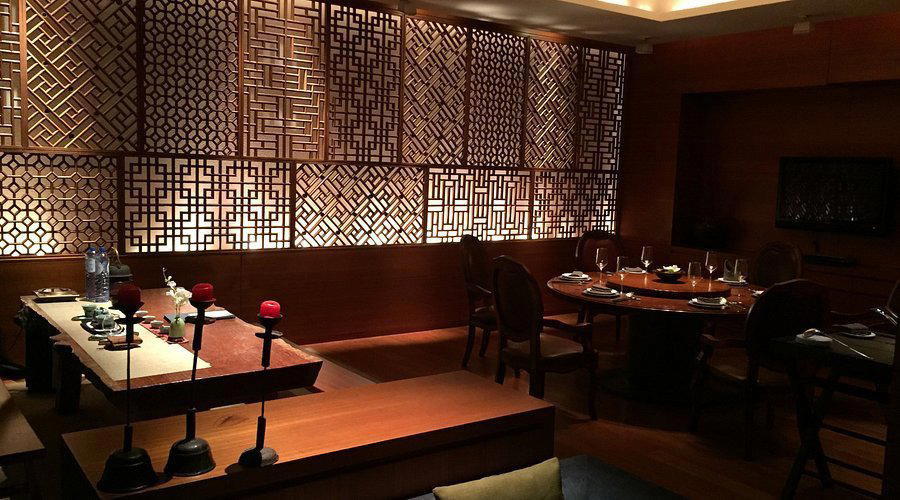
Warm, focused lighting directed at plates and knives; minimal decorative excess; counter-centric design emphasizing the chef-guest relationship without theatricality.