
Among Taipei's Michelin-recognised edomae counters, Sushi Kajin on Jilin Road distinguishes itself through direct sourcing from Tokyo's Toyosu Market and nearly three decades of craft at the counter. A Taiwanese cypress bar, Japanese lacquerware, and measured lighting create the material conditions for serious sushi. The 2025 Michelin Plate recognises a kitchen where fish aging and rice calibration receive the same attention as the catch itself.
Pearl is the En Primeur Club membership app — saves, bookings, and concierge access live there. Same editors, same standards.
- Address
- No. 28號, Jilin Rd, Zhongshan District, Taipei City, Taiwan 10491
- Phone
- +886 2 2581 8999
- Website
- sushi-kajin.com
- Directions
- Get directions
 Saves & bookings on Pearl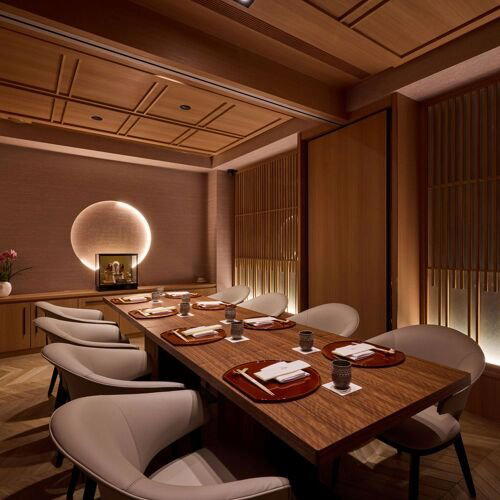
The Counter as a Considered Space
Sushi Kajin is a one-Michelin-star edomae omakase restaurant in Taipei's Zhongshan District, where a cluster of serious counters benchmarks itself against Tokyo peers rather than regional neighbours. Within that field, the physical environment at a counter tells you something about the programme before a single piece of nigiri arrives. At Sushi Kajin on Jilin Road, a Taiwanese cypress counter and Japanese lacquerware signal a deliberate calibration: local material sourcing for the room itself, Japanese discipline applied to everything inside it. The warm lighting sits low, keeping the focus on the counter and its work rather than the room's proportions.
This kind of environment is not incidental. Edomae traditions evolved in tight spaces where the chef's movements, the sequencing of fish, and the temperature of the rice were all legible to the guest. A well-designed counter makes that transparency possible. Sushi Kajin's material choices put it in company with counters that understand the room as part of the format, not just its backdrop. For the full spread of Taipei's high-end restaurant scene, our full Taipei restaurants guide maps the wider territory.
Toyosu Sourcing and What It Implies
The fish supply chain at any serious edomae counter is as important as the technique applied to it. The restaurant sources directly from Tokyo's Toyosu Market, the wholesale market that replaced Tsukiji in 2018 and now functions as the primary distribution hub for premium Japanese seafood. Flying product in from Toyosu rather than sourcing domestically is a deliberate positioning decision: it signals that the kitchen is building its programme against Japanese standards of ingredient quality, not Taiwanese ones. Taiwan has capable fish markets, and a handful of counters work with local Taiwanese catch to interesting effect, but the Toyosu route represents a particular philosophical commitment to the edomae canon.
The chef's near-30 years at the counter translates into a sourcing relationship built over time. Knowing which Toyosu vendors to trust for aged tuna, which seasonal fish warrant the flight cost, and how to adjust the programme week to week based on what arrives requires accumulated knowledge that cannot be shortcut. This kind of institutional depth is one of the signals that separates a working counter from a format being executed. Comparable sourcing commitments operate across the tier: Harutaka in Tokyo, Sushi Shikon in Hong Kong, and Shoukouwa in Singapore all operate within the same Toyosu-dependent framework that defines high-end edomae across the region.
The Team Dynamic: Aging, Rice, and Sequencing
Editorial angle that most honestly describes the restaurant is not sourcing or room design in isolation, it is the coordination of those elements into a coherent sequence. Edomae sushi at this level is a collaborative act even when a single chef dominates the narrative. The head chef handles the fish aging programme, the rice and vinegar calibration, and the pacing of the omakase sequence, but those decisions are executed within a front-of-house rhythm that dictates how the meal lands for the guest.
Fish aging at an edomae counter is one of the format's more technically demanding disciplines. Unlike the immediate-freshness model that dominates casual sushi, aging draws moisture from the flesh, concentrates umami, and allows connective tissue to break down. The specific timing varies by fish species, season, and the chef's intended result. Getting it wrong in either direction, under-aged or over-aged, produces a result that no amount of skilled knife work can fix. The 2025 Michelin star suggests the aging programme functions with consistency, not just on notable days.
Rice and vinegar calibration receives the same granular attention. The ratio of rice vinegar to sugar to salt in shari, the temperature at which rice is served, and the pressure applied when forming a piece of nigiri are all variables that a 30-year practitioner has spent decades refining. These are not touches that land for the first-time visitor as individual sensations, they read as an overall impression of the counter being in control. Spring and summer bring the kitchen's kohada to prominence: the fish, marinated in salt and vinegar, rewards a counter that has precise control over its curing times and seasoning levels. Kohada is considered a benchmark fish in the edomae canon precisely because there is nowhere to hide in its preparation.
Sushi Kajin in Taipei's Edomae Tier
Taipei's concentration of edomae counters means that a 2025 Michelin Plate sits within a competitive peer group. Counters such as Sushi Akira, Sushi Ryu, Qi 27 (Sushi 27), and Sasa all operate in the same price tier and draw from similar sourcing geographies. The differentiators within that group tend to be tenure, the chef's specific training lineage, and the consistency of the aging programme rather than dramatic differences in format. The restaurant's near-three-decade track record places it among the longer-established counters in the city.
The broader Taipei fine dining context includes counters from other Japanese traditions. Mudan Tempura operates in a related Japanese fine-dining register. Kitcho represents the kaiseki tradition. For Taiwanese and European contemporary, Taïrroir and logy define adjacent high-end categories. The sushi counter, however, occupies its own format logic: the omakase sequence, the direct relationship between chef and guest across the cypress bar, and the sourcing-to-plate transparency have no direct equivalent elsewhere in the city's fine dining field.
For visitors using Taipei as a base to explore Taiwan's wider food scene, the rest of the island offers distinct experiences: JL Studio in Taichung, GEN in Kaohsiung, A Cun Beef Soup in Tainan, and Akame in Wutai Township each map different aspects of Taiwanese culinary geography. Planning that broader circuit works well alongside our full Taipei hotels guide, our full Taipei bars guide, our full Taipei wineries guide, and our full Taipei experiences guide.
Know Before You Go
- Address: No. 28, Jilin Road, Zhongshan District, Taipei City, Taiwan 10491
- Price range: $$$$
- Awards: Michelin Plate (2025) 3 from 622 reviews
- Cuisine: Edomae sushi; omakase format
- Booking: Reservation recommended; contact details via venue directly
- Seasonal note: Spring and summer are one compelling season for the kohada programme
Compact Comparison
Comparable venues nearby, for context on price, style, and recognition.
| Venue | Cuisine | Price | Notes |
|---|---|---|---|
| Sushi KajinThis venue — the venue you are viewing | Zhongji, Edo-Style Omakase | $$$$ | Not listed |
| Sushi Akira | Qingguang, Edomae Sushi | $$$$ | Not listed |
| Eika | Not listed | $$$$ | Yanping, Modern Japanese Kappo with Taiwanese Influences |
| Ad Astra | Not listed | $$$$ | Zhongshan, Contemporary Japanese Omakase with Global Influences |
| Chuan Ya | Not listed | $$$$ | Xicun, Refined Sichuan Cuisine with Western Fine Dining Presentation |
| The Guest House | Not listed | $$$$ | Liming, Sichuan & Huaiyang Chinese with Taiwanese Elements |
Recognition history
Dated appearances from independent guides and award organizations, with the underlying list record or original source where available.
Michelin 1 Star
Michelin
Michelin 1 Star
Michelin
Continue exploring
More in Taipei
Restaurants in Taipei
Browse all →
Bars in Taipei
Browse all →
Hotels in Taipei
Browse all →
Wineries in Taipei
Browse all →
At a Glance
- Elegant
- Sophisticated
- Intimate
- Quiet
- Special Occasion
- Celebration
- Date Night
- Business Dinner
- Chefs Counter
- Open Kitchen
- Sake Program
- Sommelier Led
- Sustainable Seafood
- Local Sourcing
Current opening hours
- Monday
- 12–2:30 PM, 6–9:30 PM
- Tuesday
- 6–9:30 PM
- Wednesday
- 12–2:30 PM, 6–9:30 PM
- Thursday
- 12–2:30 PM, 6–9:30 PM
- Friday
- 12–2:30 PM, 6–9:30 PM
- Saturday
- 12–2:30 PM, 6–9:30 PM
- Sunday
- Closed
Hours can change for holidays and private events. Last verified .
Serene and refined with a soothing hinoki cypress wood aroma, spacious counter seating with warm lighting, and meticulous attention to detail in every element from tableware to plating.