



Taïrroir holds three Michelin stars and a 95-point La Liste ranking for 2026, placing it among Taipei's most decorated restaurants. Chef Kai Ho's nine-course tasting menu threads Taiwanese ingredients and cultural reference through French technique, with dishes named to echo local idioms and sourced from nearby producers. The dining room on Lequn 3rd Road is framed by a copper tile ceiling that signals the kitchen-forward intent before a single course arrives.
 Discover on Pearl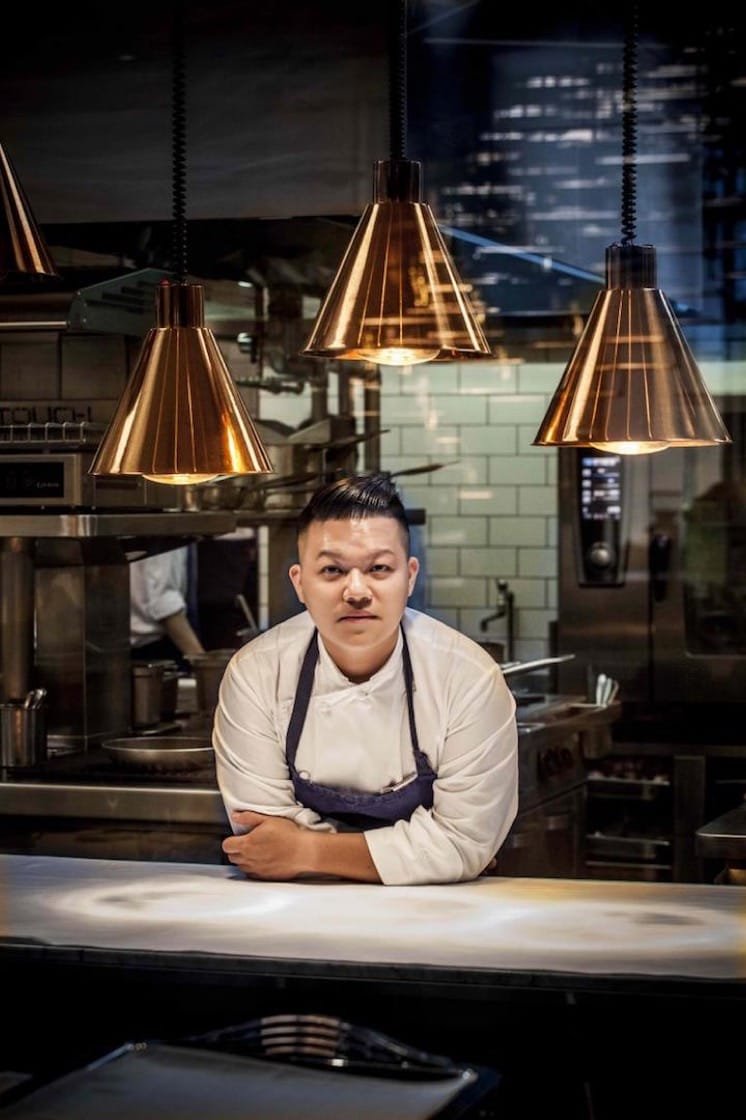
A Ceiling of Copper and a Menu Built on Memory
The sixth floor of a Zhongshan District address is an unlikely setting for one of Taiwan's most architecturally deliberate dining rooms, but the logic becomes clear the moment you look up. A cloud of copper tiles spans the ceiling above the open kitchen, catching light at angles that shift as service progresses from afternoon into evening. The room does not announce itself with grandeur so much as with intention: every surface element, including the warm metal above and the kitchen visible ahead, directs attention toward the food rather than away from it. In Taipei's fine dining tier, where rooms often borrow heavily from European staging conventions, this particular space reflects a more locally grounded design sensibility.
That design posture is consistent with a broader pattern in contemporary Taiwanese fine dining, where the last decade has produced a cohort of restaurants determined to assert local identity rather than import European prestige wholesale. Taïrroir sits at the upper bracket of that cohort: three Michelin stars held consecutively through 2024 and 2025, a La Liste score of 94 points in 2025 rising to 95 in 2026, and an Opinionated About Dining Asia ranking that moved from Highly Recommended in 2023 to number 84 in 2024 and number 128 in 2025. The trajectory across those rankings reflects a restaurant operating with sustained critical consistency rather than a single-year surge.
The shortlist, unlocked.
Hard-to-book tables, cellar releases, and concierge-planned trips.
Get Exclusive Access →How the Nine Courses Build Their Argument
The tasting menu format at this price tier in Taipei almost always runs between eight and twelve courses. What distinguishes one nine-course progression from another is rarely the count but the internal logic: whether the sequence has a coherent arc, whether it teaches you something about a cuisine or a place by the time it ends. Taïrroir's approach anchors each course to Taiwanese provenance and cultural text simultaneously. Dishes are named to rhyme with or echo local idioms, a device that places them in a specifically Taiwanese frame of reference rather than in the neutral European-fine-dining grammar that many peer menus still default to.
Sourcing runs through nearby producers, which is a commitment that has real structural consequences for a kitchen operating at this level: it constrains the palette but forces more specific seasonal decisions. When sakura shrimp are at peak, they appear. When taro from a preferred supplier is right, it forms the base of the menu's most discussed signature. That seasonal discipline aligns Taïrroir more closely with the restraint-led producer-focused model common among the Michelin three-star tier in Japan than with the European luxury model of year-round consistency regardless of ingredient origin.
The mashed taro with sakura shrimp has become the course most frequently cited in critical coverage, and it functions as something of a thesis statement for the kitchen's method: a Taiwanese staple ingredient treated with technique precise enough to justify a fine dining context, without the ingredient losing its local character in the process. Tableside preparation elements appear at points in the progression, adding textural contrast that arrives as discovery rather than theatre for its own sake. At this level of recognition, the risk in tableside work is always that it tips from genuine technique into performance; here, the sequencing keeps it grounded in the logic of the dish.
Where Taïrroir Sits in Taipei's Fine Dining Tier
Taipei's three-Michelin-star group is small and the competitive set is specific. Le Palais holds three stars for Cantonese cuisine at the Palais de Chine hotel, operating from an entirely different culinary tradition. L'Atelier de Joël Robuchon represents the French fine dining lineage directly. Logy, from the Florilège group, works the modern European and Asian contemporary intersection at the same price tier. Molino de Urdániz brings a Spanish contemporary approach from an entirely different geographic tradition. Each of these restaurants answers a different question about what fine dining in Taipei can be. Taïrroir is the one most explicitly arguing that Taiwanese identity itself is a sufficient and serious subject for the format.
That argument has traction beyond Taipei. For context on where Taïrroir's model fits in the Asian contemporary fine dining conversation, JL Studio in Taichung and GEN in Kaohsiung both represent comparable projects of asserting specific Taiwanese or Southeast Asian identity through technically rigorous tasting menus. Outside Taiwan, the parallel most frequently drawn in critical circles is with Korean fine dining restaurants like Atomix in New York City, which similarly uses cultural text and local-ingredient sourcing logic to frame a tasting progression that could otherwise read as European. The model at Le Bernardin in New York City, where precision technique is applied to a single ingredient category with maximum rigor, offers a different but instructive comparison point for understanding what it means to commit fully to a culinary thesis at the three-star level.
Beyond Taipei's major fine dining rooms, Taiwan's broader table shows similar currents of place-rooted cooking: Akame in Wutai Township works from indigenous ingredients in a very different register, and A Cun Beef Soup in Tainan demonstrates how Taiwanese culinary identity operates at every price tier, not only at the leading. Taïrroir's specific contribution is placing that identity argument inside the most technically demanding format available. For a broader survey of where to eat across the city, our full Taipei restaurants guide maps the complete range.
The Operating Rhythm and When to Go
Service runs four days a week: Monday, Friday, Saturday, and Sunday, with both lunch (noon to 2:30 pm) and dinner (6:30 to 10:30 pm) sittings. Tuesday, Wednesday, and Thursday the kitchen is closed. That schedule is tighter than most Taipei fine dining peers operate, which has direct consequences for booking depth. At this recognition level with a compressed weekly calendar, reservations book considerably ahead, and the dinner slots on Friday and Saturday are the first to fill. Approaching the spring months, when sakura shrimp season peaks in southern Taiwan's waters, the menu shifts to incorporate the ingredient at its leading. That seasonal window makes late spring the period when the most-discussed signature dish appears in its intended form.
Lunch service here, as at several of Taipei's leading tasting counters, offers an entry point that occasionally runs at a slightly different price structure than dinner, though the format remains a full tasting progression. For visitors building a broader Taipei itinerary, our full Taipei hotels guide, bars guide, and experiences guide cover the surrounding context. Those pairing a fine dining-focused trip with other forms of craft might also consult our Taipei wineries guide. For tempura at a comparable price tier in Taipei, Mudan Tempura represents a different but equally serious approach to single-technique precision. For a leisurely retreat outside the city, Volando Urai Spring Spa and Resort in Wulai District offers a counterpoint to Taipei's urban dining intensity. And if New Orleans-style American cooking is on your radar for a future trip, Emeril's in New Orleans demonstrates a very different national tradition of chef-driven fine dining.
Know Before You Go
- Address: Lequn 3rd Road, No. 299, 6th Floor, Zhongshan District, Taipei City 104053, Taiwan
- Hours: Monday, Friday, Saturday, Sunday: Lunch 12:00–2:30 pm / Dinner 6:30–10:30 pm. Closed Tuesday, Wednesday, Thursday.
- Price tier: $$$$
- Format: Nine-course tasting menu, lunch and dinner
- Awards: Michelin 3 Stars (2024, 2025); La Liste 95 pts (2026), 94 pts (2025); Opinionated About Dining Asia Ranked #84 (2024), #128 (2025)
- Chef: Kai Ho
- Cuisine: Taiwanese contemporary with French technique
- Booking: Reserve as far in advance as possible; Friday and Saturday dinners fill first
- Leading season: Late spring for sakura shrimp at peak
What Is the Signature Dish at Taïrroir?
The most consistently cited signature is mashed taro with sakura shrimp, a course that appears in La Liste's documentation of the restaurant's nine-course tasting. The dish pairs a foundational Taiwanese starch with sakura shrimp sourced from producers near the island's southwest coast, and it functions as the clearest single illustration of Chef Kai Ho's method: applying French-informed technique to ingredients that carry specific Taiwanese cultural weight, without neutralising either the ingredient or the reference. Sakura shrimp are at peak in spring, which makes that season the period when the dish appears in its most complete form. The taro preparation also serves as an anchor for understanding the broader menu logic, where Taiwanese provenance and cultural idiom are not decorative elements but structural ones throughout the progression.
104053, Taiwan, Taipei City, Zhongshan District, Lequn 3rd Rd, 299號6樓
+886 2 8501 5500
Nearby-ish Comparables
A quick look at comparable venues, using the data we have on file.
| Venue | Cuisine | Price | Notes |
|---|---|---|---|
| Taïrroir | Taiwanese/French, Taiwanese contemporary | $$$$ | This venue |
| logy | Modern European, Asian Contemporary | $$$$ | Modern European, Asian Contemporary, $$$$ |
| Le Palais | Cantonese | $$$$ | Cantonese, $$$$ |
| Mudan Tempura | Tempura | $$$$ | Tempura, $$$$ |
| de nuit | French Contemporary | $$$$ | French Contemporary, $$$$ |
| Golden Formosa | Taiwanese | $$ | Taiwanese, $$ |
Need a table?
Our members enjoy priority alerts and concierge-led booking support for the world's most difficult tables.
Get Exclusive AccessThe shortlist, unlocked.
Hard-to-book tables, cellar releases, and concierge-planned trips.
Get Exclusive Access →