


Mudan Tempura holds two Michelin stars and a place on the 2025 Opinionated About Dining Asia rankings, making it one of Taipei's most decorated specialists in Japanese tempura. The Da'an District address on Lane 52 of Siwei Road puts it inside a residential pocket that rewards the effort of finding it. Lunch and dinner sittings run Tuesday through Sunday in a format built around precision frying rather than multi-course spectacle.
 Discover on Pearl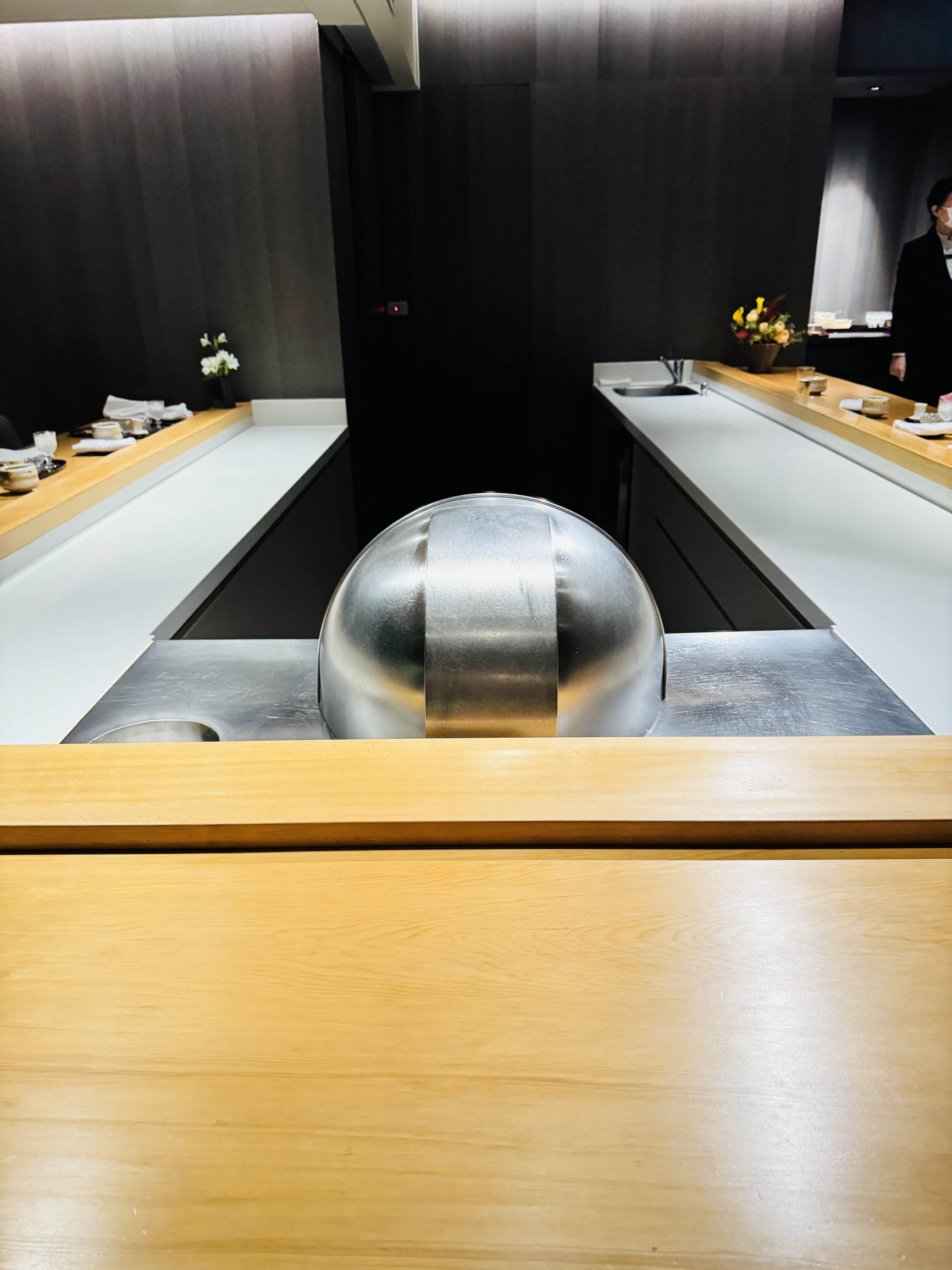
A Quiet Lane, a Demanding Craft
Taipei's premium dining belt in Da'an District has developed a pattern over the past decade: high-commitment restaurants occupying side streets and residential laneways rather than ground-floor hotel lobbies or commercial strips. Lane 52 off Siwei Road follows that pattern precisely. The address is residential in character, and arriving at Mudan Tempura for the first time involves the kind of quiet attention to street numbers that signals you are somewhere operating on reputation rather than footfall. That context matters, because it establishes the register before you sit down.
Within Taipei's two-Michelin-star tier, Mudan occupies a specific and narrowly defined position. The city's fine-dining scene at this level is almost entirely oriented around either tasting-menu formats drawing on French or contemporary European frameworks (see logy, Taïrroir) or classical Chinese traditions anchored in Cantonese cooking (Le Palais). Mudan sits outside both of those reference points entirely. It is a tempura specialist at the leading of the awards pyramid, and that distinction carries weight in a city where Japanese culinary disciplines, though deeply embedded in Taiwanese food culture, rarely reach two-star recognition.
The shortlist, unlocked.
Hard-to-book tables, cellar releases, and concierge-planned trips.
Get Exclusive Access →What Tempura at This Level Actually Means
The craft discipline underlying premium tempura is worth understanding on its own terms before reading any specific restaurant's credentials. Tempura as a cooking form rewards an extremely narrow set of technical variables: batter temperature and viscosity, oil temperature and its management across multiple batches, ingredient sequencing to match frying times, and the chef's read on texture and doneness without any external verification instrument. There is no long braise to correct an error, no sauce reduction to compensate for timing. The margin between a piece of tempura that expresses the ingredient and one that mutes it is measured in seconds and degrees.
In Japan, the restaurants that have reached top-tier recognition in this discipline — counters like Numata and Shunsaiten Tsuchiya in Osaka, or Tempura Ginya in Tokyo — tend to operate at small counter formats, with the chef frying directly in front of the guest and pieces served individually as they emerge from the oil. The format imposes discipline on the kitchen and immediacy on the diner: you are watching a technical performance and eating the results in real time. Mudan operates within that same tradition, and its two Michelin stars position it alongside those Japanese counterparts rather than primarily in competition with Taipei's tasting-menu restaurants.
The La Liste score of 77 points in the 2026 edition adds a second major benchmark to the Michelin recognition. La Liste's methodology aggregates from multiple guide and critic sources, which means the 77-point mark reflects assessment from more than one evaluative lens. Combined with the Opinionated About Dining Asia ranking at position 284 in 2025 (288 in 2024, indicating a small upward movement year-on-year), the picture is consistent: a restaurant that registers clearly across the different methodologies used to assess Asia's leading tables.
Da'an's Place in Taipei's Fine-Dining Geography
Understanding where Mudan sits geographically helps set expectations. Da'an District is Taipei's most concentrated zone for serious restaurant investment across multiple categories. The MRT corridor connecting Da'an, Xinyi Anhe, and Technology Building stations threads through a neighbourhood where high-rent residential addresses coexist with the kind of independent restaurant density that builds over decades rather than through deliberate planning. This is not a designed dining district in the way that some cities develop gastro-quarters; it is an organic accumulation of serious operators who have found that residents in this area support the model.
Mudan's Lane 52 address places it within walking distance of several other top-tier restaurants in the Da'an pocket, including Motoichi. The area also supports the city's other dedicated tempura specialist worth tracking: Tempura Sugimura. The presence of two serious tempura operations within the same district is an index of how deeply Japanese culinary forms are embedded in Taipei's premium dining culture, a relationship rooted in the Japanese colonial period and maintained through continued influence in cooking education, ingredient sourcing, and dining habits.
The Kitchen Structure and What It Implies
The venue data lists the kitchen under "various" for chef attribution rather than naming a single individual, which is unusual at the two-star level and worth noting. It may reflect a counter-rotation model, a deliberate house-style approach that de-emphasises individual chef identity, or simply how the restaurant presents itself publicly. What it does not change is the consistency implied by stable award recognition across multiple years. Michelin's evaluation process rewards repeatable quality across multiple anonymous visits; a restaurant does not hold two stars through 2024 and 2025 by producing variable results.
The session structure supports focused execution: Tuesday through Sunday, with a lunch window running 12 to 3 pm and a dinner window from 6 to 9:30 pm. Monday is closed. These are relatively contained sittings for a restaurant operating at this price point (the $$$$ tier), suggesting a tight capacity model that keeps the kitchen-to-guest ratio manageable , a structural prerequisite for counter-style tempura where sequencing and timing cannot be scaled without degradation.
Taipei in a Wider Taiwan Context
Mudan is one data point in what has become a compelling national picture for Taiwan's restaurant scene. Across the island, restaurants are accumulating international recognition at a rate that reflects both ingredient quality and a culinary culture willing to absorb and commit to exacting outside disciplines. JL Studio in Taichung operates in a different register entirely, with a Southeast Asian–inflected tasting menu, while GEN in Kaohsiung and Akame in Wutai Township represent the range of what serious cooking looks like outside the capital. Even at the other end of the formality register, A Cun Beef Soup in Tainan demonstrates how deeply food culture runs at every tier of the Taiwanese table.
Within Taipei specifically, restaurants at the $$$$ price point and multiple-star level are operating in a competitive environment that covers a broad stylistic range. Visitors building a multi-meal itinerary in the city should cross-reference our full Taipei restaurants guide to map how Mudan sits relative to the broader field. Those planning a longer stay should also check our full Taipei hotels guide, our full Taipei bars guide, our full Taipei wineries guide, and our full Taipei experiences guide. For resort-style accommodation in the wider region, Volando Urai Spring Spa and Resort in Wulai District offers a contrasting pace outside the city.
Know Before You Go
- Address: No. 17, Lane 52, Siwei Road, Da'an District, Taipei 106
- Hours: Tuesday to Sunday, 12–3 pm (lunch) and 6–9:30 pm (dinner). Closed Monday.
- Price tier: $$$$
- Awards: Michelin 2 Stars (2025); La Liste Leading Restaurants 77 pts (2026); OAD Asia #284 (2025)
- Google rating: 4.6 from 637 reviews
- Booking: No booking method confirmed in public data , approach via the restaurant directly or through a concierge given the two-star demand level
- Getting there: Da'an District is well connected by MRT; the Xinyi Anhe and Da'an stations are the closest reference points. Lane 52 is residential; allow time to locate the address
No. 17號, Lane 52, Siwei Rd, Da’an District, Taipei City, Taiwan 106
+886 2 2706 8699
Recognition Snapshot
A quick peer snapshot; use it as orientation, not a full ranking.
| Venue | Awards | Cuisine | Notes |
|---|---|---|---|
| Mudan Tempura | Michelin 2 Stars | Tempura | This venue |
| logy | Michelin 2 Star | Modern European, Asian Contemporary | Modern European, Asian Contemporary, $$$$ |
| Le Palais | Michelin 3 Star | Cantonese | Cantonese, $$$$ |
| Taïrroir | Michelin 3 Star | Taiwanese/French, Taiwanese contemporary | Taiwanese/French, Taiwanese contemporary, $$$$ |
| de nuit | Michelin 1 Star | French Contemporary | French Contemporary, $$$$ |
| Golden Formosa | Michelin 1 Star | Taiwanese | Taiwanese, $$ |
Need a table?
Our members enjoy priority alerts and concierge-led booking support for the world's most difficult tables.
Get Exclusive AccessThe shortlist, unlocked.
Hard-to-book tables, cellar releases, and concierge-planned trips.
Get Exclusive Access →