On Rue Jarroui in Tangier, Snack Brahim Abdelmalik represents a category of neighbourhood eating that defines how locals actually feed themselves in a port city built on layered cultural exchange. No reservations, no printed menus in multiple languages, no performance. Just the kind of direct, unmediated Moroccan snack cooking that more formal dining rooms spend considerable effort trying to reference.
Pearl is the En Primeur Club membership app — saves, bookings, and concierge access live there. Same editors, same standards.
- Address
- Rue Jarroui, Tangier, Morocco
- Directions
- Get directions
 Saves & bookings on Pearl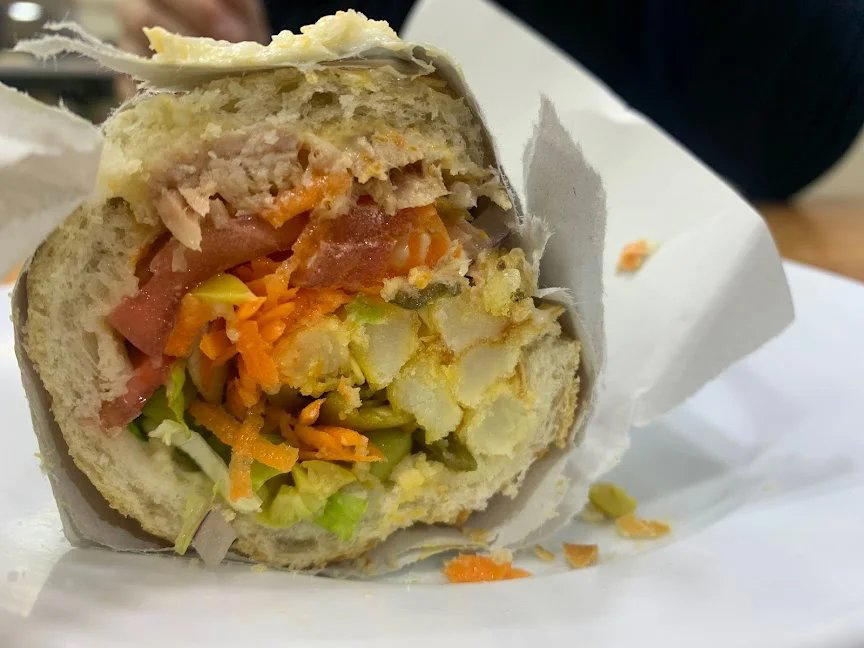
Where Tangier Eats Without Ceremony
Snack Brahim Abdelmalik is a Spanish-Style Sandwich Shop in Tangier, Morocco, known for its low-cost counter service. The street sits within the everyday commercial fabric of Tangier, a city whose dining scene has always run on two parallel tracks: the medina restaurants and rooftop terraces that have oriented themselves toward visitors, and the neighbourhood spots that never did. Snack Brahim Abdelmalik belongs firmly to the second track. The physical approach is typical of the form, a frontage open to the street, the kitchen visible or audible before you arrive, the seating arranged for turnover rather than comfort. In Moroccan snack culture, this is not a shortcoming. It is the point.
Tangier's position as a transit and trading city means its street-level food has always absorbed influences without making a show of it. Tangier's port brought Andalusian, Spanish, and sub-Saharan West African currents into a culinary base already shaped by Amazigh and Arab traditions. The result is a snack culture where a single street can hold a brochette grill, a sandwich counter, and a msemen station within fifty metres of one another, each feeding a different rhythm of city life. Snack Brahim Abdelmalik operates within that continuum, not as a curated interpretation of it, but as a functioning part of it. For comparison, consider what the more formally composed Andalus or the seafood-focused Restaurant Saveur de Poisson do with Moroccan culinary tradition: both work within structured dining formats, with menus and table service. The snack register Brahim Abdelmalik occupies operates by different rules entirely.
The Ritual of the Moroccan Snack Counter
Understanding how to eat at a place like this requires understanding the ritual, not the menu. Moroccan snack culture has its own pacing. You arrive, you look at what is being prepared, at the grill, in the pan, behind the glass, and you order from what is in motion rather than from a laminated sheet. This is eating as observation and negotiation, not as selection from a static document. The ritual here is participatory in a way that table-service dining, even at its most attentive, cannot replicate.
At the counter format common to Tangier's street-level spots, the sequence matters: you establish what is available, you communicate your order directly to whoever is cooking, and you receive your food quickly because the operation depends on throughput. There is no pacing in the fine-dining sense, no interval between courses designed to extend the experience. The experience is the food, and the food arrives when it is ready. Eating standing, or on a small stool at a shared counter, is not a diminished form of the meal. In this context, it is the correct one.
This stands in sharp contrast to how Moroccan cuisine is presented at the formal end of the country's dining spectrum. At La Grande Table Marocaine at Royal Mansour in Marrakesh, the architecture of service is as deliberate as the food. At Cafe Clock in Fes, the format is designed partly to make the food legible to international visitors. The snack counter asks nothing of the diner in terms of prior knowledge. It asks only that you pay attention to what is in front of you.
Tangier's Neighbourhood Eating in Context
Tangier has developed a more structured restaurant scene in recent years, with venues like Azurita working a Moroccan-Mediterranean register and Restaurant Casa Harris and Cafétéria Dopamine serving different segments of the city's eating population. That diversification has not displaced the snack counter. If anything, the contrast has sharpened. As more of Tangier's mid-range and upper dining options orient toward a visitor-aware format, the neighbourhood spot becomes a clearer statement of what the city actually eats when it is not performing for anyone.
Morocco's snack culture is not a lesser version of its restaurant culture. It is a different discipline. The cooking required to produce a proper merguez sandwich, a correctly fried kefta, or a brochette grilled over charcoal at the right temperature within a two-minute window is specific and practised. Street-level operators who sustain a neighbourhood clientele over years do so because they cook consistently, not because they have captured a trend. At Amal Gueliz Center in Marrakech, a similar logic applies to traditional home cooking presented in a social enterprise format, the value is in authenticity to an original rather than in elaboration of it. The snack counter operates on the same principle at a more compressed scale.
For visitors who have spent time at Morocco's more formatted dining experiences, whether at La Grande Table Marocaine in Casablanca, at a wine-forward property like Château Roslane, or at a resort restaurant like Hyatt Place Taghazout Bay in Agadir, the snack counter is a useful corrective. It strips the meal back to its most functional and, most honest form. The food at this register is not designed to impress. It is designed to feed people efficiently and well, which is a harder brief than it sounds when you are operating at volume on a street with direct competition.
The wider Moroccan dining picture, from medina restaurants in Essaouira to the olive-country cooking of L'Oliveraie in El Hajeb, shares a common thread: the ingredients are regional, the technique is direct, and the seasonality is built in rather than declared. The snack counter at street level in Tangier is that same principle operating at its most compressed.
Planning Your Visit
Snack Brahim Abdelmalik sits on Rue Jarroui in Tangier. You arrive, you assess, you order. The practical approach for visitors is to go mid-morning for fresh preparations, or at lunch when the city's working population moves through quickly, these are the windows when the kitchen is at its most active. Cash is the assumed payment method at spots in this category. For a broader view of where this fits within Tangier's dining options across different formats and price registers, the EP Club Tangier restaurants guide maps the full picture, from street-level counters to formal dining rooms. For those interested in how the snack format compares to the disciplined tasting-menu end of the spectrum internationally, the distance between this and a venue like Le Bernardin in New York or Lazy Bear in San Francisco is instructive precisely because both ends of the spectrum take their craft seriously, they simply apply it under completely different constraints. In Tangier, the snack counter is where the craft is daily, unremarked, and entirely without audience.
Where It Fits
Comparable venues nearby, for context on price, style, and recognition.
| Venue | Cuisine | Price | Notes |
|---|---|---|---|
| Snack Brahim AbdelmalikThis venue — the venue you are viewing | Spanish-Style Sandwich Shop | $ | Not listed |
| Restaurant Casa Harris | Moroccan Fusion | $$ | Malabata |
| Andalus | Authentic Moroccan Seafood | $$ | Medina |
| Azurita | Moroccan-Spanish Fusion | $$ | central Tangier |
| Restaurant Saveur de Poisson | Authentic Moroccan Seafood | $$ | Medina |
| Cafétéria Dopamine | Moroccan Pastries & Cafe | $$ | Medina |
At a Glance
- Lively
- Casual Hangout
Current opening hours
- Monday
- 11 AM–1:30 AM
- Tuesday
- 11 AM–1:30 AM
- Wednesday
- 11 AM–1:30 AM
- Thursday
- 11 AM–1:30 AM
- Friday
- 11 AM–1:30 AM
- Saturday
- 11 AM–1:30 AM
- Sunday
- 11 AM–1:30 AM
Hours can change for holidays and private events. Last verified .
Bustling fast-food spot with a lively, no-frills atmosphere focused on quick service.