Tabelog Gold #29
Our verdict
Shumoku-cho Shimizu holds consecutive Tabelog Gold Awards (2025 and 2026) and a 4.59 score, placing it among Nagoya's most recognised kaiseki counters. The 12-seat room in Higashi Ward serves dinner-only kaiseki rooted in Gifu seasonal produce, with an average spend of JPY 40,000–59,000. Reservations are accepted online only, and the room operates Monday through Saturday from 18:00.

Pearl is the En Primeur Club membership app — saves, bookings, and concierge access live there. Same editors, same standards.
- Address
- Japan, 〒462-0844 Aichi, Nagoya, Kita Ward, Shimizu, 2 Chome−4−6 清水ビル
- Phone
- +81 52-890-5515
- Hours
- Mon–Tue ClosedWed–Sat 5–11 PMSun Closed
- Website
- tabelog.com
- Directions
- Get directions
The menu
What to order
- Nagoya Cochin Oyakodon
- Kuwana Simmered Clams
- Homemade Karasumi Hand Rolls
Higashi Ward's Quiet Counter
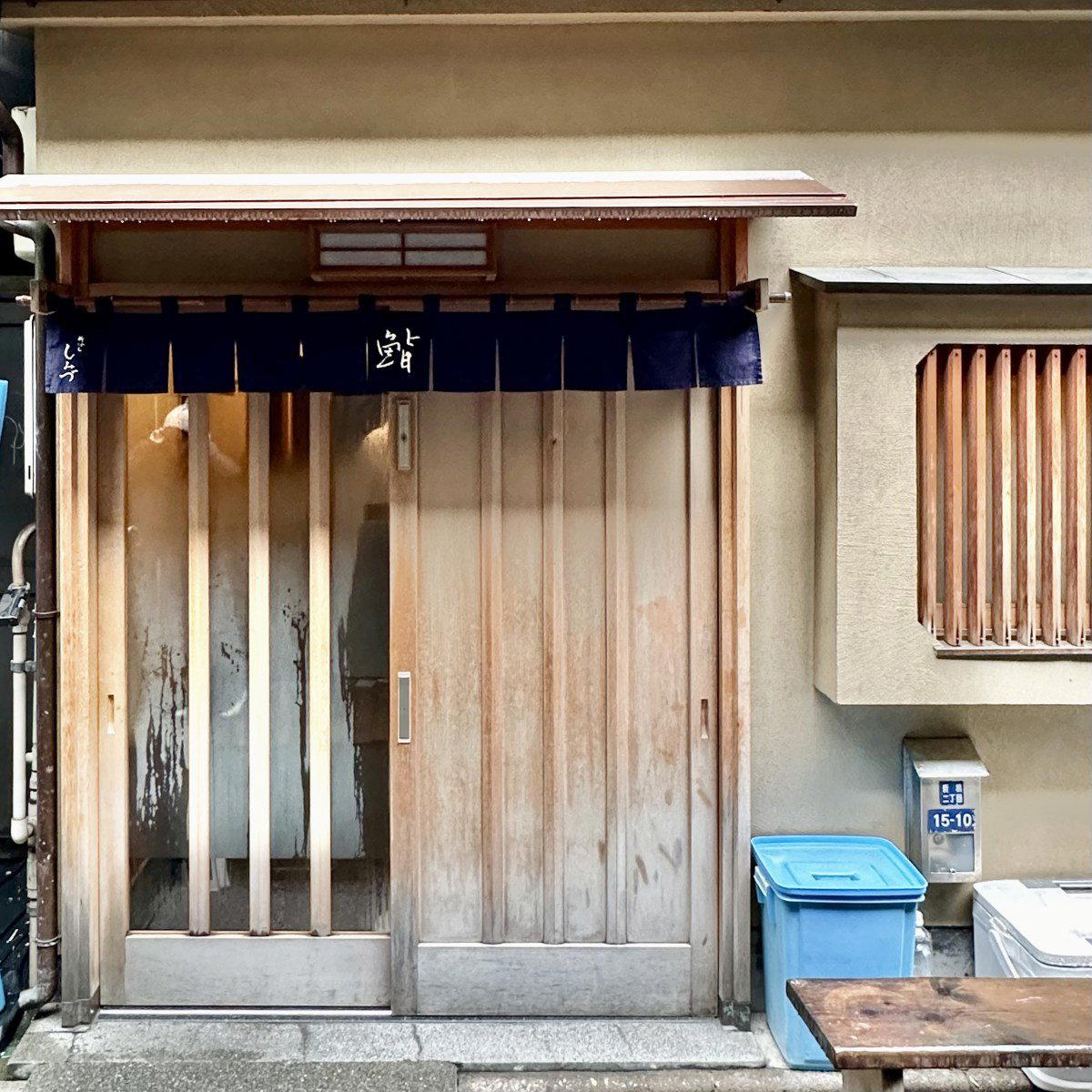
Nagoya's dining geography tends to concentrate prestige addresses around Sakae and Marunouchi, where hotel restaurants and long-established ryotei compete for the same corporate clientele. Higashi Ward operates differently. The Shumoku-cho neighbourhood carries a lower profile by the standards of the city centre, a quality that has historically attracted the kind of intimate, owner-operated room that prizes guest concentration over foot traffic. Shumoku-cho Shimizu, housed on the ground floor of a low-rise building a ten-minute walk from Takadake Station, belongs to that tradition. Its location says something about the room before you enter it: this is not a restaurant designed to be found by chance.
The street-level approach in a residential-adjacent pocket of Higashi Ward is typical of the cohort of Nagoya kaiseki counters that have emerged since 2020, when a new generation of chefs opened small, appointment-only rooms away from the city's commercial dining corridors. Within that cohort, Shimizu has moved fastest through Tabelog's recognition tiers, graduating from Silver in 2023 and 2024 to consecutive Gold awards in 2025 and 2026, with a current score of 4.59. For context, Tabelog Gold represents the top tier of the platform's annual award structure, and fewer than 200 restaurants across Japan receive it each year. Shimizu earned it less than three years after opening on 17 January 2022, a rate of ascent that is worth noting on its own terms.
The Logic of Seasonal Place
Kaiseki's central discipline is the expression of season through ingredient, technique, and sequence. What distinguishes rooms that hold long-term Tabelog recognition from those that cycle in and out is usually not technical skill alone, but the specificity of their ingredient sourcing and the coherence of their editorial point of view about place. Shimizu's stated orientation is Gifu Prefecture, the landlocked region to the north of Aichi that supplies mountain vegetables, river fish, and agricultural produce with a seasonal rhythm distinct from the coastal ingredients that dominate Nagoya's more sea-facing tables.
That geographic commitment positions Shimizu differently from peers operating within the same price tier. At JPY 40,000 to JPY 49,999 per dinner (with review-based averages running closer to JPY 50,000 to JPY 59,999 before the 10% service charge), the room competes against Nagoya addresses oriented toward Ise-bay seafood, premium wagyu from Mie and Shiga, and the broader Kyoto-inflected kaiseki vocabulary that has long dominated high-end Japanese dining nationally. The decision to anchor the menu to Gifu mountain produce is, in effect, a positioning choice: it creates a distinct seasonal logic that separates Shimizu from the city's more conventionally sourced kaiseki counters.
This kind of regional commitment appears across Japan's highest-regarded kaiseki rooms. Gion Sasaki in Kyoto and HAJIME in Osaka each demonstrate that sustained critical recognition in Japanese fine dining typically follows menus that articulate a clear geographic or seasonal identity rather than tracking trends. Shimizu's Tabelog trajectory suggests it is executing that logic with consistency.
Twelve Seats, Two Formats
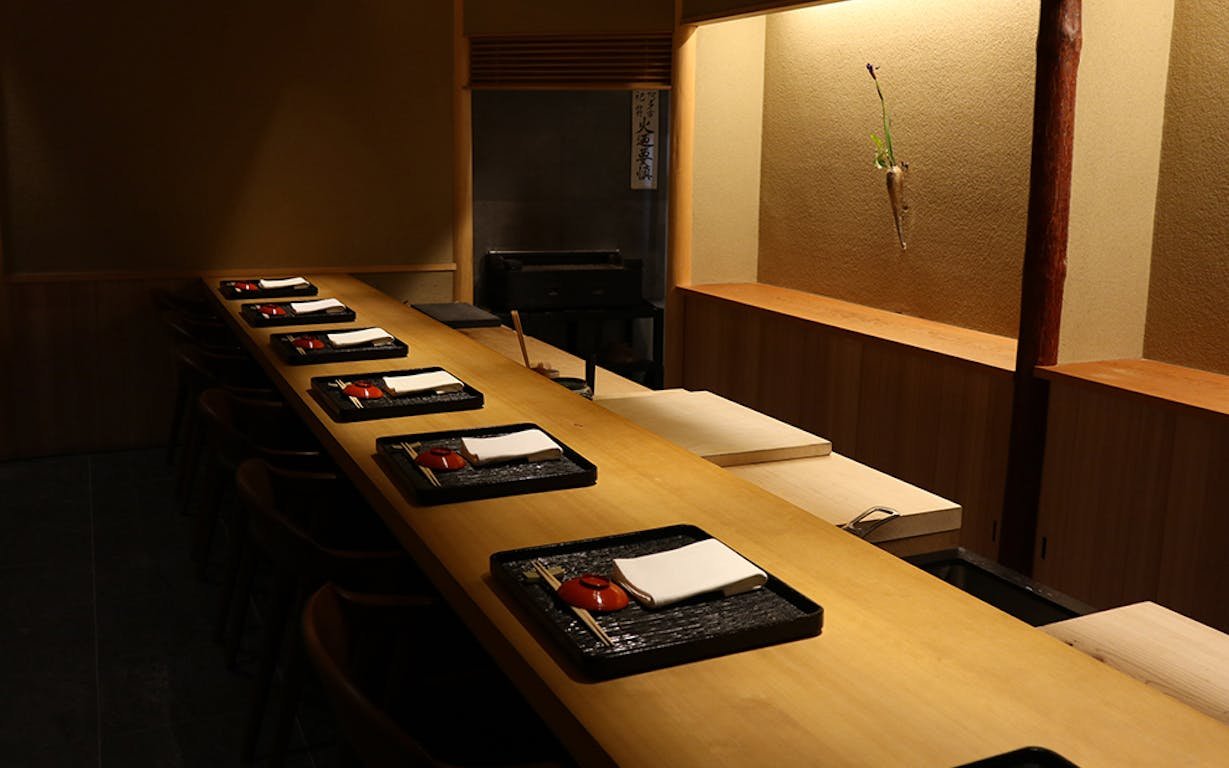
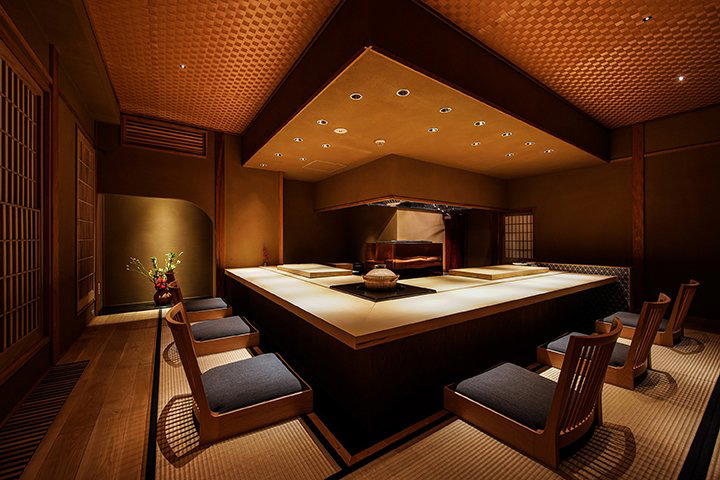
The room holds 12 seats in total: eight at the counter and four in a private room accommodating a single party. The counter is the primary format, and in kaiseki at this tier, counter seating is not simply a layout preference — it is the mechanism through which timing, temperature, and sequencing are controlled. Rooms of eight counter seats or fewer are standard among Japan's most demanding kaiseki audiences, and the format enforces a discipline that larger dining rooms cannot replicate.
For comparison, Hachisen, Nagoya's Kyoto-cuisine reference point, and Hama Gen, one of the city's established sushi counters, operate within the same small-format, high-attention model. Hanaichi and French Ryori Kochuten extend Nagoya's range into adjacent categories at similar price points, and Cucina Italiana Gallura occupies a parallel tier in the city's Italian-Japanese crossover segment. Shimizu's counter sits at the top of this competitive set by Tabelog score, with a 4.59 rating placing it above Silver-tier peers and level with a small group of nationally recognised rooms.
The private room option, available for parties of up to four, extends the venue's utility for corporate or celebratory occasions while keeping total seat count low enough to maintain service consistency. Full venue buyout is available for up to 20 people, which implies a second configuration of the space not visible in the standard seating count. For kaiseki in Nagoya at this price point, that flexibility is an operational differentiality worth factoring into group dining plans.
Staying in the Room
Shimizu operates on a reservation-only basis, with bookings accepted through online channels exclusively. Phone reservations are not accepted. The expected duration of a sitting is approximately three hours, consistent with kaiseki counters at the JPY 40,000-plus tier nationally. Guests are asked to arrive five to ten minutes before their reservation time; arriving more than fifteen minutes late risks cancellation. Dinner service runs from 18:00 Monday through Saturday, with no lunch service and no Sunday opening.
The no-photograph policy applies to food. This is unusual enough to register as a deliberate constraint rather than an oversight, and it signals something about how the room frames the experience: the food is not intended to circulate on social platforms. Among Japan's kaiseki rooms at the Gold tier, this kind of policy is rare but not unprecedented, and it tends to produce a more concentrated dining atmosphere.
Payment is accepted by credit card (Visa, Mastercard, JCB, Amex, Diners Club). Electronic money and QR code payments are not accepted. A 10% service charge is added to all bills. Parking is not available at the address, which is consistent with the neighbourhood's urban density and public transport orientation.
Where Shimizu Sits Nationally
Tabelog's "Japanese Cuisine EAST Tabelog 100" selection, which Shimizu has held in both 2023 and 2025, is a curated list distinct from the annual award tiers. It draws on aggregated review scores to identify the 100 most highly rated Japanese cuisine restaurants in eastern Japan. Inclusion alongside rooms in Tokyo, Kyoto, and Osaka at a counter operating in Nagoya's Higashi Ward reflects a recognition that extends beyond regional ranking.
At the national level, the relevant peer group includes kaiseki and Japanese cuisine rooms that have achieved similar Tabelog trajectories from non-Tokyo bases. Goh in Fukuoka and akordu in Nara represent the regional-counter model in other Japanese cities, where the absence of Tokyo premium pricing does not correlate with lower technical ambition. Harutaka in Tokyo and 1000 in Yokohama show how the counter format at this price point performs within the metropolitan tier. Internationally, the concentration of technique and seasonal specificity in a small-seat format has analogues at Le Bernardin in New York and Atomix in New York City, where the argument for a restaurant's authority rests on sustained critical recognition over multiple review cycles rather than single-year publicity.
Shimizu's Gold awards in 2025 and 2026, combined with three consecutive Tabelog 100 selections and a score of 4.59, constitute the most consistent run of top-tier recognition among Nagoya's Japanese cuisine rooms in recent years. For anyone building a serious dining itinerary through central Japan, it belongs in the same planning conversation as the city's most decorated rooms.
Planning Your Visit
Shimizu is located at 愛知県名古屋市東区橦木町3-24, Plandour Shumokucho 1F, in Nagoya's Higashi Ward. The closest station is Takadake on the Meijo Line, approximately a ten-minute walk from the restaurant. Takaoka Station provides an alternative access point at 743 metres. All reservations are made online; the restaurant does not accept phone bookings. Service runs Monday through Saturday from 18:00 to 22:00, with Sunday and public holidays closed. Allow three hours for a full sitting. The venue is non-smoking throughout, and guests are asked to avoid strong fragrances. For broader dining context in the city, see our full Nagoya restaurants guide, and for planning accommodation and other experiences, refer to our Nagoya hotels guide, bars guide, wineries guide, and experiences guide.
Frequently asked questions
Where do I go for Shimizu?
Shimizu is located at Japan, 〒462-0844 Aichi, Nagoya, Kita Ward, Shimizu, 2 Chome−4−6 清水ビル, Nagoya.
What distinctions does Shimizu have?
Shimizu has received recognition including: {"Year":"2026","Award Source":"Tabelog","Award Type":"The Tabelog Award","Award Group":"gold","Award Group Rank":"29","Restaurant Name":"Shumoku Cho Shimizu","Score":"4.59","Budget":"Dinner: JPY 40,000 - JPY 49,999; Lunch: -","Budget Dinner….
What's the best thing to order at Shimizu?
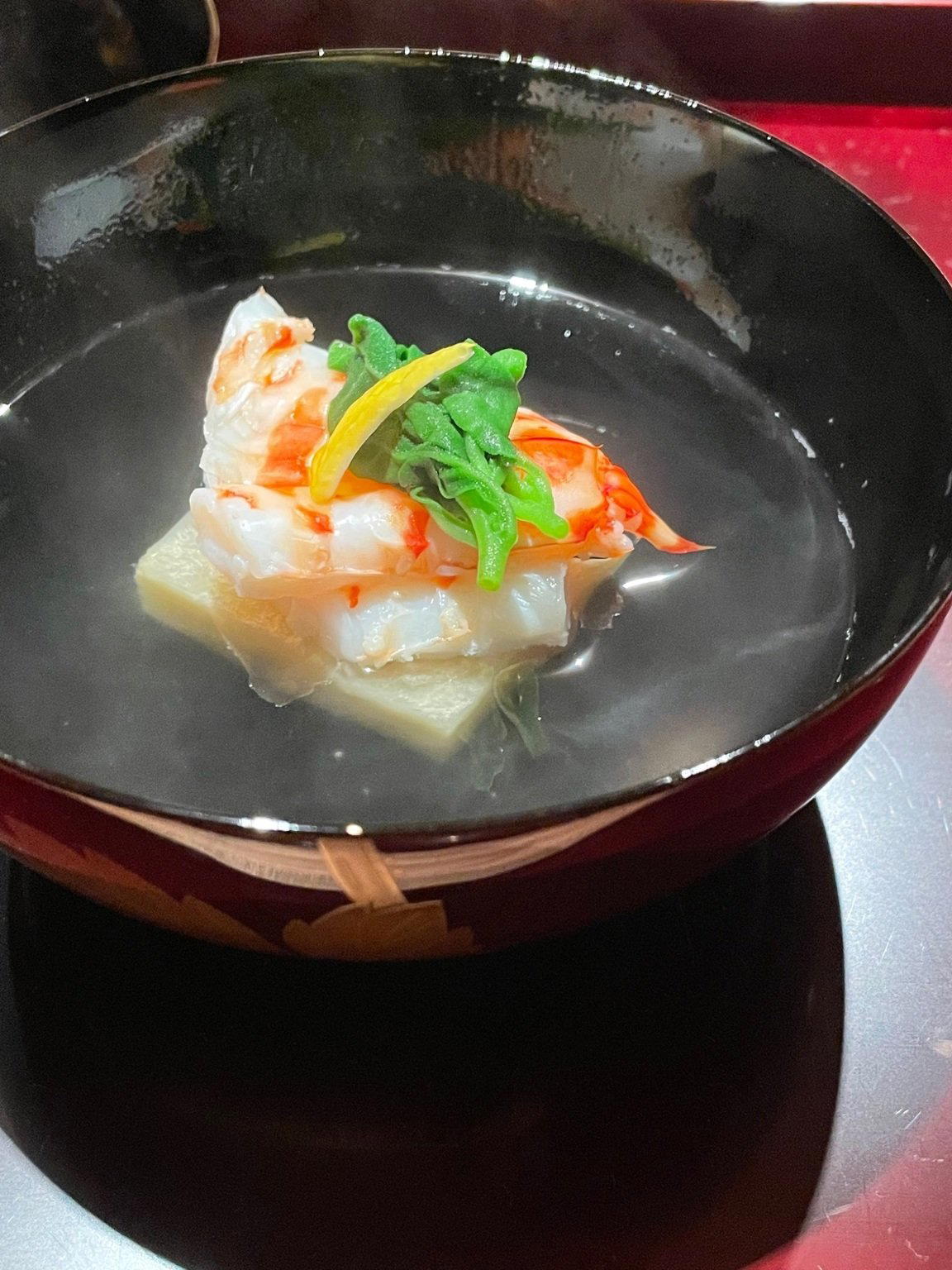
Shimizu operates a fixed kaiseki format, so there is no à la carte selection. The menu changes with the season, drawing on ingredients from Gifu Prefecture. Budget JPY 40,000–49,999 per person at the listed price, though reviewer-reported spending on Tabelog averages JPY 50,000–59,999 including the 10% service charge.
What are the opening hours for Shimizu?
Hours at Shimizu: Mon, Tue, Wed, Thu, Fri, Sat 18:00 - 22:00.
What has Shimizu built its reputation on?
Since opening in January 2022, Shimizu has earned Tabelog Gold in both 2025 and 2026 alongside a 4.59 score, progressing from Silver in 2023–2024. It has also been selected for the Tabelog Japanese Cuisine EAST Top 100 in both 2023 and 2025. The kitchen frames its output around Gifu Prefecture seasonality, delivered across eight counter seats and a four-seat private room in Nagoya's Higashi Ward.
Compact Comparison
| Venue | Cuisine | Price | Awards | Notes |
|---|---|---|---|---|
| ShimizuThis venue — the venue you are viewing | Edomae Sushi | $200–300 | Tabelog Gold #29 | Not listed |
| Cucina Italiana Gallura | Authentic Italian with Local Seafood | $100–150 | Tabelog Bronze #50 | Sushi |
| Hachisen | Kyoto-Style Kaiseki | $200–300 | Tabelog Bronze #91 | Kyoto Cuisine |
| il AOYAMA | Japanese-Inflected Italian Cuisine | $300–500 | Tabelog Silver #42 | Italian |
| Reminiscence | Modern French with Japanese influences | $150–200 | La Liste Top Restaurants · Tabelog Silver #108 | French |
| Tokusen | Premium Yakiniku with Rare Wagyu | $50–100 | Not listed | Japanese |
Recognition history
Dated appearances from independent guides and award organizations, with the underlying list record or original source where available.
Tabelog Gold #29
Tabelog
Opinionated About Dining Top Restaurants in Japan Ranked #121
Opinionated About Dining
Full recognition history (7 entries)
Tabelog 100 #26 · No. 26
Tabelog · Tabelog 100 - Japanese cuisine - EAST - 2025
Tabelog 100 #61 · No. 61
Tabelog · Tabelog 100 - Sushi - EAST - 2025
Tabelog Bronze
Tabelog
Tabelog Gold
Tabelog
Tabelog 100 #64 · No. 64
Tabelog · Tabelog 100 - Asian cuisine / Ethnic cuisine - EAST - 2024