Shihding Hsu's Handmade Noodle Company
Shihding Hsu's Handmade Noodle Company operates in New Taipei's Shihding District, where handmade noodle craft carries more authority than restaurant design or award recognition. The format is functional and local-facing, with the texture and consistency of hand-worked dough forming the basis of its reputation. It sits within a New Taipei specialist food tradition that rewards narrow focus and ingredient discipline over broad menus.
Pearl is the En Primeur Club membership app — saves, bookings, and concierge access live there. Same editors, same standards.
- Address
- New Taipei, Taiwan
- Directions
- Get directions
 Saves & bookings on Pearl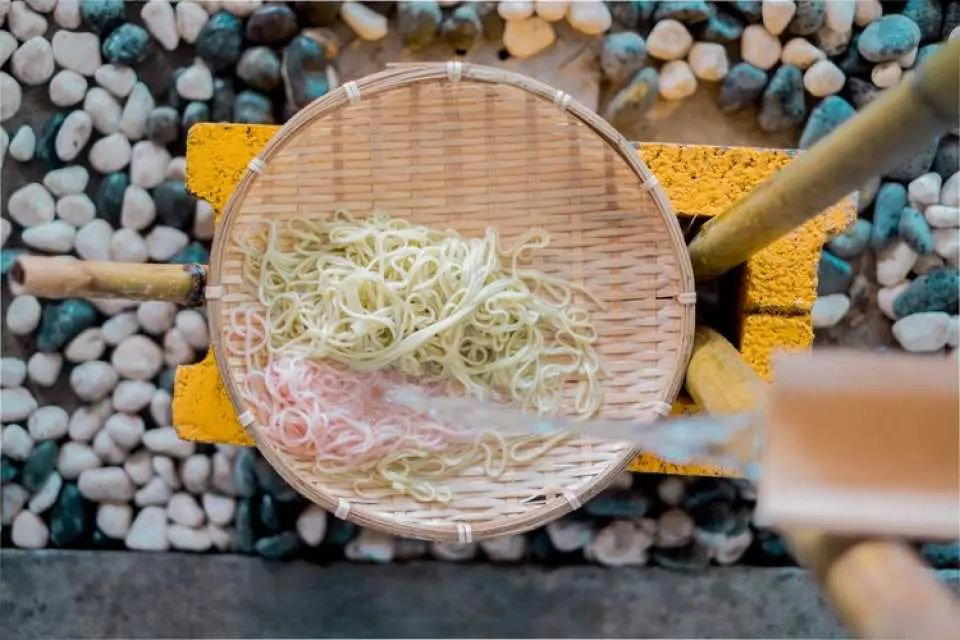
Where New Taipei's Noodle Tradition Earns Its Reputation
There is a particular kind of eating establishment that defines New Taipei's food character more than any fine-dining address: the specialist shop that has committed to one thing, done with accumulated skill. Handmade noodle houses sit at the centre of that tradition. Unlike the broad-menu brasseries that dominate city dining, these operations derive their authority from a narrow focus, the flour, the hydration ratio, the pull and texture of noodles shaped by hand rather than extruded by machine. Shihding Hsu's Handmade Noodle Company belongs to that category.
New Taipei, which encircles Taipei proper and reaches into hillside and riverine districts, carries a food tradition that often runs parallel to rather than in the shadow of the capital. Shihding District, in the city's southeastern reaches, is the kind of area where local producers and long-standing family operations have historically had more influence than imported culinary fashions. That geography matters when considering what a handmade noodle shop here is drawing from: proximity to mountain-adjacent ingredients, a customer base that rewards consistency over novelty, and a regional expectation that the product justify itself entirely on texture and flavour.
The Sourcing Logic Behind Handmade Noodle Work
The editorial angle that matters most for understanding any handmade noodle operation is ingredient provenance. Machine-made noodles can tolerate a wider range of flour grades because the extrusion process compensates for inconsistency. Handmade noodles cannot. The elasticity that comes from hand-pulling or hand-cutting depends on flour protein content, ambient humidity, water temperature, and resting time. A shop that produces noodles by hand is implicitly making claims about its sourcing, or the product exposes the gaps immediately in the bowl.
Taiwan's domestic wheat production is limited, and premium noodle operations typically source from a combination of local and imported flour selected for specific protein ranges. The artisan shops that have survived long enough to build a reputation in districts like Shihding do so partly because their sourcing has stabilised over years into something the regular customer can taste as consistency. That consistency is what separates the specialist from the generic noodle counter, and it is the standard against which a place like Shihding Hsu's Handmade Noodle Company positions itself within New Taipei's category.
This sourcing discipline shows up elsewhere in New Taipei's more ingredient-focused operations. Venues like Amajia and Chi Yuan represent a similar investment in the quality of base materials, each within their own format. The pattern across these addresses is the same: the closer a restaurant sits to a single product or technique, the more the sourcing decision becomes the editorial story.
New Taipei's Specialist Food Culture in Wider Context
It is worth mapping where handmade noodle shops sit in Taiwan's broader dining hierarchy. The island's food press and international recognition have concentrated on Taipei's fine-dining and izakaya registers, with venues like logy in Taipei representing the precision-technique end of Taiwanese cooking, while JL Studio in Taichung shows what happens when regional produce meets a formally trained kitchen. At the other end of that spectrum, in southern Taiwan, operations like A Xia in Tainan carry a different kind of local authority built on centuries of Tainan food culture. The handmade noodle specialist occupies a different register entirely: not trying to win international recognition, but servicing a local demand where the craft itself is the credibility signal.
New Taipei's food scene is varied enough to hold multiple tiers simultaneously. BAK KUT PAN brings a different cultural lineage to the city's table, while sweet-focused operations such as A Gan Yi Taro Balls and A-ba's Taro Ball illustrate how seriously the city takes its traditional dessert formats alongside its savoury specialists. For a broader map of where these venues sit relative to each other, the full New Taipei restaurants guide provides one complete picture of how the city's food character distributes across districts and categories.
Compared to the high-profile counter formats in Kaohsiung, such as GEN, or precision-driven tasting menus of the kind that earn global attention alongside Le Bernardin or Atomix in New York, the handmade noodle shop operates on entirely different terms. It is not competing for the same diner. Its authority derives from repetition, local trust, and the legibility of a product that a regular customer can assess in the first mouthful.
The Physical Experience
The settings that house New Taipei's noodle specialists tend to be functional rather than designed: tiled walls, tables set close together, the sound of broth and the smell of wheat in the air before the bowl arrives. The Shihding area reinforces this character through its hillside surrounds and relative distance from central New Taipei's more commercial corridors. Getting there requires intention, which is itself a filter: the clientele arriving at a Shihding noodle house is almost always a local or a deliberate traveller rather than a passing tourist.
Other district-specific operations across the wider region follow a similar logic of place-determining audience. GARDENh in Yonghe District and operations in Sanchong District each carry the particular character of their respective New Taipei neighbourhoods, reinforcing that the city reads as a collection of distinct food districts rather than a single unified scene. Planning a visit to Shihding with time to explore the district rather than simply eat and leave is the approach that makes most sense given the area's character.
Planning a Visit
Specific hours, pricing, and booking details for
FAQ
Does Shihding Hsu's Handmade Noodle Company work for a family meal?
A handmade noodle specialist in Shihding fits well for a family meal. The price tier is accessible across age groups.
How would you describe the vibe at Shihding Hsu's Handmade Noodle Company?
If you are arriving from Taipei's more polished dining districts, the contrast will be immediate: this is a functional, local-facing setting where the product does the work rather than the room. New Taipei's outer-district noodle shops operate on neighbourhood trust and repeat custom, and the atmosphere reflects that directly.
What's the leading thing to order at the restaurant?
The benchmark item is usually whatever format showcases the noodle texture most directly, typically a clear or lightly dressed preparation rather than a heavy sauce that masks the dough quality.
Is the restaurant representative of a broader Shihding food tradition?
Shihding District has historically supported small-scale food production tied to its hillside geography and relatively self-contained local economy. A handmade noodle operation here fits into a pattern of craft-focused food businesses that serve a local rather than tourist-driven market, placing it in the same category as other long-standing specialist shops across New Taipei's outer districts. Visitors interested in Taiwan's less publicised food traditions, beyond the venues tracked by international guides like those covering Volcanic Rock in Zhubei City or Chenggong Douhua, will find this register of eating among the more instructive.
In Context: Similar Options
Comparable venues nearby, for context on price, style, and recognition.
| Venue | Cuisine | Price | Awards | Notes |
|---|---|---|---|---|
| Shihding Hsu's Handmade Noodle CompanyThis venue — the venue you are viewing | Traditional Taiwanese Handmade Noodles | $ | Not listed | Not listed |
| Yeh Chia Pork Ribs Medicinal Herbs Soup | Chinese Medicinal Pork Ribs Soup | $ | Bib Gourmand | Banqiao District |
| Chin Ta Lu Rou Fan | Taiwanese Braised Pork Rice | $ | Michelin Plate | Sanchong District |
| NATURAL TEA MANOR | Tea-infused Taiwanese | $$ | Michelin Plate | Xizhi District |
| Shi Yang | Contemporary Taiwanese Kaiseki | $$$ | Michelin Plate | Xizhi District |
| BAK KUT PAN | Traditional Taiwanese Bak Kut Teh | $ | Michelin Plate | Xindian District |
Continue exploring
More in New Taipei
Restaurants in New Taipei
Browse all →
Bars in New Taipei
Browse all →
Hotels in New Taipei
Browse all →


Wineries in New Taipei
Browse all →
At a Glance
- Rustic
- Family
- Casual Hangout
- Open Kitchen
- Local Sourcing
- Mountain
Rustic mountain workshop atmosphere with sun-drying noodles and fresh mountain breeze.