Amajia

A converted red-brick house on a slope in Jinshan District, Amajia draws from the Huanggang port catch and the logic of home cooking. The name translates as 'grandma's home' in Mandarin, and the menu follows that premise with braised pork belly and seafood dishes that prioritise familiarity over spectacle. It is a useful counterpoint to the formal dining circuits elsewhere in Taiwan.
Pearl is the En Primeur Club membership app — saves, bookings, and concierge access live there. Same editors, same standards.
- Address
- 189 Huanggang Road, Jinshan District
- Phone
- +886 965 282 535
- Directions
- Get directions
 Saves & bookings on Pearl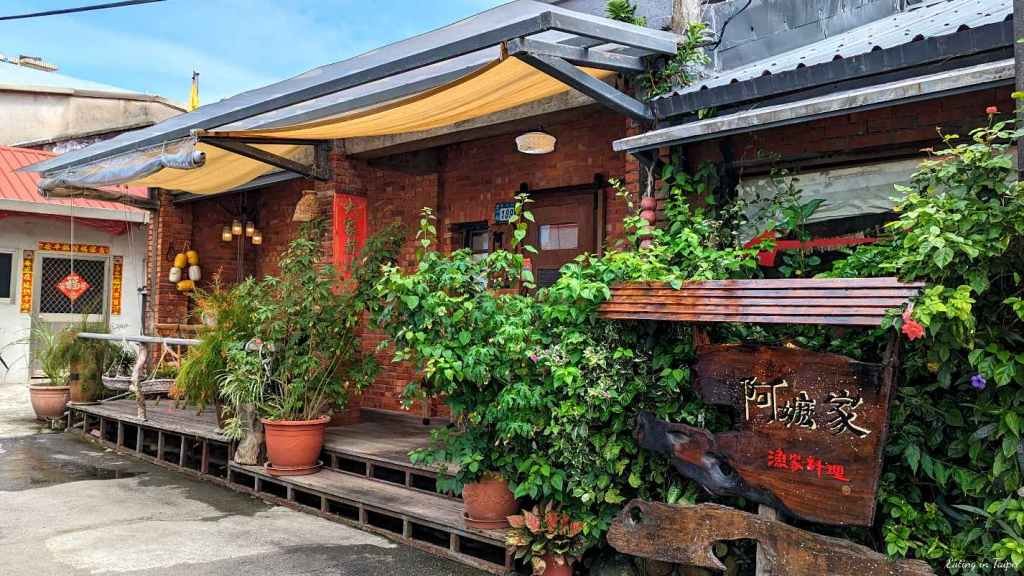
A Red-Brick House and a Port Within Reach
Jinshan District sits at the northern tip of New Taipei, where the coastline turns and the fishing boats that work Huanggang port come back with whatever the season allows. The approach to Amajia, set in a red-brick house perched on a slope, reads less like a restaurant arrival and more like the walk up to a relative's home: a modest exterior, the kind of building that doesn't signal ambition from the road. That restraint is the first clue that the meal inside operates on different terms from the formal dining circuits running through central Taipei.
Amajia is a restaurant in Jinshan District, New Taipei, serving traditional Taiwanese seafood in a casual, walk-in-friendly setting. The name is a transliteration of 'grandma's home' in Mandarin, and the kitchen takes that framing seriously. The cooking draws from the rhythms and techniques of home kitchens, applied to some of the freshest seafood available on this stretch of the northern coast.
The Ritual of the Table Here
Home-style Taiwanese dining operates according to its own pacing, and Amajia works within that tradition rather than against it. Dishes arrive at the table as they are ready, not staged in formal courses. The meal unfolds communally, with shared plates passed and portions adjusted by whoever is at the table. There is no tasting menu count, no amuse-bouche to announce the kitchen's presence. The experience is closer to the rhythm of a family meal than a service sequence, and that distinction changes what the visit demands from the diner.
That rhythm places specific dishes at the centre of the meal rather than at the edges. The braised pork belly, which the house is known for, arrives tender and fragrant with the aromas of dried bamboo shoot, a combination that appears across Taiwanese home kitchens but rarely with this degree of execution. Slow braising requires patience and calibration; the result at Amajia reflects a cook who has made the dish many times and sees no reason to modify it for restaurant optics. The seafood, sourced from the nearby Huanggang port, follows similar logic: proximity to the catch is the advantage, and the preparation lets that advantage speak. This is a kitchen that has decided what it does well and declines to reach beyond that.
Comparable approaches to region-specific, tradition-led cooking can be found across Taiwan. Akame in Wutai Township uses Indigenous Rukai ingredients with a similarly restrained hand, and Ang Gu in Hsinchu County maps its menu around local glutinous rice traditions. Amajia occupies a different geographic and culinary register, but the underlying commitment to place over performance is shared. By contrast, the more internationally oriented end of Taiwan's fine dining, represented by venues like logy in Taipei and JL Studio in Taichung, operates with entirely different reference points and expectations.
Jinshan District and What the Coast Provides
The context of Jinshan matters to understanding the menu. This is a district where the land meets the sea with relatively little development between them, and where the Huanggang port has supplied local tables for generations. Restaurant cooking in this part of New Taipei has historically been driven by what the boats bring back rather than by what the menu demands. Amajia fits that pattern, treating port proximity as a structural advantage rather than a marketing point.
That relationship between place and plate is not common in urban dining, where supply chains compress and decouple the restaurant from any specific geography. At Amajia, the distance between the fish and the table is short enough to be meaningful. It is an argument for dining outside the city that the food makes more convincingly than any description could. Nearby in New Taipei, the dessert-focused spots like A Gan Yi Taro Balls and A-ba's Taro Ball draw on a different local tradition, while BAK KUT PAN represents the influence of Southeast Asian heritage on the northern New Taipei dining scene.
For those building a wider itinerary around Taiwan's regional cooking, the contrast with southern restaurants such as Zhu Xin Ju in Tainan and GEN in Kaohsiung is instructive. Each operates from a different regional pantry and a different set of culinary assumptions. Amajia is unambiguously northern coastal Taiwanese: the port, the slope, the red brick, the braised pork belly with dried bamboo shoot.
Planning the Visit
Amajia is located at 189 Huanggang Road, Jinshan District, New Taipei. The restaurant is positioned outside the main public transport corridors, so a car or taxi from central Taipei or from Danshui is the practical approach for most visitors; Because the restaurant is known locally and operates at residential rather than hotel scale, it is worth making contact well ahead of a planned visit, particularly on weekends or during holidays when northern coast destinations attract more traffic from the city. The restaurant is walk-in friendly.
Internationally, the closest parallels to Amajia's format, a small-scale, tradition-grounded house built around local produce and communal pacing, might be found in places like Lazy Bear in San Francisco, which also applies personal cooking convictions at an intimate scale, though the reference points and price positioning are entirely different. And for seafood-led cooking that operates at the technical extreme, Le Bernardin in New York City represents what Amajia is conspicuously not: formal, technically maximalist, and expensive. The distance between those two dining modes is part of what makes Amajia's position coherent. Emeril's in New Orleans offers a third reference: regional American cooking given institutional form. Amajia stays domestic and local in a way that all three of those venues, by definition, cannot.
The red-brick house on the slope in Jinshan is doing something that formal restaurant culture rarely rewards with awards or lists: a kitchen that has decided what it represents, where to source it, and how to serve it without modification for outside approval. That consistency is, in most dining traditions, the harder discipline to maintain. At Volando Urai Spring Spa and Resort in Wulai District, the integration of landscape and hospitality is the governing logic; at Amajia, it is the integration of port and table. Both are exercises in letting geography set the terms.
Category Peers
Comparable venues nearby, for context on price, style, and recognition.
| Venue | Cuisine | Price | Awards | Notes |
|---|---|---|---|---|
| AmajiaThis venue — the venue you are viewing | Traditional Taiwanese Seafood | $$ | Michelin Plate | Not listed |
| Lao Hsu | Taiwanese and Jiangzhe Cuisine | $$ | Michelin Plate | New Taipei City |
| Wonderful Baba Bak Kut Teh King Of King | Fujian-Style Bak Kut Teh | $$ | Michelin Plate | Banqiao District |
| Huí Huí | Modern French-Taiwanese Bistro | $$$ | Michelin Plate | Ruifang District |
| Lai Kang Shan | Traditional Taiwanese Lamb Soup | $ | Bib Gourmand | Xindian District |
| QING YA | Cantonese Chinese | $$$ | Michelin Plate | Banqiao District |
Recognition history
Dated appearances from independent guides and award organizations, with the underlying list record or original source where available.
Michelin Plate
Michelin
Continue exploring
More in New Taipei
Restaurants in New Taipei
Browse all →
Bars in New Taipei
Browse all →


At a Glance
- Scenic
- Cozy
- Rustic
- Casual Hangout
- Family
- Group Dining
- Date Night
- Waterfront
- Terrace
- Local Sourcing
- Sustainable Seafood
- Waterfront
Current opening hours
- Monday
- Closed
- Tuesday
- Closed
- Wednesday
- 11 AM–2 PM, 5–7:30 PM
- Thursday
- 11 AM–2 PM, 5–7:30 PM
- Friday
- 11 AM–2 PM, 5–7:30 PM
- Saturday
- 11 AM–3 PM, 4:30–7:30 PM
- Sunday
- 11 AM–3 PM, 4:30–7:30 PM
Hours can change for holidays and private events. Last verified .
Quaint, homely atmosphere with red-brick courtyard and flower-adorned main venue; relaxing seaside setting with mountain views and seagull sounds in background.