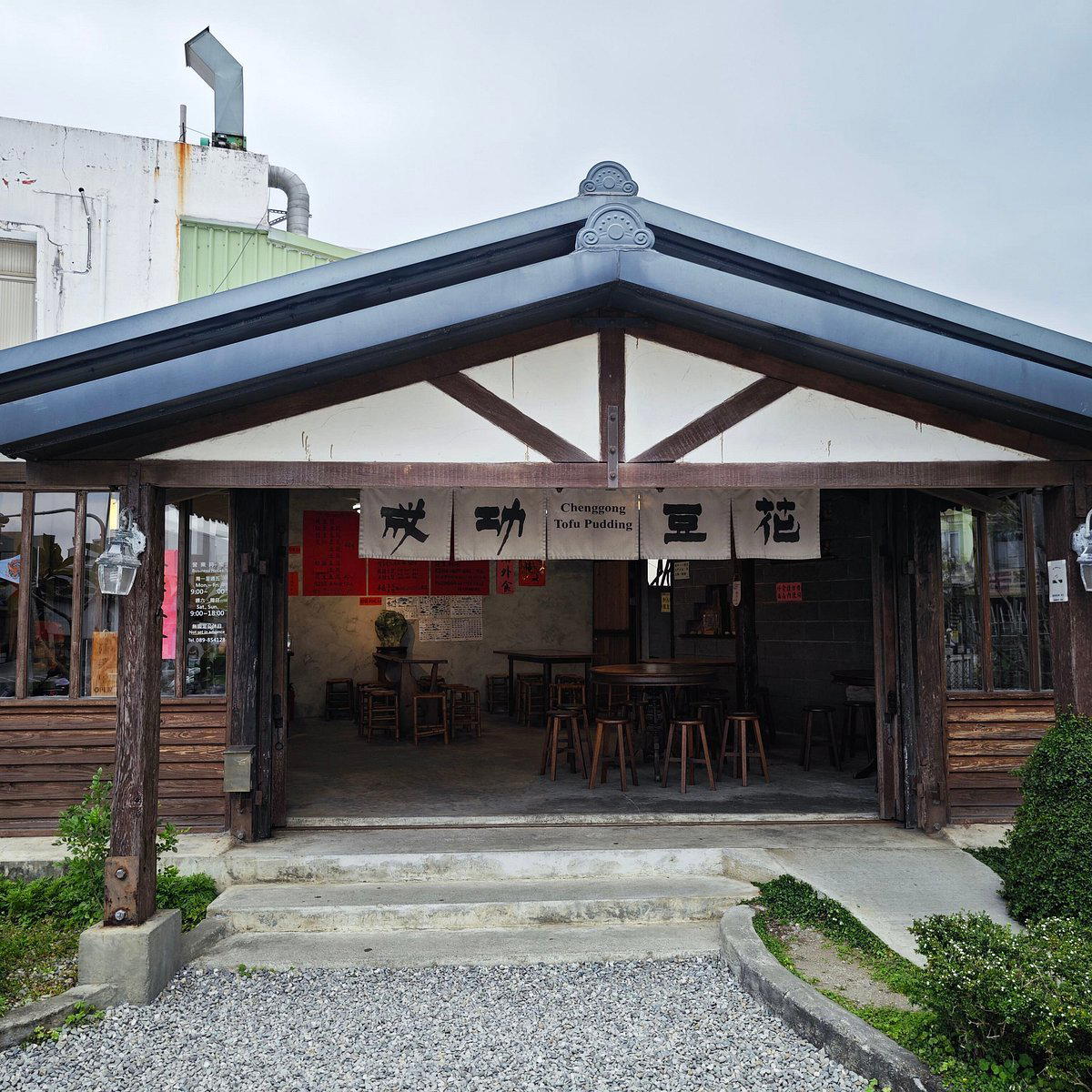
Douhua, Taiwan's silken tofu dessert, finds one of its most straightforward expressions in Chenggong, a small coastal town on the island's east coast where the ingredient supply chain is short and the preparation unadorned. Chenggong Douhua draws from that local tradition, serving a dish whose quality is inseparable from where and how its soybeans are grown. For visitors passing through Hualien County, it represents the kind of regional specificity that larger city venues rarely replicate.
 Discover on Pearl
Pearl is the En Primeur Club membership app — saves, bookings, and concierge access live there. Same editors, same standards.
Where the Tofu Comes From Matters More Than the Recipe
In Taiwan's east coast towns, the distance between farm and bowl is one of the defining factors in douhua quality. Chenggong sits in Taitung County, a stretch of coastline and mountain foothills where small-scale soybean cultivation has historically supported a dense network of local tofu producers. The logic here is direct: douhua made from soybeans grown within a short supply chain, processed without the extended transit times that urban suppliers accept as standard, carries a different textural and flavour profile. The curds set more cleanly. The sweetness reads as natural rather than added. That supply-chain proximity is what gives east coast douhua its regional character, and Chenggong Douhua sits inside that tradition.
Douhua as a category spans an enormous range across Taiwan. At the premium end, venues in Taipei's Da'an District or Tainan's historic centre compete on toppings, syrups, and provenance narratives. Further up Taiwan's dining register, restaurants like logy in Taipei and JL Studio in Taichung represent how Taiwanese ingredients enter fine-dining frameworks. Chenggong Douhua operates in an entirely different register: unaffected, local, and shaped by what the surrounding area actually produces rather than by any aspirational positioning.
The Physical Setting and What It Signals
Chenggong is a working town rather than a tourist destination. Approaching any douhua operation here, the environment reads as functional: tiled surfaces, minimal signage, the kind of space that communicates its purpose without embellishment. That physical directness is not incidental. In Taiwan's east, where the hospitality infrastructure is thinner than in Taipei or Tainan, a douhua counter's longevity depends on the product rather than on atmosphere management. The setting signals that the kitchen is not compensating for anything. Visitors arriving from Taiwan's west coast restaurant circuit, where venues like GEN in Kaohsiung or A Xia in Tainan represent polished, award-recognised dining, will find Chenggong Douhua at the opposite end of the production spectrum.
That contrast is worth sitting with. Taiwan's food culture has always maintained parallel tracks: the Michelin-chasing fine-dining circuit and the street-level, market-adjacent tradition that produces some of the island's most technically careful cooking without any institutional recognition. Douhua belongs firmly to the second track. Its craft is in temperature control, coagulation timing, and soybean quality, not in plating or conceptual framing.
Ingredient Sourcing as the Central Argument
The case for east coast douhua rests almost entirely on ingredient provenance. Taitung County's agricultural profile includes organic soybean cultivation in volumes that larger counties do not match, partly because the eastern rift valley's soil composition and lower industrial agriculture density favour small-batch growing. That agricultural context shapes what a producer in Chenggong can access that a Taipei vendor cannot: soybeans harvested recently, processed locally, and turned into tofu without the cold-chain holding times that metropolitan supply demands.
This is the same logic that underlies regional food specificity across Taiwan. The raw milk used near Guanshan, the mangoes from Yujing, the rice from Chishang: each of these ingredients has an institutional connection to the place that produces it, and that connection produces flavour differences that are real rather than marketed. Douhua in Chenggong belongs in that same category of place-contingent ingredients. You are not eating a dish that could be identically reproduced in Taipei with imported components. The geography is inside the bowl.
Elsewhere in Taiwan, venues like Golden Formosa Taiwanese Cuisine in 士林 and Good Good Hainan Chicken Rice in 信義 demonstrate how ingredient sourcing and regional tradition operate even in Taipei's densely competitive dining scene.
Placing Chenggong Douhua in Its Peer Context
Douhua operations in small Taiwanese towns rarely draw comparison to the island's fine-dining tier, but they compete actively within a regional comparable set that visitors to the east coast will encounter repeatedly. Along the Hualien-Taitung corridor, douhua quality varies significantly. The differentiating factors are soybean origin, water quality, and the ratio of coagulant used to set the curd: less coagulant produces softer, more delicate texture, but demands fresher soybeans to hold structure. Producers working with locally grown beans can push that ratio in ways that urban vendors relying on commodity soybeans cannot.
For visitors eating across Taiwan's broader street food and casual dining spectrum, comparisons also extend to other regional specialists: Ah Zhen Rou Bao in Lukang represents how a single product, prepared with regional ingredient specificity and long practice, can anchor a venue's identity without any formal recognition. That model is common in Taiwan and it is what Chenggong Douhua operates within. Nearby in Chenggong itself, Sky Burger represents the town's other casual eating option, working in an entirely different format.
Planning a Visit
Chenggong is accessible via Taiwan's east coast rail line, with Chenggong Station connecting to Hualien and Taitung. The town sees significantly less tourist traffic than Hualien City or Taitung City, which means that east coast visitors willing to stop rather than pass through will find eating options at a pace and scale that larger towns no longer offer. Douhua operations in small Taiwanese towns typically operate morning through early afternoon, with supply often running out before a formal closing time: arriving before noon is the practical approach. Pricing for douhua here is in the lowest tier of Taiwanese dining.
Visitors building a broader east coast itinerary can use Chenggong as a stop between Hualien and Taitung, with the douhua visit fitting naturally into a morning market circuit. For broader regional context on how Taiwan's ingredient-led food culture maps across different price points and cities, the range covered by venues like Hómee in 大園區 and GARDENh in Yonghe District illustrates how sourcing-conscious cooking operates across Taiwan's dining tiers.
Comparable Spots, Quickly
Comparable venues nearby, for context on price, style, and recognition.
| Venue | Cuisine | Price | Awards | Notes |
|---|---|---|---|---|
| Chenggong DouhuaThis venue — the venue you are viewing | Taiwanese Douhua (Tofu Pudding) | $ | , | |
| Sky Burger | Burgers | $ | , | Chenggong Township |
| Shihding Hsu's Handmade Noodle Company | Traditional Taiwanese Handmade Noodles | $ | , | Shiding District |
| Ba Fang Yun Ji Dumpling | Casual Taiwanese Dumpling House | $ | , | Da’an District |
| Old Arbor Freshly Marinated Dried Tofu | Taiwanese Dried Tofu Specialty | $ | , | Taoyuan |
| Gongzheng Street Baozi (公正街包子店) | Traditional Taiwanese Baozi & Dumplings | $ | , | 花蓮市中心 |
Continue exploring
More in Chenggong
Restaurants in Chenggong
Browse all →
At a Glance
- Hidden Gem
- Cozy
- Casual Hangout
Cozy and quaint with a Japanese-style garden facade.