Chin Ta Lu Rou Fan
.png)
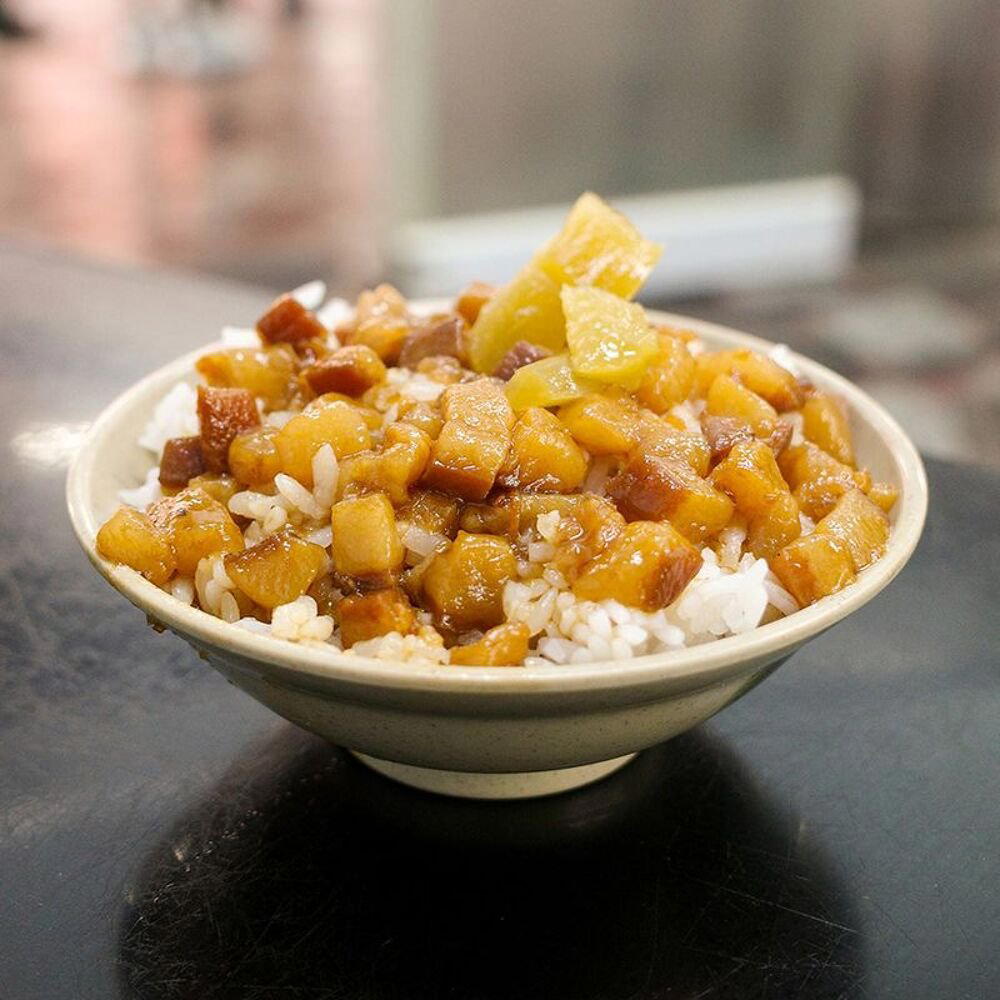
A Sanchong institution that has been ladling braised pork rice for over 20 years, Chin Ta Lu Rou Fan sits at the working transport corridor between Taipei and its industrial neighbours. Diced fatty pork slow-cooked in sweet soy, cut by tangy pickles, and accompanied by a ceramic-jar pork rib soup represents the dish in one of its most focused expressions in the New Taipei area.
 Discover on Pearl
Pearl is the En Primeur Club membership app — saves, bookings, and concierge access live there. Same editors, same standards.
- Address
- 40 Daren Street, Sanchong District
- Phone
- +886 2 2983 6726
Where the Commuter Belt Meets the Bowl
Daren Street in Sanchong District occupies a particular position in the geography of the Greater Taipei basin. Sandwiched between the Danshui River and the arterial roads feeding into Taipei's northern districts, Sanchong has historically been a throughput zone: workers moving between the city's administrative core and its manufacturing and logistics periphery. The food that has taken root here reflects that function. It is fast, filling, precisely calibrated for people who have somewhere else to be. Lu rou fan, the braised pork rice that defines a certain register of Taiwanese everyday eating, belongs to this context almost by definition.
Chin Ta Lu Rou Fan, at 40 Daren Street, has occupied this junction for over 20 years. The address alone tells you something about the intended audience: not a destination restaurant extracting effort from its diners, but a fixed point in a daily routine, the kind of place that earns its reputation one repeat visit at a time. That accumulation of trust, across two decades of service to a neighbourhood defined by transit, is its own credential.
Lu Rou Fan in Its Sanchong Register
Lu rou fan is one of those dishes where the gap between a mediocre version and a good one is immediately legible, even to first-time visitors. The variable that separates them is almost always the pork fat ratio and the length of the braise. Too lean and the rice stays dry; too brief a cook and the collagen never fully breaks down into that characteristic sticky gloss. The version here uses diced fatty pork rather than the minced format more common in southern Taiwan, slow-cooked in a sweet soy base until the fat has rendered down to something approaching liquid silk. Tangy pickles arrive alongside, providing the acidic counterpoint that keeps the dish from becoming cloying across a full bowl. White pepper, available to add at the table, opens the aromatics further.
The accompaniment format here points toward a specific northern Taiwanese eating tradition. The pork rib soup, double-steamed in a ceramic jar, is not a side dish in the casual sense. The ceramic vessel retains heat and, more importantly, concentrates the broth through steam rather than reducing it on an open flame, producing a cleaner, less aggressive savouriness than a standard stockpot delivers. The pairing of a ceramic-jarred soup with a soy-braised rice bowl is a combination that speaks to the functional elegance that characterises the better end of Taiwanese street food.
This shop sits in a peer group that spans the working-lunch counters of Sanchong and the more celebrated lu rou fan destinations that draw visitors from across the city. The distinction between the two tiers is not always quality: it is often visibility, access, and whether a place has been absorbed into the tourism circuit. Chin Ta Lu Rou Fan remains on the working side of that divide, which for most visitors makes it the more interesting proposition. For a broader map of what the New Taipei eating scene covers, from taro ball shops like A Gan Yi Taro Balls and A-ba's Taro Ball to the Teochew-influenced cooking at Amajia and the bak kut teh format at BAK KUT PAN, the full New Taipei restaurants guide covers the range.
The Queue as Quality Signal
The instruction to expect queues during peak hours is not a warning so much as a description of the operational model. Shops like this one do not manage demand through reservations or timed sittings; they manage it through throughput. A queue that forms and dissipates in rhythm with the lunch and dinner rush is the mechanism by which a small kitchen at a fixed address serves the maximum number of people without restructuring into something it is not. Coming outside the core hours, mid-morning or mid-afternoon, bypasses that constraint without changing what arrives in the bowl.
Taiwan's street food and casual dining registers operate on a logic that higher-format restaurants in the same country do not. The fine dining tier, represented elsewhere in Taiwan by places like JL Studio in Taichung, logy in Taipei, and GEN in Kaohsiung, operates on advance bookings, tasting formats, and structured progression. The register occupied by Chin Ta Lu Rou Fan operates on none of those terms. The value proposition is transparency: a small number of things, cooked well, available to anyone who arrives and waits their turn. That directness is not a lesser version of hospitality; it is a different and, in its own framework, complete version of it.
The contrast extends internationally. Considered against reservation-driven dining rooms like Le Bernardin in New York City or Emeril's in New Orleans, the Sanchong model seems categorically different. But the underlying principle, that a place earns authority through consistency over time, applies across every tier.
Planning a Visit
Sanchong District is accessible via the Taipei MRT network, with connections into central Taipei running frequently. The address at 40 Daren Street places the shop within the district's denser commercial grid, walkable from the transport interchange. No reservation system is in place; the format is walk-in only. Arriving outside the standard lunch window, between noon and one-thirty, or the dinner rush, reduces wait time without sacrificing anything in the bowl. No phone or website is listed, which reflects the operational model: the shop's longevity and local reputation function as its booking infrastructure.
For accommodation and other planning, our New Taipei hotels guide covers the district-by-district options. The bars guide, wineries guide, and experiences guide round out what the wider municipality offers beyond the table. Elsewhere in the New Taipei eating circuit, Chi Yuan represents a different dimension of the local food culture, and Zhu Xin Ju in Tainan and Akame in Wutai Township extend the Taiwan context further afield. For mountain-adjacent hospitality of a different register, Volando Urai Spring Spa & Resort in Wulai District sits within the same broader municipality.
A Minimal comparable set
Comparable venues nearby, for context on price, style, and recognition.
| Venue | Cuisine | Price | Notes |
|---|---|---|---|
| Chin Ta Lu Rou FanThis venue — the venue you are viewing | $ | ||
| Da One Gone Lamb | Banqiao District, Herbal Lamb Soup | $ | |
| Superman | Xindian District, Taiwanese Small Eats | $$ | |
| JIA YEN | $$$ | Banqiao District, Greater Chinese: Cantonese-Shanghai-Sichuan-Zhejiang-Shaanxi Fusion | |
| Shou Wu | Banqiao District, Hakka Cuisine | $$ | |
| SÒNG JHAO | $$ | Yonghe District, Taiwanese with Sichuan Influences |
Continue exploring
More in New Taipei
Restaurants in New Taipei
Browse all →
Bars in New Taipei
Browse all →
Hotels in New Taipei
Browse all →
Wineries in New Taipei
Browse all →
At a Glance
- Hidden Gem
- Cozy
- Casual Hangout
- Standalone
Casual, no-frills small shop atmosphere.