Our verdict
Schnitzelei Mitte occupies a Hinterhof off Chausseestrasse, operating in the tradition of Berlin's no-frills schnitzel houses that have anchored working neighbourhoods for generations. The format is deliberate in its simplicity: a single dish executed with consistency, served to a clientele that returns on routine rather than occasion. It sits outside the city's Michelin circuit and is better understood alongside it.

Pearl is the En Primeur Club membership app, where members save venues, book tables and use the concierge.

The menu
What to order
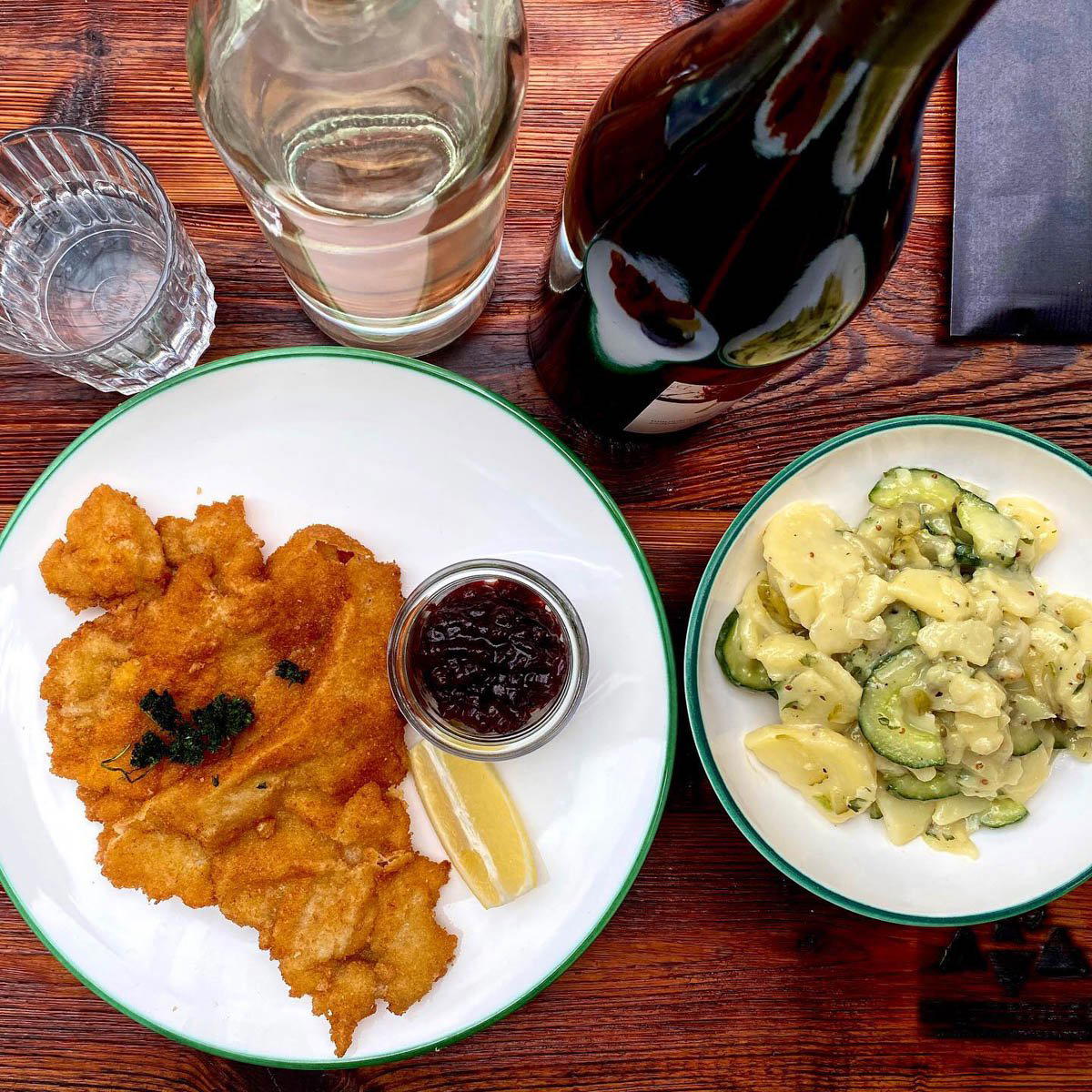
- Wiener Schnitzel
- Vegan oyster mushroom schnitzel
The Hinterhof and What It Signals
Berlin has long organised a particular kind of dining around its Hinterhöfe, the rear courtyards reached through arched passageways that bisect residential and commercial blocks across Mitte, Prenzlauer Berg, and beyond. These spaces have housed printing presses, workshops, and underground clubs at different points in the city's history, and they continue to host restaurants that benefit from the deliberate remove they create. Schnitzelei Mitte sits in one such courtyard off Chausseestrasse 8, accessible through a passage that filters out casual foot traffic before a guest even reaches the door. In practical terms, this means the room fills with people who came specifically, not accidentally. That self-selection shapes the atmosphere as much as any design decision.
The broader context matters here: Berlin's restaurant scene has fractured into distinct tiers over the past decade. At the upper end, addresses like Rutz, Nobelhart & Schmutzig, and FACIL operate tasting-menu formats with Michelin recognition, pricing that reflects kitchen complexity, and booking windows measured in weeks. CODA Dessert Dining and Restaurant Tim Raue occupy similarly ambitious territory. Understanding it requires accepting that comparison.
What Regulars Actually Come For
The restaurants that accumulate genuine repeat clientele in Berlin tend to do so through consistency and specificity rather than novelty. Schnitzelei Mitte fits that pattern: the name is the menu, and the menu is the point. The schnitzel as a format has a precise claim on Central European culinary identity. Properly executed, it demands thin, evenly pounded meat, a breadcrumb coating that stays adhered through the frying process, and a fat temperature high enough to cook the coating before the meat loses moisture. Done correctly, the result arrives at the table with a crust that audibly separates from the meat beneath it. That gap, a result of the coating puffing slightly during frying, is the mark of the technique working as intended.
Regulars at schnitzel-focused restaurants across Berlin and Vienna tend to read this quickly. They are not ordering into an unknown. They arrive with a developed baseline expectation and return when that expectation is met reliably. This is a different loyalty mechanism than the one operating at tasting-menu restaurants, where return visits are partially about tracking a kitchen's evolution. Here, the draw is repetition confirmed.
The Hinterhof location reinforces this. A courtyard address in Mitte is not a discovery for most people who find it. It requires a name or a recommendation. The clientele that arrives is therefore pre-qualified in a way that street-level restaurants are not: they know what they are looking for and made a specific effort to find it.
Berlin's Schnitzel Tradition in a Wider Frame
Germany's relationship with the schnitzel is more regionally layered than the dish's apparent simplicity suggests. The Wiener Schnitzel is legally protected as a designation in Austria, requiring veal, but German iterations have always accommodated pork, chicken, and turkey variants without the same restrictions. Berlin's interpretation has historically leaned toward the pork Schnitzel Wiener Art, a version that follows the same method without the protected designation. The dish's affordability and scalability made it a staple of the kind of no-frills neighbourhood restaurants that Berlin maintains in greater density than most comparable European capitals.
That density is worth noting. While fine-dining programmes in Germany have concentrated significantly in destinations like Wolfsburg, Baiersbronn, and Bergisch Gladbach, and in smaller cities such as Piesport, Trier, and Grassau, Berlin's culinary identity has never been anchored in Michelin density alone. Addresses like Victor's Fine Dining by Christian Bau in Perl, Waldhotel Sonnora in Dreis, and Restaurant Haerlin in Hamburg represent a strain of German fine dining built around formal service and classical structure. Berlin, by contrast, has always maintained a parallel tradition of forthright, ingredient-led eating that resists that formality. Schnitzelei Mitte belongs to that tradition.
This places it in interesting company when considered against international reference points. The same logic that governs a loyalist schnitzel house in Mitte is the logic that governs a neighbourhood trattoria in Rome or a ramen counter in Osaka: narrow focus, consistent execution, clientele that self-selects through knowledge rather than proximity. It is a different ambition than the one driving Le Bernardin in New York or Atomix, but not a lesser one. It is simply operating against a different standard of success. For a broader view of where Schnitzelei Mitte sits within Berlin's dining scene, the EP Club Berlin restaurants guide maps the city's full range, from the Michelin circuit to the neighbourhood institutions that shape daily eating.
Readers planning a broader German itinerary that includes fine dining at addresses like JAN in Munich will find Schnitzelei Mitte useful as a counterpoint: a deliberate step down in register that clarifies, by contrast, what each format is actually doing.
Planning Your Visit
The Chausseestrasse address places Schnitzelei Mitte in the northern section of Mitte, within walking distance of the Naturkundemuseum U-Bahn station and the broader cultural corridor running toward the Hamburger Bahnhof. The courtyard access point means first-time visitors should confirm the passage entrance before arriving. Reservations: Dress: No dress code information is available; the format and neighbourhood context suggest casual dress is standard. Budget:
Frequently asked questions
What part of town is Schnitzelei Mitte in?
Schnitzelei Mitte is located at Chausseestr. 8 Hinterhof erreichbar über, Berlin.
How do I find Schnitzelei Mitte's entrance on Chausseestrasse?
The restaurant sits in a Hinterhof, a rear courtyard, reached through a passageway at Chausseestrasse 8 in Berlin Mitte, a format common to the neighbourhood's older building stock. The entrance is not street-facing, so look for the archway or gate rather than a shopfront. The nearest U-Bahn station is Naturkundemuseum, making it straightforward to reach from central Berlin.
What's the best thing to order at Schnitzelei Mitte?
The schnitzel is the operational centre of the menu, that is the point of coming. Berlin's Mitte location and the Hinterhof setting both signal a focused, no-detour approach to the dish rather than a broad German brasserie format. Order accordingly and skip the impulse to treat this as a multi-course venue.
Do they take walk-ins at Schnitzelei Mitte?
Schnitzelei Mitte is located in a Hinterhof off Chausseestrasse 8, accessed through a rear courtyard passageway, which means first-time visitors should allow extra time to find the entrance. Walk-in availability is not formally documented, so arriving at off-peak hours on weekdays is the lower-risk approach. Calling ahead is advisable given the courtyard access.
What makes Schnitzelei Mitte worth seeking out?
The Hinterhof address is the first signal: restaurants that survive in Berlin's rear courtyards do so on repeat local trade rather than tourist foot traffic. Schnitzelei Mitte has built its clientele in Mitte's northern section around consistency with a single dish category, which in Berlin's crowded dining field is a more durable proposition than novelty-driven menus. The Chausseestrasse location also puts it within the residential fabric of the neighbourhood rather than the heavily touristed centre.
Accolades, Compared
Comparable venues nearby, for context on price, style, and recognition.
| Venue | Cuisine | Price | Notes |
|---|---|---|---|
| Schnitzelei MitteThis venue (the venue you are viewing) | Modern German Schnitzel | $20–30 | Not listed |
| Neue Zukunft | German Beer Garden Pub | Not listed | Friedrichshain |
| Fischer & Lustig | Traditional German Fish & Meat | $30–50 | Mitte |
| Försters | Vegan German Home Cooking | $20–30 | Prenzlauer Berg |
| The Dining Room' | Sophisticated German Cuisine | Not listed | Baumschulenweg |
| Wiener Conditorei Caffeehaus | Viennese Bakery Café | $10–20 | Grunewald |