
A Michelin Plate-recognised contemporary restaurant on Osaka's Nakanoshima island, Rooots is the sister location to a Hiroshima original. The kitchen works a French-Italian register using ingredients from the Kinki region and Hiroshima, with potato gnocchi as the signature. At ¥¥¥, it occupies a considered mid-tier in Osaka's increasingly competitive European-influenced dining scene.
Pearl is the En Primeur Club membership app — saves, bookings, and concierge access live there. Same editors, same standards.
- Address
- Japan, 〒530-0005 Osaka, Kita Ward, Nakanoshima, 6 Chome−1−45 フクエイ中之島 102
- Phone
- +81 6-7777-0822
- Website
- omakase.in
- Directions
- Get directions
 Saves & bookings on Pearl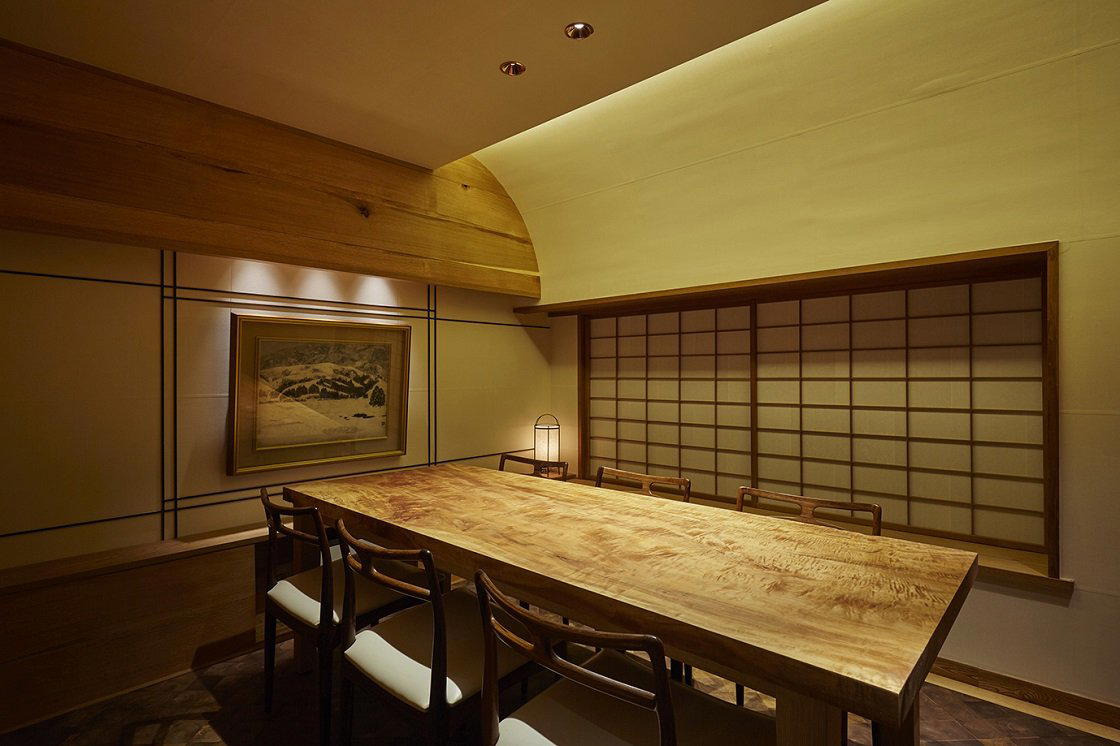
Where Nakanoshima Meets the Italian South
Nakanoshima, the slender island wedged between the Dojima and Tosabori rivers in central Osaka, has long carried a civic gravity, government offices, the Museum of Oriental Ceramics, a park that fills with cherry blossoms in early April and soft persimmon light through October. Its restaurant scene has developed more quietly than Namba or Shinsaibashi, drawing a professional, local crowd rather than the tourist circuit. That context matters for understanding what Rooots Nakanoshima is doing and who it is doing it for. This is a restaurant in a neighbourhood that takes its food seriously without performing it.
The address, tucked inside the Fukuei Nakanoshima building on the island's western end, signals something low-key from the approach. Contemporary European cooking in Osaka often announces itself with more fanfare. Here, the tone is set before you sit down: considered, without theatre, focused on what arrives on the plate.
The Franco-Italian Register and What It Means in Osaka
Osaka's European-influenced dining tier has expanded significantly over the past decade. At the ¥¥¥¥ ceiling, HAJIME (French, Innovative) and La Cime (French) operate at a Michelin-starred intensity that positions them as destination restaurants first. Rooots sits at ¥¥¥, sharing that tier with several kaiseki and Japanese-format restaurants, including Tosara and Kamado. What distinguishes Rooots within that tier is the kitchen's specific culinary grammar: Italian technique as the structural foundation, French influence layered over it from the Hiroshima flagship, and Kinki-region produce as the primary ingredient source.
That layering is not unusual in Japan's contemporary restaurant scene, the country has absorbed European culinary traditions with a precision that often exceeds the originals, but the particular combination here produces something with its own coherence. Italian cooking's emphasis on texture and simplicity, French cooking's saucing logic and refinement: when applied to ingredients sourced from the surrounding Kinki region and the chef's home prefecture of Hiroshima, the result is a menu that reads as regional without being parochial. The double-O spelling in the name, Rooots rather than Roots, is deliberate: those culinary origins run deep enough to warrant the extra character.
For a comparative frame within Japan's contemporary European scene, akordu in Nara follows a comparable model of European technique applied to local Japanese ingredients. At the international level, Jungsik in Seoul and César in New York City work similar cultural translation projects in their own cities. The instinct to anchor European cooking in local produce and identity has become one of the defining moves of contemporary restaurant culture across the Asia-Pacific region.
The Signature: Potato Gnocchi as Argument
The potato gnocchi carries greater weight on the menu, both as a signature dish and as an argument for what the kitchen believes. Gnocchi is among the more technically exacting pasta forms: the ratio of potato to flour, the handling of the dough, the cook time all sit on a narrow margin between correct and collapsed. That a kitchen rooted in Italian technique would choose it as its statement dish rather than a more forgiving format says something about confidence in execution.
The ingredient sourcing, Kinki region produce alongside Hiroshima materials, means the gnocchi's flavour profile will shift across the year. Autumn through winter, when Osaka's markets run to root vegetables and citrus, is when that kind of dish tends to express itself with the clarity. Spring, with the cherry blossom season drawing visitors to Nakanoshima's riverside park, also represents a strong window for visiting: the city is at its most atmospheric, and seasonal produce transitions from winter roots to lighter spring ingredients.
Recognition and Where It Sits
Rooots Nakanoshima holds a Michelin Plate (2024), the guide's signal for a restaurant producing food worth seeking out below the starred tier. In Osaka's Michelin universe, that places it in substantial company: the city has one of the densest concentrations of Michelin recognition anywhere in the world, which means a Plate here reflects real quality without implying any shortfall.
At ¥¥¥, Rooots occupies a more accessible price point than Osaka's Michelin-starred European rooms. For context on what ¥¥¥¥ delivers in the French-innovative category, the starred kitchens at HAJIME and La Cime operate at a different price and expectation tier. Rooots is not competing with them; it occupies a different position for a different decision. The comparison that matters more is within the ¥¥¥ contemporary European category, where its Franco-Italian framework and Hiroshima lineage give it a distinct identity.
For broader Osaka dining context, the RiVi entry in our guide reflects similar positioning dynamics in the city's contemporary scene. Across Japan, restaurants working the European-meets-local register include Harutaka in Tokyo, Gion Sasaki in Kyoto, Goh in Fukuoka, 1000 in Yokohama, and 6 in Okinawa, each working its own regional-European synthesis.
Planning Your Visit
Rooots Nakanoshima is on the western end of Nakanoshima island in Osaka's Kita Ward, inside the Fukuei Nakanoshima building at 6 Chome-1-45 Nakanoshima. Budget: ¥¥¥, placing it in the mid-upper tier for Osaka contemporary dining. Leading timing: Autumn and early spring, when Nakanoshima's riverside setting is at its leading and seasonal ingredient transitions align with the kitchen's sourcing approach. Dress: No confirmed dress code; the Nakanoshima setting and ¥¥¥ price point suggest smart-casual as the default.
Comparable Venues
Comparable venues nearby, for context on price, style, and recognition.
| Venue | Cuisine | Price | Notes |
|---|---|---|---|
| Rooots NakanoshimaThis venue — the venue you are viewing | Modern French-Italian Fusion | $$$$ | Not listed |
| capi | Innovative Fusion Omakase | $$$$ | Kita |
| milpa | Modern Mexican | $$$$ | Nishi |
| Naniwakappo NOBORU | Naniwa Kappo | $$$$ | Kita |
| La casa TOM Curiosa | Contemporary Italian Omakase | $$$$ | Kita |
| La Baie | Michelin-Starred French Seafood | $$$$ | Kita |
Recognition history
Dated appearances from independent guides and award organizations, with the underlying list record or original source where available.
Michelin 1 Star
Michelin
Michelin Plate
Michelin
Continue exploring
More in Osaka
Restaurants in Osaka
Browse all →




Bars in Osaka
Browse all →

Hotels in Osaka
Browse all →




Wineries in Osaka
Browse all →
At a Glance
- Sophisticated
- Elegant
- Intimate
- Modern
- Special Occasion
- Date Night
- Chefs Counter
- Extensive Wine List
- Sake Program
- Sommelier Led
- Local Sourcing
Current opening hours
- Monday
- 12–3 PM, 6–10:30 PM
- Tuesday
- 12–3 PM, 6–10:30 PM
- Wednesday
- Closed
- Thursday
- 12–3 PM, 6–10:30 PM
- Friday
- 12–3 PM, 6–10:30 PM
- Saturday
- 12–3 PM, 6–10:30 PM
- Sunday
- 12–3 PM, 6–10:30 PM
Hours can change for holidays and private events. Last verified .
Sophisticated and refined setting with stylish, relaxing counter-only space emphasizing an intimate, high-end dining experience.