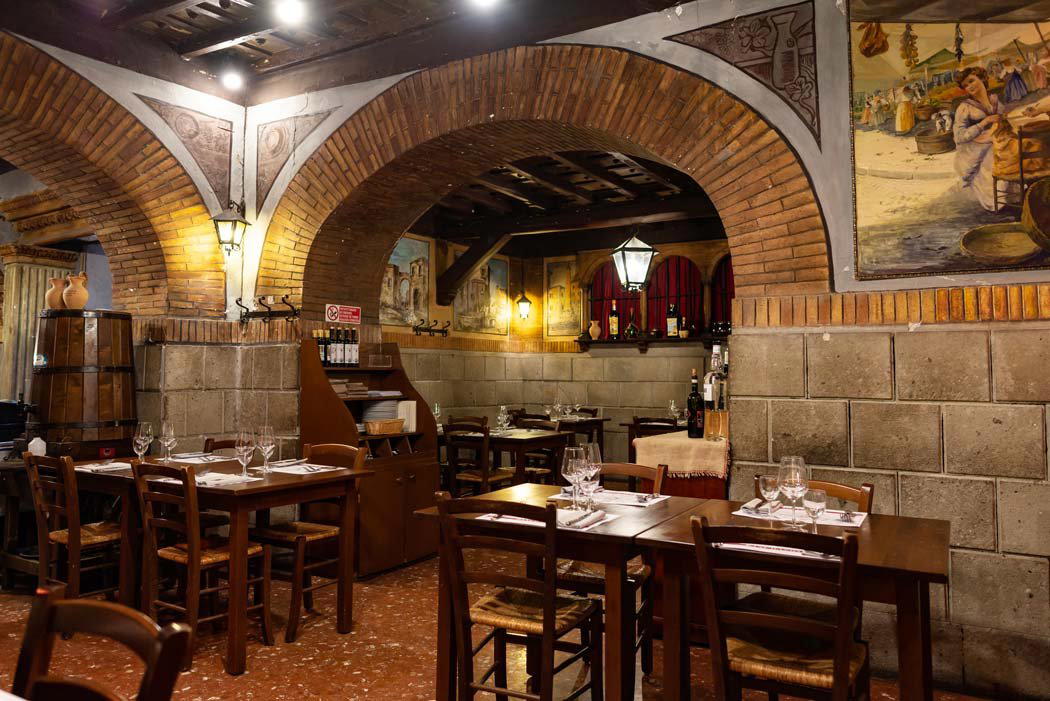
Ristorante Pancrazio occupies a corner of Campo de' Fiori's southern edge, on Piazza del Biscione, where the neighbourhood transitions from market chaos to quieter medieval streets. The restaurant is associated with Roman tradition and draws on the deep culinary identity of Lazio, positioning itself among the city's more historically grounded dining addresses rather than its contemporary tasting-menu circuit.
 Discover on Pearl
Pearl is the En Primeur Club membership app — saves, bookings, and concierge access live there. Same editors, same standards.
- Address
- P.zza del Biscione, 92, 00186 Roma RM, Italy
- Phone
- +393966861246
- Website
- quandoo.it
Where the Menu Tells the Story of a City
Piazza del Biscione sits on the southern rim of Campo de' Fiori, one block removed from the noise of the daily market and the tourist-facing trattorias that crowd the square itself. The streets here narrow and darken slightly, the buildings older and the foot traffic less deliberate. It is the kind of address that rewards orientation over accident: you arrive because you planned to. Ristorante Pancrazio occupies this corner with the quiet confidence of a place that has long served the neighbourhood.
Rome's dining identity has always been fractured along a clear axis. On one side sit the contemporary tasting-menu restaurants, venues like Il Pagliaccio, Acquolina, and Enoteca La Torre, where the menu functions as a composed argument about technique and seasonality. On the other sits the trattoria-to-ristorante continuum, where the menu is less a statement than a record, of what Roman cooking has always demanded from its ingredients, its seasons, and its diners. Pancrazio belongs to that second tradition, and understanding that distinction is the first step to reading the menu correctly.
How the Menu Is Built, and What It Reveals
In Rome's more historically anchored restaurants, menu architecture tends to function as a kind of editorial, a sequence of decisions that communicates a position on Roman cooking rather than on contemporary Italian gastronomy broadly. The logic is antipasto, primo, secondo, contorno: a structure that predates the tasting-menu format by centuries and still carries genuine argumentative weight. Each course exists as a category with its own internal logic rather than as a stepping stone in a chef's composed narrative.
This format places the responsibility of curation on the diner rather than the kitchen. You are not being led through a sequence designed to build toward a single crescendo. Instead, you are making choices within a structure, and those choices reveal your own literacy with Roman cooking. The antipasto section in a restaurant of this type typically signals its sourcing instincts: whether it leans on preserved traditions (supplì, offal preparations, cured fish) or hedges toward safer, more tourist-accessible options tells you something immediate about the kitchen's confidence in its clientele.
The primi in a Roman context are dominated by pasta preparations with deep Lazio roots: cacio e pepe, carbonara, amatriciana, gricia. These four dishes have become something close to a canon, and the margin between a competent and a serious version of each is measurable. Technique here is everything, the emulsification of the sauce, the choice of guanciale, the age and type of pecorino, whether the pasta carries any colour from the eggs. No tasting note or menu description can substitute for that evidence once it arrives at the table. In a restaurant operating within this tradition, the primi are where a kitchen announces its standards most plainly.
The secondi in the Roman tradition are where the historical record of Lazio's cucina povera becomes most legible. Abbacchio, coda alla vaccinara, trippa alla romana, dishes that developed around inexpensive cuts and long preparation times. The presence or absence of these preparations on a menu, and their proportion relative to more neutral proteins, is one of the clearest indicators of a restaurant's genuine relationship with the tradition it claims.
Positioning Within Rome's Dining Tiers
Rome's fine-dining conversation in 2024 centres on a relatively small number of addresses. La Pergola, with its three Michelin stars atop the Cavalieri hotel, sits at the top of the formal tier. Immediately below are the two-star and one-star operations with contemporary ambitions: Achilli al Parlamento among them. But the city has always maintained a parallel prestige tier that operates outside the award-recognition system, restaurants whose reputation rests on continuity, neighbourhood anchoring, and a consistent reading of Roman cooking over decades rather than on innovation cycles.
Pancrazio sits in this second tier. The competitive set here is not the Michelin-tracked contemporary restaurants but rather the handful of family-run or historically embedded ristoranti in the centro storico that have maintained standards across multiple generations of Roman dining culture. Against that peer group, the measure of quality is fidelity and consistency rather than evolution, a different but equally demanding standard.
This distinction matters for readers who arrive in Rome having tracked the contemporary Italian fine-dining circuit. Venues like Osteria Francescana in Modena, Le Calandre in Rubano, or Piazza Duomo in Alba represent the Italian fine-dining canon in its most internationally visible form. Rome's contribution to that conversation runs through La Pergola. But the city's deeper culinary identity is expressed through a different register entirely, one that Pancrazio is positioned within.
The Neighbourhood as Context
Campo de' Fiori's surrounding streets hold some of Rome's densest concentration of historic restaurant addresses. The area draws both Roman regulars and well-oriented visitors, and it has generally retained more neighbourhood credibility than the streets immediately adjacent to the Pantheon or Piazza Navona, where tourist volume has pushed out a significant share of serious cooking. Piazza del Biscione sits at the edge of this concentration, far enough from the Campo's market square to avoid the worst of the lunchtime tourist surge, close enough to retain the area's characteristic mix of locals and knowing visitors.
For broader context on where Pancrazio sits relative to the full range of serious eating in Rome, Rome's dining tiers run from formal fine dining to neighbourhood trattorie. Internationally, the tradition of regionally grounded Italian cooking expressed across long-format menus also finds expression at Dal Pescatore in Runate, Uliassi in Senigallia, and Reale in Castel di Sangro, each of which anchors deeply in a regional tradition while operating at the highest level of Italian dining.
Know Before You Go
- Address: Piazza del Biscione, 92, 00186 Roma, Italy
- Neighbourhood: Campo de' Fiori / Centro Storico
- Reservations: Booking ahead is advisable for dinner, particularly on weekends, given the address's neighbourhood draw and limited tourist-replacement turnover
- Leading approach: Walk from Campo de' Fiori (30 seconds south) or from Largo Argentina (5 minutes north)
- Dress code: Smart casual is the accepted standard in this price tier across the centro storico
- Note: Hours run daily from 9 AM to 12 AM, and the price per person is about $30.
Price and Positioning
Comparable venues nearby, for context on price, style, and recognition.
| Venue | Cuisine | Price | Awards | Notes |
|---|---|---|---|---|
| Ristorante PancrazioThis venue — the venue you are viewing | Parione, Traditional Roman Trattoria | $$ | , | |
| Er Faciolaro | Colonna, Classic Roman Trattoria | $$ | , | |
| Piatto Romano | Testaccio, Authentic Roman Trattoria | $$ | , | |
| Taverna Urbana | Monti, Roman Trattoria | $$ | , | |
| Amaranto | Trieste, Modern Roman Pizza al Taglio | $$ | , | |
| Mamma Angelina | $$ | , | Trieste, Traditional Roman Trattoria with Fresh Seafood |
Continue exploring
More in Rome
Restaurants in Rome
Browse all →
Bars in Rome
Browse all →
Hotels in Rome
Browse all →
Wineries in Rome
Browse all →
At a Glance
- Classic
- Historic
- Intimate
- Rustic
- Date Night
- Special Occasion
- Historic Building
Rustic and atmospheric with historical charm from ancient Roman ruins, providing an intimate and romantic setting away from tourist chaos.