Reibekuchen Heinz is a street-food fixture on Olpener Strasse in Cologne's eastern districts, where the city's long tradition of potato pancake stands operates well outside the tourist centre. The format is utilitarian by design: counter service, no reservations, and a menu anchored to one of Rhineland cooking's most durable staples. For visitors who know Cologne beyond the cathedral quarter, this is where the local eating tradition has fewer concessions to outside tastes.
Pearl is the En Primeur Club membership app — saves, bookings, and concierge access live there. Same editors, same standards.
- Address
- Olpener Str. 870a, 51109 Köln, Germany
- Phone
- +491724841338
- Website
- reibekuchen-heinz.de
- Directions
- Get directions
 Saves & bookings on Pearl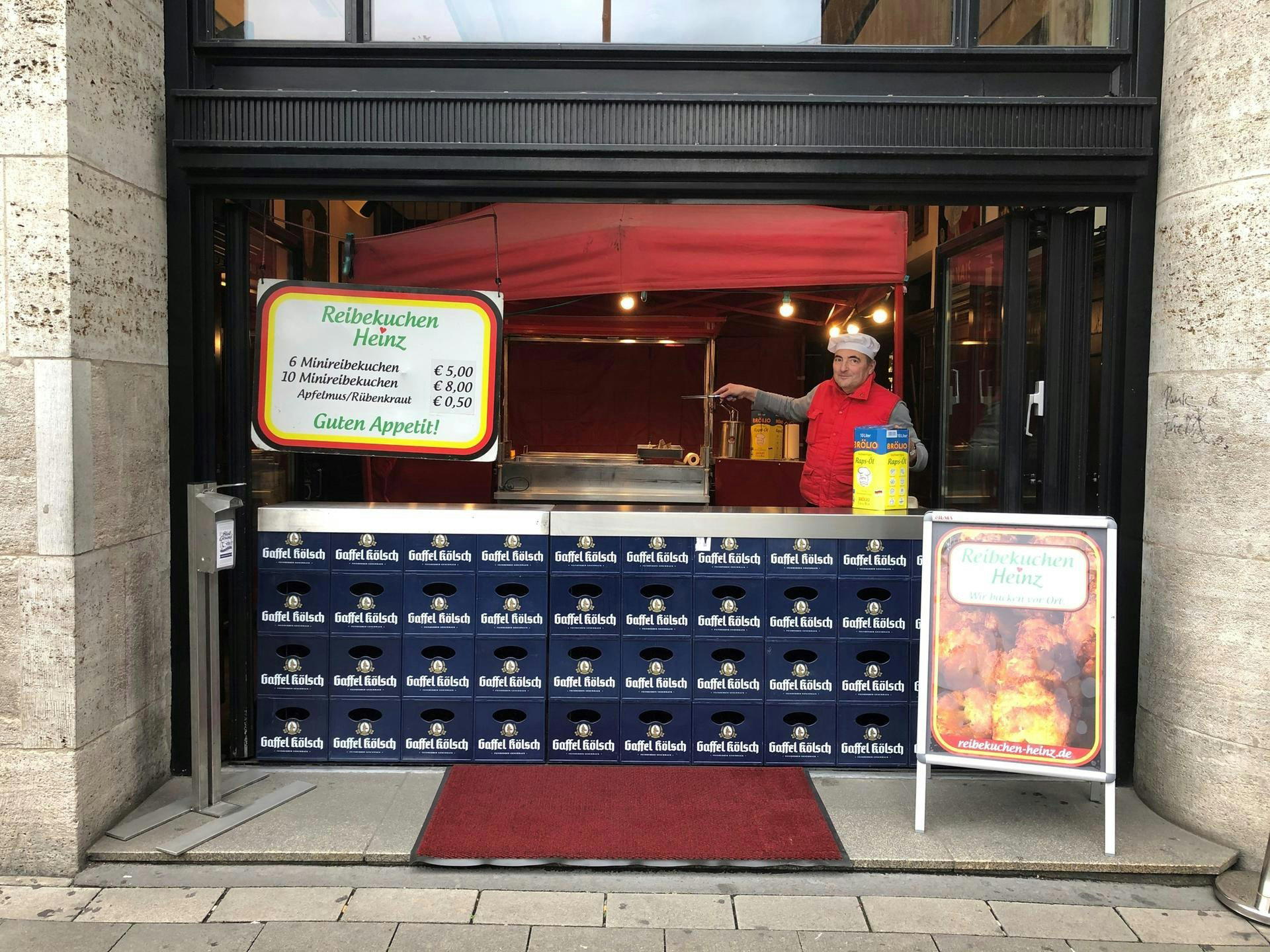
The Rhineland Potato Pancake Tradition, and Where Heinz Fits
Cologne's relationship with the Reibekuchen, the thin, crisped potato pancake that has appeared at every Christmas market, fairground, and neighbourhood snack stand in the Rhineland for generations, is not a nostalgic affectation. It is a functioning food culture, one that operates through a network of dedicated small operators rather than restaurant kitchens. Reibekuchen Heinz is a restaurant at Olpener Str. 870a, 51109 Köln, Germany, serving Traditional German Potato Pancakes. The address itself tells you something: this is not the tourist-facing version of Cologne, shaped around the cathedral and the Hohe Strasse. It is a working-neighbourhood spot that serves a local clientele on their own terms.
In German cities, the distinction between a restaurant and a stand-format food operation is not merely one of size. It reflects a separate eating logic: immediate, informal, standing-up or taken away, priced for regularity rather than occasion. The Reibekuchen stand sits firmly in that category, alongside the Currywurst counter and the Döner kiosk, but with deeper regional roots than either. The potato pancake predates fast food as a concept. It is Rhineland street cooking in its least modified form.
Counter Format, Physical Setting, and the Logic of the Stand
The design language of a Reibekuchen operation is spare by necessity. A frying station, a counter, somewhere to take your order. Reibekuchen Heinz operates in that register. The physical container is functional rather than curated: the experience is structured around proximity to the cooking process, the audible sound of batter hitting hot oil, and the transaction speed that counter service demands. There is no interior dining architecture to assess in the way you would at Cologne's higher-end addresses. The seating arrangement, if it exists at all, will be the street itself or a ledge surface rather than a chair and table.
This format is worth understanding on its own terms rather than against a fine-dining comparison. The absence of tables, reservations, and menu complexity is not a limitation, it is the category specification. Visitors oriented toward the table-service end of Cologne's food scene, including addresses like Ox & Klee, La Cuisine Rademacher, or La Société, are looking at a different eating occasion entirely. Reibekuchen Heinz belongs to a separate axis of the city's food provision, one defined by immediacy and tradition rather than by creative programming.
What the Dish Is, and Why It Persists
The Reibekuchen is made from grated raw potato, shaped loosely, and fried until the edges crisp and the interior cooks through. The canonical accompaniments in the Rhineland are apple sauce (Apfelmus), which provides acidity against the fat, or sour cream. Some operators add onion to the batter; others keep it plain. The ratio of surface area to volume means that the crust-to-interior ratio is high relative to a thicker potato preparation, and the leading examples carry a pronounced savoury depth from the Maillard reaction on the exterior. The specific preparation details at Reibekuchen Heinz are not described here, but the category conventions are consistent across the region.
The dish persists because it costs relatively little to produce and delivers a specific textural satisfaction that has no close substitute in German street food. It is also tied to a particular seasonal rhythm: Christmas markets across Cologne and the broader Rhineland run Reibekuchen stalls from late November through December, making the dish inextricably linked to the cold months in public consciousness. Year-round operators like stand-format specialists occupy a different position, serving the dish outside its festive context and sustaining the tradition as a daily food rather than a seasonal event.
Eastern Cologne's Eating Character
51109 postal district, where Olpener Strasse runs, sits in the eastern part of the city well beyond the Deutz bridge and the inner ring. The neighbourhood's food provision reflects a mixed residential character: bakeries, döner operations, small supermarkets, and local snack stands are more representative than the bistros and wine bars that populate Ehrenfeld or the Belgian Quarter. This is where Cologne eats practically rather than aspirationally, and a Reibekuchen stand fits the area's functional eating culture without friction.
Visitors who take the city's restaurant scene seriously, tracking tables at Le Moissonnier Bistro or maiBeck, occasionally move through neighbourhoods like this in search of the less-curated version of Cologne's food culture. The eastern districts offer that, though the density of notable food operations is lower than in the more documented western and inner-city areas. A Reibekuchen stand is not an anchor destination for a city trip, but it functions as a grounding reference point for the kind of everyday food culture that restaurant guides rarely cover in depth.
Placing This Against Germany's Wider Fine-Dining Map
The contrast with Germany's higher-end restaurant scene is instructive, not to suggest competition between categories, but to clarify where each sits. Germany's multi-Michelin end is anchored by addresses like Aqua in Wolfsburg, Vendôme in Bergisch Gladbach, and Victor's Fine Dining by Christian Bau in Perl. Within the Rhineland region specifically, Waldhotel Sonnora in Dreis represents the formal end of the spectrum. Cologne's own ambitious table-service addresses include comparative reference points in the Black Forest for context on how regional German fine dining operates outside the city. None of these overlap with the street-food category. They exist on separate axes, and treating them as a hierarchy rather than as distinct food-occasion types misreads how German eating culture actually functions.
Internationally, the pattern holds: the artisanal street-food specialist and the multi-course tasting counter occupy different purpose categories. A traveller who books at Le Bernardin in New York or Atomix on the same trip is not making a contradictory choice by also seeking out a neighbourhood stand. The two eating occasions serve different functions in a complete picture of a city's food provision.
Planning a Visit
The counter-service model means visits are walk-up. The eastern address requires a deliberate trip from Cologne's centre. The stand sits on Olpener Strasse 870a; public transport routes serving that corridor in the 51109 district connect back to the central network, though journey times from the Hauptbahnhof area are longer than for inner-city addresses. Price points for Reibekuchen operations in the Rhineland are generally low relative to table-service dining, the format is built around accessibility, but specific pricing at this location is unconfirmed.
Price and Recognition
Comparable venues nearby, for context on price, style, and recognition.
| Venue | Cuisine | Price | Notes |
|---|---|---|---|
| Reibekuchen HeinzThis venue — the venue you are viewing | Not listed | $ | Not listed |
| Bon Frites | Deutz, German Street Food | $ | Not listed |
| Feinkost Seemann | Not listed | $$ | Bayenthal, Traditional Austrian Specialties |
| Markthalle Körnerstraße | Not listed | $$ | Ehrenfeld, German Market Hall Bistro with Turkish Döner |
| Augustin | Not listed | $$$ | Altstadt/Nord, Modern German-French Brasserie |
| Bun Pho | Not listed | $ | Altstadt/Süd, Authentic Vietnamese Pho & Noodles |
Continue exploring
More in Cologne
Restaurants in Cologne
Browse all →
Bars in Cologne
Browse all →
Hotels in Cologne
Browse all →

At a Glance
- Rustic
- Cozy
- Casual Hangout
- Standalone
Casual street food stand atmosphere focused on fresh, crispy comfort food.