
2 Michelin Stars · La Liste Top Restaurants · Falstaff Restaurant - 97 Falstaff Points
Our verdict
Ox & Klee holds two Michelin stars and consistent La Liste recognition at Cologne's Zollhafen waterfront, where chef Daniel Gottschlich works within the modern European fine dining tradition. The kitchen bridges classical technique and contemporary sensibility at the top of Cologne's price tier, placing it alongside the city's other four-symbol addresses while drawing a distinct culinary line of its own.

Pearl is the En Primeur Club membership app, where members save venues, book tables and use the concierge.
The menu
What to order
- Mackerel with sturgeon caviar and calamansi
- Halve Hahn reinterpretation
- Veal inspired by grandmother's dish
- Mussels with black lime and caviar
Where the Zollhafen Sets the Tone
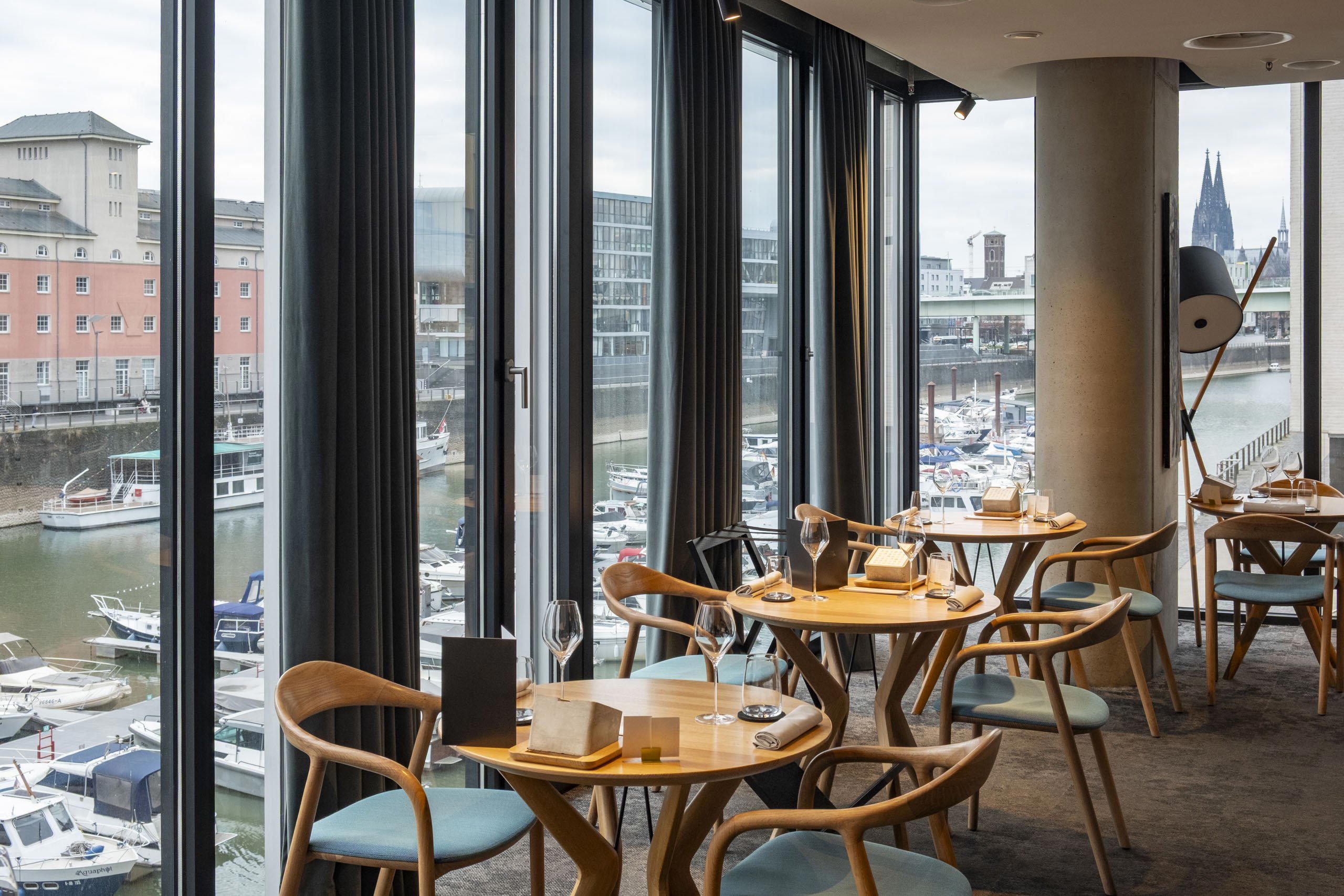
Cologne's Zollhafen district carries the particular atmosphere of post-industrial reinvention done at pace. Former customs warehouses and loading quays along the Rhine have been converted into residential towers, offices, and restaurants over roughly a decade, creating a waterfront precinct that functions as a kind of aspirational urban edge. Im Zollhafen 18, where Ox & Klee operates, sits within this reclaimed geography: the address signals ambition, and the surrounding architecture sets expectations before any plate arrives. Approaching along the harbour promenade, the shift from old Cologne's ecclesiastical skyline to this cleaner, quieter waterline registers immediately. The restaurant occupies a position within that change, as much a product of the neighbourhood's redefinition as of any single culinary programme.
Two Stars in a City Still Finding Its Fine Dining Register
Germany's fine dining tier has long been distributed unevenly across its cities. Munich, Hamburg, and the Black Forest carry much of the Michelin weight nationally, while Berlin punches experimentally rather than classically. Cologne sits in a different position: a commercial and media capital with a strong restaurant culture at every price point, but fewer two-star addresses than cities of comparable scale. Ox & Klee holds two Michelin stars as of both 2024 and 2025, a consistent double-star position that places it at the top of Cologne's fine dining cohort. La Liste, which aggregates critical sources and rankings globally, scored the restaurant at 82.5 points in 2025 and 81 points in 2026. That slight softening in aggregated score across one cycle is worth noting as a signal of how competitive the tier has become internationally, rather than any reflection of a decline in the kitchen's output.
Within Cologne specifically, the two-star position separates Ox & Klee from the broader cluster of ambitious one-star and star-adjacent addresses. La Société and maiBeck represent the city's confident modern European register at a step below; La Cuisine Rademacher and Le Moissonnier Bistro operate within French culinary frameworks that have deep roots in the Rhineland. Ox & Klee occupies the tier above all of them, at €€€€ pricing that aligns with peer counters in Frankfurt or Düsseldorf rather than with Cologne's broader mid-market. For the city's dining scene, the restaurant functions as a proof point that the Rhineland can sustain serious fine dining ambition outside the traditional clusters.
Modern Cuisine as Cultural Position
The classification of Ox & Klee as Modern Cuisine is not simply a booking category. It describes a particular cultural stance that emerged across European fine dining in the 2000s and consolidated through the 2010s: the deliberate refusal to anchor a kitchen's identity to a single national tradition, in favour of technique-led, ingredient-responsive cooking that draws broadly across sources. In Germany, this approach has produced some of the country's most discussed restaurants. JAN in Munich, Aqua in Wolfsburg, and Schwarzwaldstube in Baiersbronn all sit within broadly similar frameworks, though each with distinct regional or biographical inflections. CODA Dessert Dining in Berlin takes the format into a more experimental register; Vendôme in Bergisch Gladbach, just east of Cologne, has been one of the country's reference points for contemporary luxury cooking for years. ES:SENZ in Grassau represents the Bavarian edge of the same conversation.
These are kitchens that have moved past the question of national culinary identity and focus instead on material quality, technical precision, and the structuring of a meal as an extended, considered experience. The cultural roots of this tradition lie partly in Nouvelle Cuisine's break from classical codification in the 1970s and partly in the Scandinavian emphasis on locality and process that reshaped European fine dining from the 2000s onward. At Ox & Klee, under chef Daniel Gottschlich, those broader currents are filtered through a Rhineland sensibility and a very particular address on the Rhine waterfront.
Chef Daniel Gottschlich and the Kitchen's Position
In the Modern Cuisine tier, the chef functions less as personality brand and more as technical curator: the question is not which tradition they represent but how consistently and intelligently the kitchen executes within a demanding, self-imposed brief. Gottschlich's consistent double-star retention across multiple Michelin cycles is the most direct evidence available here. Holding two Michelin stars across 2024 and 2025, in a category where the guide applies significant scrutiny to consistency across visits, requires a kitchen that functions at a high level without variance. That is the institutional signal of a well-run two-star operation, and it is the most meaningful credential available in the absence of detailed menu documentation.
Cologne's Fine Dining Context: What Surrounds Ox & Klee
Any visit to Ox & Klee benefits from understanding what Cologne's restaurant scene looks like at adjacent price points and register. The city's culinary character has traditionally been shaped by its brasserie tradition, its deep French influence given geographical proximity to the border, and a strong civic appetite for informal but quality-focused eating. Ouzeria represents the Mediterranean strand of that informal register. The transition from those mid-market and casual addresses to the two-star tier at Ox & Klee is one of the more pronounced jumps in Cologne's dining spectrum, which is partly why the restaurant has drawn attention beyond the city's immediate dining community.
The Zollhafen location contributes to that dynamic. Waterfront dining in German cities tends to attract a different demographic from historic centre restaurants: more corporate hospitality, more destination dining from outside the city, more deliberate occasion eating. That is not a criticism; it is a structural observation about how premium restaurants in redeveloped districts tend to function.
Planning a Visit
Ox & Klee is at Im Zollhafen 18, 50678 Köln. The Zollhafen is accessible by tram from Cologne's central station, with the waterfront a short walk from the stop, making the logistics direct from central hotels or from the main rail connection. The €€€€ price classification puts this at the top of Cologne's restaurant tier, and booking at this level in Germany typically requires advance planning of several weeks, with demand peaking around weekend evenings and seasonal dining periods. Given the La Liste and Michelin profile, visitors travelling specifically for the meal should treat this as a primary itinerary anchor rather than an add-on. For orientation across the broader city dining scene, our full Cologne restaurants guide maps the range from brasserie to two-star. The Cologne hotels guide, bars guide, wineries guide, and experiences guide cover the rest of the city's premium offer for those building a longer stay around a visit here.
Frequently asked questions
What should I budget for a meal at Ox & Klee?
Pricing at Ox & Klee is listed as €€€€.
Who is the chef at Ox & Klee?
The chef associated with Ox & Klee is Daniel Gottschlich.
What should I order at Ox & Klee?
At the two-Michelin-star level, Ox & Klee operates within a set tasting format rather than à la carte, so the menu is largely decided for you. Chef Daniel Gottschlich works within the Modern Cuisine register, which at this tier means a structured sequence where technique and sourcing carry the argument. The price range (€€€€) places this firmly in Cologne's highest bracket, so arrive expecting a full evening commitment rather than a selective order.
What should I expect cuisine-wise at Ox & Klee?
What's Ox & Klee's location?
Ox & Klee is located at Im Zollhafen 18, 50678 Köln, Germany, Cologne.
Recognition, Side-by-Side
| Venue | Cuisine | Price | Awards | Notes |
|---|---|---|---|---|
| Ox & KleeThis venue (the venue you are viewing) | Modern European Fine Dining with Six-Sense Concept | $200–300 | 2 Michelin Stars · La Liste Top Restaurants | Not listed |
| maximilian lorenz | Modern German Fine Dining | $200–300 | 1 Michelin Star | French Brasserie, Modern Cuisine |
| NeoBiota | Modern European Fine Dining | Not listed | 1 Michelin Star | Modern German, Modern Cuisine |
| ZEN Japanese Restaurant | Modern Japanese Omakase & Sushi | $30–50 | Michelin Plate | Not listed |
| La Cuisine Rademacher | Modern French Fine Dining | $150–200 | 1 Michelin Star | Modern French |
| La Société | Michelin-Starred Modern French | Not listed | 1 Michelin Star · La Liste Top Restaurants | Modern Cuisine |
Recognition history
Dated appearances from independent guides and award organizations, with the underlying list record or original source where available.
Michelin 2 Stars
Michelin
La Liste Top Restaurants
La Liste
Falstaff Restaurant - 97 Falstaff Points
Falstaff
The Best Chef One Knife
The Best Chef
Full recognition history (7 entries)
La Liste Top Restaurants
La Liste
Michelin 2 Stars
Michelin
Michelin 2 Stars
Michelin