On the corner where Via Vigevano meets the Navigli canal, Osteria della Darsena occupies a position that tells you something about Milan's relationship with its waterways: once industrial, now the city's most reliably convivial dining district. The osteria format here leans into that neighbourhood character, pairing canal-side atmosphere with a kitchen that treats the northern Italian table as a living tradition rather than a museum piece.
Pearl is the En Primeur Club membership app — saves, bookings, and concierge access live there. Same editors, same standards.
- Address
- Via Vigevano, 1, 20144 Milano MI, Italy
- Phone
- +39291539321
- Website
- osteriadarsena.it
- Directions
- Get directions
 Saves & bookings on Pearl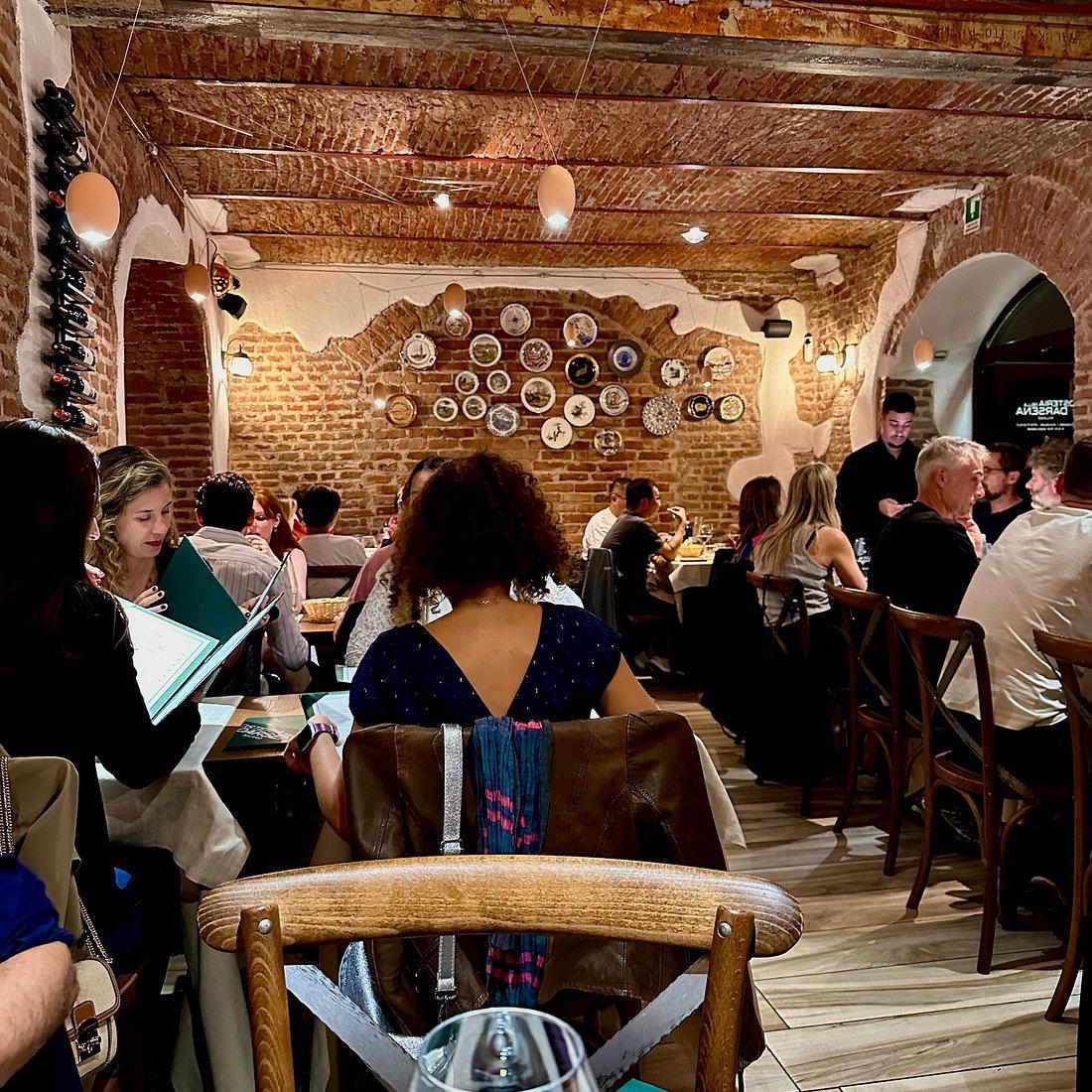
Where the Navigli Sets the Tempo
Via Vigevano runs along the edge of the Naviglio Grande, and the buildings that line it carry the particular weight of a neighbourhood that has been repurposed slowly and honestly. Warehouses became workshops, workshops became bars and restaurants, and the canal-side strip now functions as one of the few parts of Milan where the pace drops below the city's default register. Osteria della Darsena sits at number one on this stretch, positioned at a corner that captures both the foot traffic of the canal towpath and the quieter residential hum of the streets behind. Approaching in the early evening, the light off the water, the low sound of conversation spilling from open windows, the smell of something braising, the scene is enough before you step inside.
The Navigli district has been Milan's informal dining and drinking quarter for decades, but its character is not uniform. The southern end of Naviglio Grande edges toward tourist-facing aperitivo bars with laminated menus; the stretch around Via Vigevano retains more neighbourhood texture. Within that context, an osteria format anchors a different expectation than the tasting-menu restaurants that dominate Milan's critical conversation. Where Enrico Bartolini, Cracco in Galleria, Andrea Aprea, and Seta position themselves at the formal end of the city's dining spectrum with multi-course menus and corresponding price brackets, a canal-side osteria operates on a different social contract: the room matters as much as the plate, and the interaction between front-of-house and guest is less ceremonial and more like a good conversation.
The Logic of the Osteria Format in a City That Wants Both Things
Milan is one of the few Italian cities where the high-end restaurant infrastructure is genuinely comparable to Paris or London. The concentration of Michelin-starred addresses, the quality of the wine programs, the kitchen talent moving between properties, all of it reflects a city with serious resources and serious appetite. But Milan also has a strong counterweight: a dining culture that reserves genuine affection for the trattoria and osteria format, for places where the cooking is anchored in Lombard and broader northern Italian tradition rather than technique-first modernism. Osteria della Darsena occupies that second position without apology.
The osteria category across northern Italy runs from the casual and unremarkable to the genuinely accomplished. The distinction between a good osteria and a great one usually comes down to the coherence of the team running it: how well the kitchen's choices are read and communicated by the floor, how the wine service reinforces or undermines the food, whether the people working the room understand what they're serving well enough to make the guest feel oriented rather than left to figure it out alone. This is the editorial angle that matters at a place like Darsena. It is not a destination for tasting menus or chef-driven theatre. It is a place where the quality of the daily operation, the floor reading the room, the kitchen cooking to season, the wine list matching the food register, determines the experience more than any single element in isolation. Compared with Milan's multi-Michelin tier, or with Italian benchmarks like Osteria Francescana in Modena or Le Calandre in Rubano, Darsena is plainly not competing on formal ambition. Against the neighbourhood osteria category it serves, it holds a position defined by location, consistency, and that canal-side quality of light.
Northern Italian Cooking and What an Osteria Owes It
Lombard cooking is not flashy. Its leading dishes, risotto alla milanese coloured with saffron and finished with bone marrow, ossobuco braised low and long, cotoletta beaten thin and fried in clarified butter, require patience and restraint more than they require innovation. The osteria format is historically where these dishes are kept honest: cooked without modification, served without explanation, priced without ceremony. When the format works, it functions as a kind of institutional memory for regional cooking. When it doesn't, it drifts toward nostalgia-as-product, serving approximations of tradition to an audience that doesn't know the difference.
The challenge for any osteria on a tourist-proximate canal in a design-capital city is to hold the line between those two outcomes. The Navigli corridor sees enough international foot traffic that the temptation to soften the cooking toward broader palatability is real. Italy's most serious regional kitchens, Dal Pescatore in Runate, Piazza Duomo in Alba, Uliassi in Senigallia, maintain a hard connection to regional ingredient and tradition even at high price points. The osteria format asks the same question at lower price points and higher volumes.
Planning a Visit
Via Vigevano 1 places the osteria at the northernmost point of the Navigli towpath, a short walk from the Porta Genova metro station (Line 2, green line), which makes it particularly accessible of the canal-side addresses. The Navigli is most animated in the evenings from Thursday through Saturday, when the canal fills with locals and the aperitivo hour stretches past sunset. Visiting on a Tuesday or Wednesday produces a noticeably quieter room, better suited to a conversation-led dinner.
Milan connects naturally to a broader northern Italian circuit. Those tracking the evolution of Italian regional cooking at the highest level can extend to Atelier Moessmer Norbert Niederkofler in Brunico, Reale in Castel di Sangro, or Casa Perbellini 12 Apostoli in Verona. For those moving between Italy and other major dining cities, the contrast in register between Navigli osteria culture and something like Le Bernardin in New York or Atomix in New York City illustrates how differently two serious food cities have institutionalised the relationship between formality and quality.
Also worth considering alongside a Darsena visit: Verso Capitaneo in Milan offers a useful contrast for readers who want to move between the osteria register and something more formally constructed within a single trip. Enoteca Pinchiorri in Florence and Quattro Passi in Marina del Cantone round out the wider Italian picture for readers building a multi-city itinerary.
Comparison Snapshot
Comparable venues nearby, for context on price, style, and recognition.
| Venue | Cuisine | Price | Notes |
|---|---|---|---|
| Osteria della DarsenaThis venue — the venue you are viewing | Traditional Lombard Trattoria | $$$ | Not listed |
| Al Pont de Ferr | Modern Italian Fine Dining | $$$ | Porta Ticinese - Conchetta |
| La Scaletta | Seasonal Italian with Mediterranean influences | $$$ | Porta Ticinese - Conchetta |
| Cantine MILANO | Mediterranean Italian Wine Restaurant | $$$ | Isola |
| Peck | Traditional Milanese Gastronomy | $$$ | Duomo |
| Bianca | Modern Italian Seafood | $$$ | Porta Magenta |
Continue exploring
More in Milan
Restaurants in Milan
Browse all →
Bars in Milan
Browse all →
Hotels in Milan
Browse all →
At a Glance
- Cozy
- Rustic
- Romantic
- Classic
- Intimate
- Date Night
- Group Dining
- Casual Hangout
- Courtyard
- Standalone
- Extensive Wine List
- Beer Program
- Local Sourcing
Current opening hours
- Monday
- 12:30–3 PM, 7–11 PM
- Tuesday
- Closed
- Wednesday
- 12:30–3 PM, 7–11 PM
- Thursday
- 12:30–3 PM, 7–11 PM
- Friday
- 12:30–3 PM, 7–11 PM
- Saturday
- 12:30–3 PM, 7–11 PM
- Sunday
- 12:30–3 PM, 7–11 PM
Hours can change for holidays and private events. Last verified .
Warm and welcoming with rustic elegance; exposed wooden beams and brick walls create an intimate, timeless neighborhood atmosphere with soft lighting conducive to conversation.