1 Michelin Star · We're Smart World 4 Radishes
Our verdict
Holding a Michelin star since 2024 and ranked #190 in Europe by Opinionated About Dining (2025), Horto positions Milan's modern plant-forward dining at the intersection of radical locality and technical ambition. Chef Alberto Toè runs two tasting menus under Norbert Niederkofler's direction, with every ingredient sourced within an hour of the city. The outdoor terraces, framed by views stretching from the Duomo to the Castello Sforzesco, make this one of central Milan's most considered dining addresses.

Pearl is the En Primeur Club membership app — saves, bookings, and concierge access live there. Same editors, same standards.
- Address
- Via S. Protaso, 5, 20121 Milano MI, Italy
- Phone
- +39 02 3651 7496
- Hours
- Mon–Sat 8:30–11 AM, 12:30–2:30 PM, 7–9:45 PMSun Closed
- Website
- hortorestaurant.com
- Directions
- Get directions
The menu
What to order
- Risotto Carnaroli Riserva San Massimo
- Trota Iridea
- Petto d'Anatra alla Brace
- Veal Tongue in Red Wine
From the Dolomites to Via San Protaso
Milan's serious dining circuit has long favoured theatrics: the grand hotel dining room, the trophy-chef flagship, the Galleria address positioned for maximum visibility. The arrival of Norbert Niederkofler in the city represented a different kind of ambition. Niederkofler, whose three-Michelin-starred work at Atelier Moessmer in Brunico built one of the most discussed sustainability programmes in Alpine cooking, did not open a Milanese restaurant to compete on those terms. Horto, at Via San Protaso 5, entered the city quietly and with a specific editorial position: locality at its strictest, vegetables at the centre, and a kitchen young enough to be restless.
That positioning has sharpened over the short years since opening. What began as a highly recommended new arrival (Opinionated About Dining, Leading New Restaurants in Europe, 2023) moved to a Michelin star in 2024 and a ranking of #194 in OAD's Leading Restaurants in Europe the same year. By 2025 it had climbed to #190 in that same list. For a restaurant that refuses to import ingredients from beyond a roughly 80-kilometre radius of the city, that trajectory says something about where European fine dining's values have been heading.
The Physical Setting as an Argument
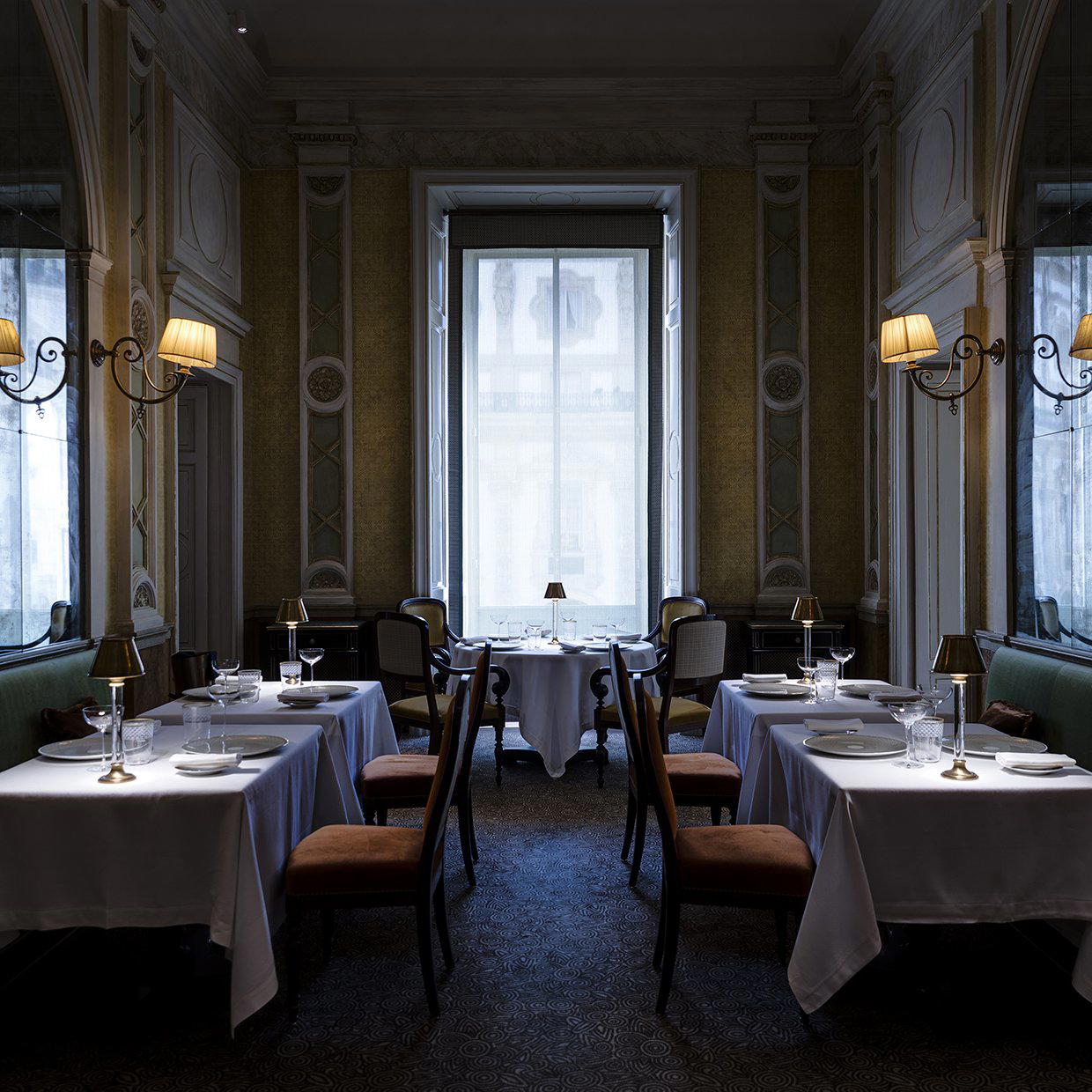
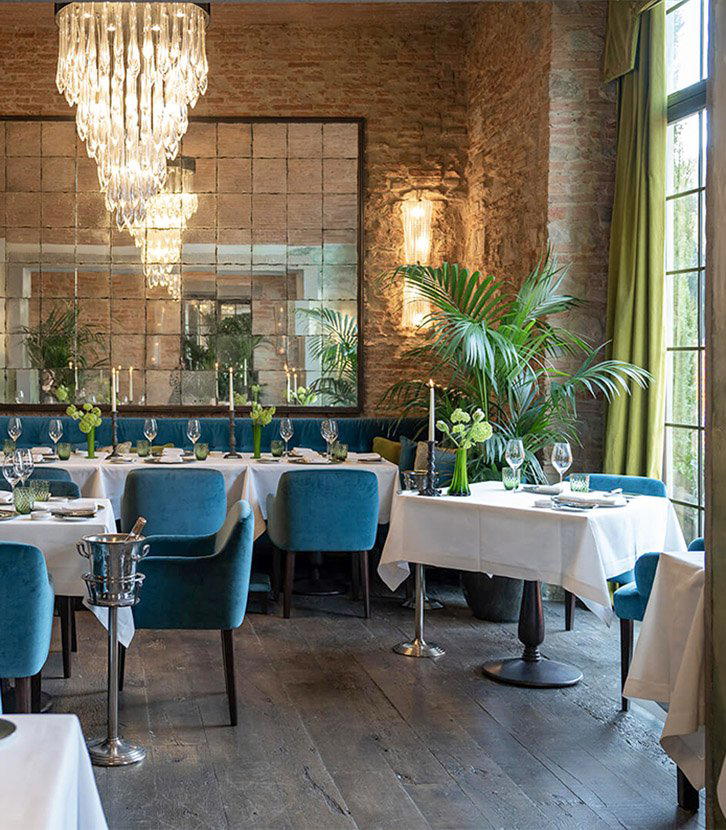
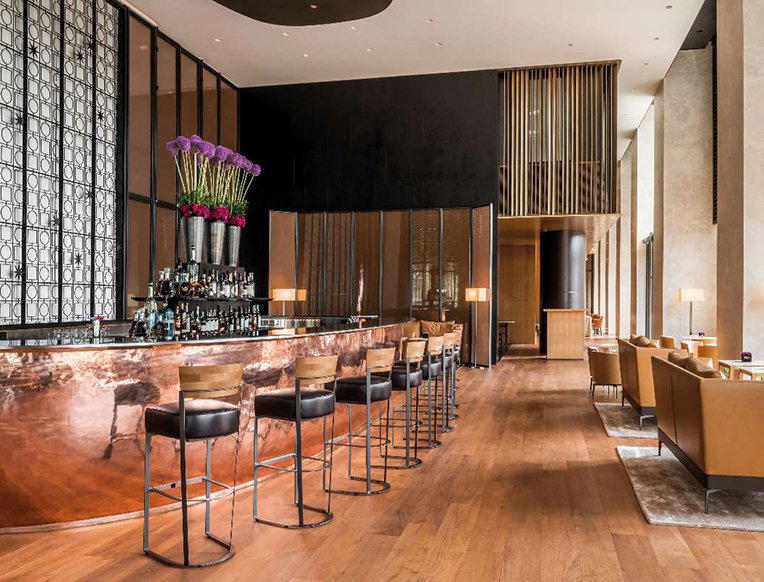
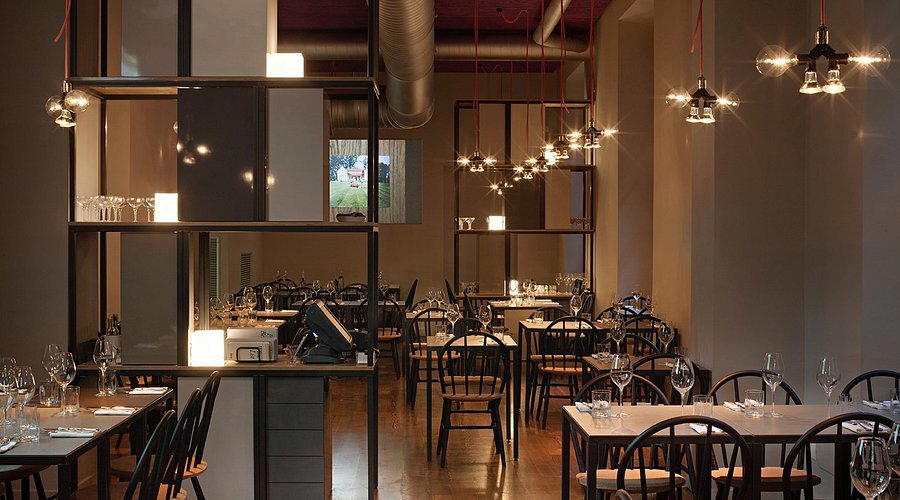
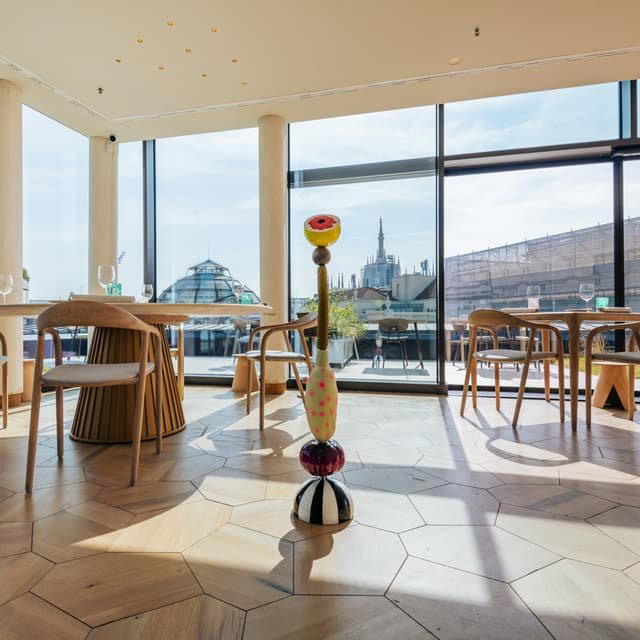
The address sits in the Brera-adjacent quarter of central Milan, close enough to the financial district to attract that clientele but far enough from the design-hotel corridor to operate on its own terms. The interior is built around natural-wood tables and an aesthetic of deliberate simplicity: no tablecloth theatre, no mirror-and-marble formality. The logic is coherent with the kitchen's philosophy. When the ingredient is the story, the room should not compete with it.
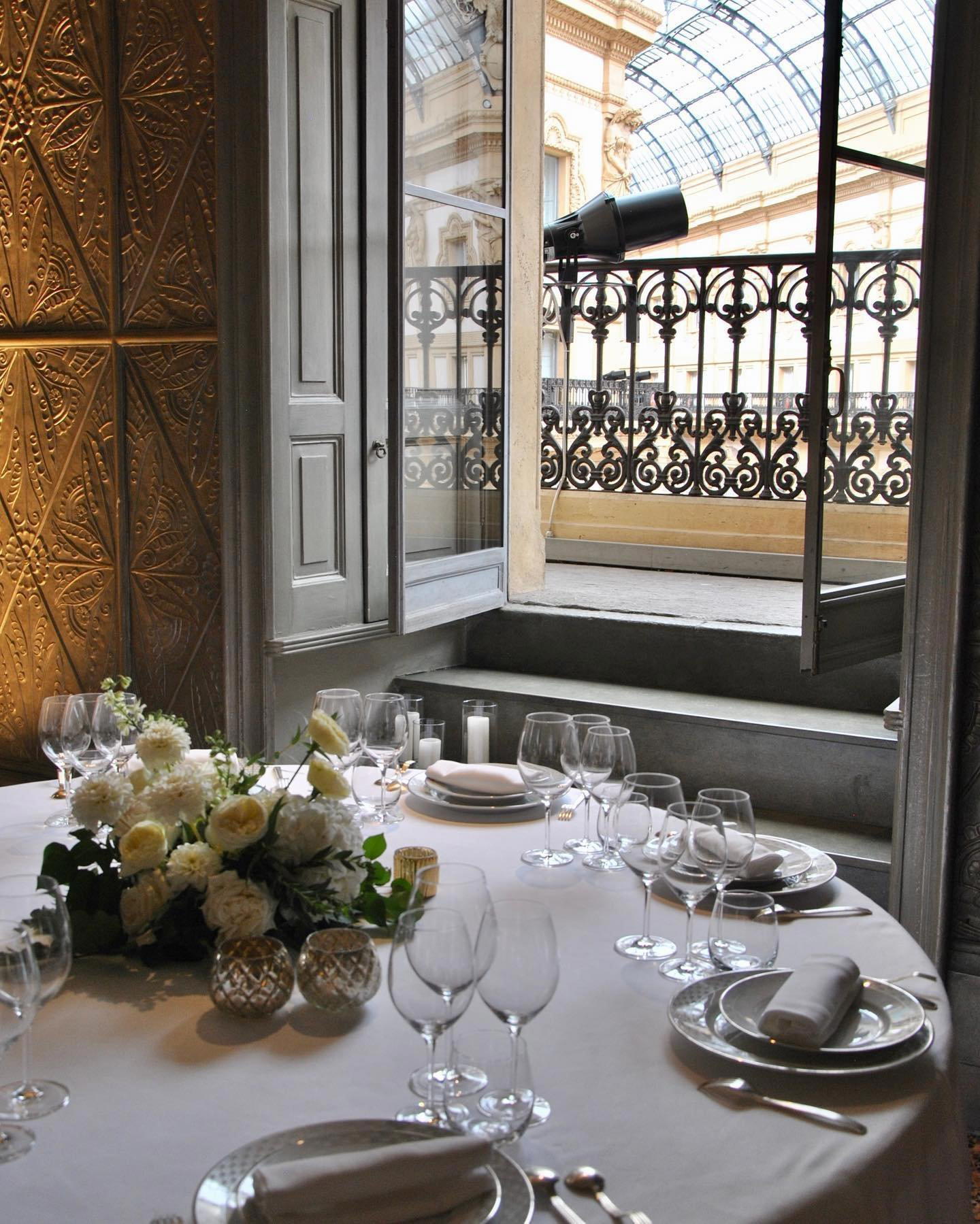
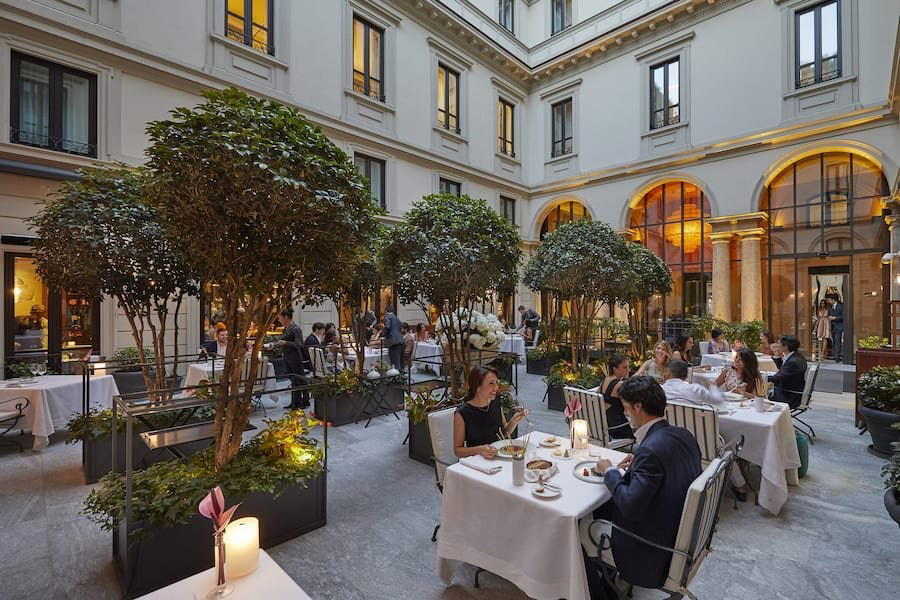
The outdoor terraces, however, are a different calculation entirely. The panorama from that height encompasses the Duomo to the south and the Castello Sforzesco to the west, a sweep of Milan's most recognisable skyline that few dining addresses in the city centre can match. The terraces serve as an aperitif space before dinner, and the cocktail list is considered enough to hold attention on its own. This is one of central Milan's more convincing arguments for arriving early, particularly in the warmer months when that view operates at full effect.
How the Menus Have Evolved
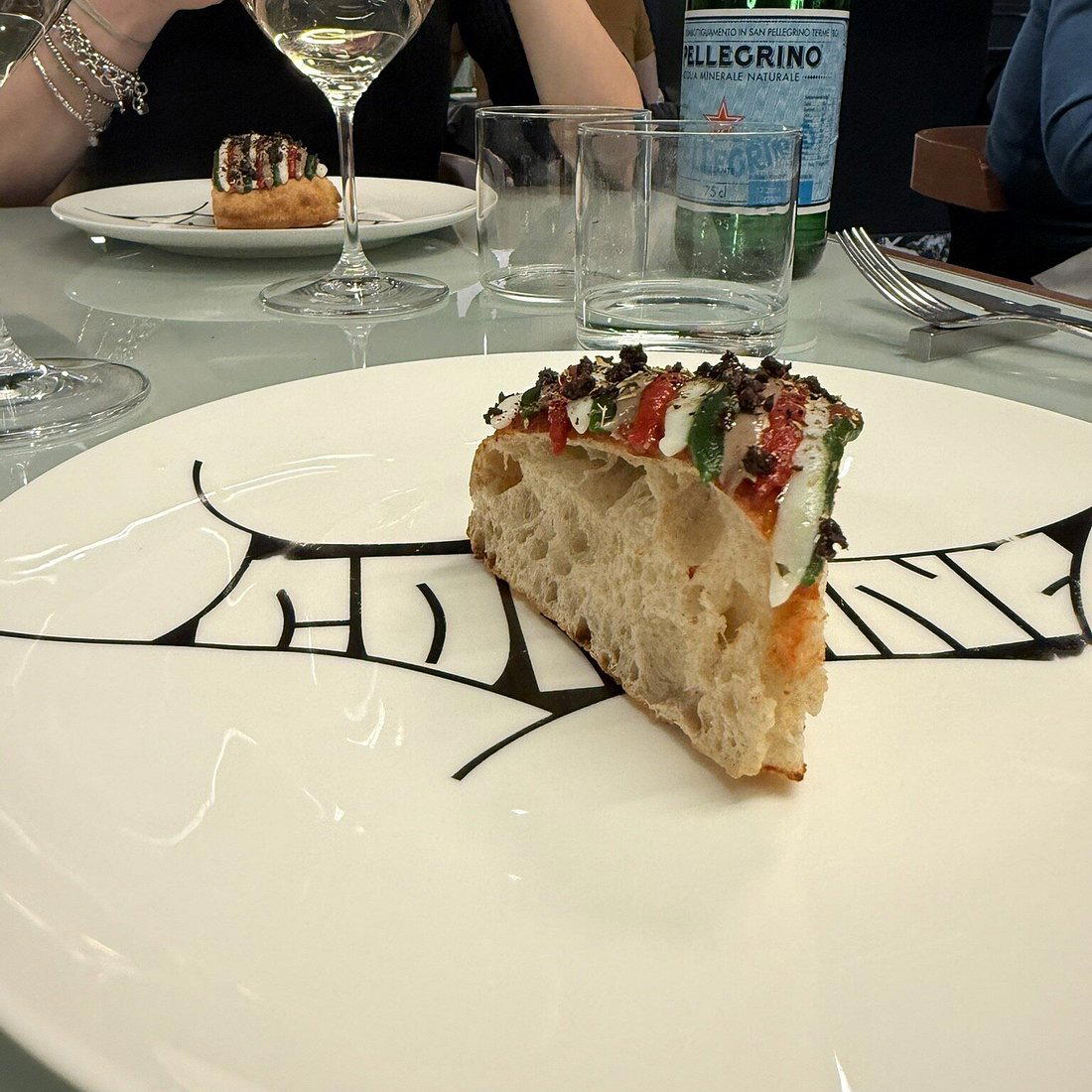
Editorial angle at Horto is genuinely the evolution of a concept rather than a static declaration. The kitchen launched with a strong sustainability framework, but the specific expression of that framework has grown more focused with each season. The two tasting menus currently on offer represent distinct registers: one is the full plant-only format called Vegetali Mon Amour, which is as pure a plant-based tasting menu as you will find at this price level in Italy; the other incorporates the broader sourcing philosophy but is not exclusively vegetable-driven. Both operate within the same constraint: all primary ingredients sourced from within an hour of Milan.
That constraint, in a city that sits at the edge of the Po Valley and within reach of Alpine foothills, Lombard lakes, and some of Italy's most productive agricultural land, turns out to be less restrictive than it sounds and more demanding than it looks. The kitchen, led by Alberto Toè in daily operations, works with fermentation and dehydration as primary technical tools. These are not decorative gestures toward modernity; in a zero-waste framework they serve a functional purpose, extending the usable life and transforming the textural character of ingredients that might otherwise require sourcing substitutions. The result is a menu where technique is in service of a constraint rather than performed for its own sake.
This places Horto in a specific sub-category of Milan's €€€€ fine dining tier. Compared to peers like Andrea Aprea or Seta, which operate within the modern Italian idiom with broader sourcing latitude, Horto accepts a harder set of rules. Against Enrico Bartolini or Cracco in Galleria, where creative ambition is expressed through a different kind of technical programme, Horto argues that the constraint itself is the creative act. Verso Capitaneo explores a related territory with its own set of references. Within Italy more broadly, the conversation around ingredient-led modern cooking runs through addresses like Osteria Francescana in Modena, Uliassi in Senigallia, and Dal Pescatore in Runate, each with their own sourcing logic and regional identity. Horto sits within that conversation but makes its case through urban locality rather than regional terroir.
Vegetables as the Main Event
The plant-focused approach at this level of cooking in Italy represents a specific cultural argument. Italian fine dining has historically been structured around protein: the aged Fassona, the lake fish, the game bird in autumn. A restaurant that places vegetables not as accompaniment but as protagonist is working against strong defaults in both the kitchen tradition and the customer expectation. The fact that Horto has won Michelin recognition while doing so is a signal about where Italian fine dining's conversation has moved in the past several years.
For context, the plant-forward fine dining wave in Europe is not new, but its Italian expression at this level of seriousness is still relatively recent. Internationally, restaurants like Le Bernardin in New York have demonstrated that a single-category constraint (in that case, fish) can build a decades-long institution. The question for Horto's long-term position is whether the locality-plus-plants framework compounds into a comparable depth of identity over time, or whether it remains primarily a values statement. The OAD trajectory and the Michelin star suggest the kitchen is on the right side of that question so far.
Beyond Italy, analogous models appear at addresses like Hyle in San Giovanni in Fiore and Quattro Passi in Marina del Cantone, each operating within a defined ingredient or regional constraint. The Italian fine dining scene has made space for these more specific propositions in ways it had not a decade ago. Enoteca Pinchiorri in Florence represents the older model of Italian fine dining grandeur; Horto is arguing for something structurally different.
Planning a Visit
Horto operates at the €€€€ price range, consistent with Milan's top-tier tasting menu circuit. Two formats are available: the full plant-only Vegetali Mon Amour menu and a broader tasting menu. Crucially, the menu choice must be communicated at the time of booking, not on arrival. This is a kitchen that plans and preps to a constraint, and a same-day change in direction is not accommodated in the same way it might be at a less tightly structured operation.
The format divides between a more formal dinner experience and a simpler lunch service, with the terrace functioning as an aperitif space in favourable weather. For those planning a broader Milan stay, the city's full restaurant circuit is covered in our full Milan restaurants guide, with additional resources across hotels, bars, wineries, and experiences.
For those who want to trace Niederkofler's wider culinary thinking, the original context remains in the Dolomites at Atelier Moessmer in Brunico, where the Alpine sourcing framework was first fully developed. Horto is the urban translation of that framework, adapted to what Lombardy can provide within a short radius of a major European city.
Frequently asked questions
What does dinner at Horto typically cost?
Pricing at Horto is listed as €€€€.
What are the opening hours for Horto?
Hours at Horto: Location.
What's Horto known for in terms of accolades?
Horto has received recognition including: Norbert Niederkofler’s arrival in Milan is accompanied by his strong commitment to the environment. The chef offers two tasting menus with a focus on locally sourced ingredients (all from within an hour of the city). The outdoor terraces ar….
What dish is Horto famous for?
Horto's calling card is its all-plant tasting menu, Vegetali Mon Amour, which places vegetables at the centre of every course rather than as supporting ingredients. The kitchen, led by Alberto Toè under Norbert Niederkofler's direction, applies fermentation and dehydration techniques to produce sourced exclusively within an hour of Milan. The menu earned the restaurant a Michelin star in 2024 and a ranking of #190 in Opinionated About Dining's Top Restaurants in Europe for 2025. If you're booking for Vegetali Mon Amour specifically, the restaurant asks that you note your menu choice at the time of reservation.
How would you describe the cuisine at Horto?
Budget and Context
| Venue | Cuisine | Price | Awards | Notes |
|---|---|---|---|---|
| HortoThis venue — the venue you are viewing | Contemporary Italian Fine Dining | $150–200 | 1 Michelin Star · We're Smart World 4 Radishes | Not listed |
| Enrico Bartolini | Modern Italian Fine Dining | $300–500 | 3 Michelin Stars · World's 50 Best #85 | Creative |
| Cracco in Galleria | Modern Italian Fine Dining | $150–200 | 1 Michelin Star · World's 50 Best #33 | Modern Cuisine |
| Andrea Aprea | Modern Italian Fine Dining | $200–300 | 2 Michelin Stars · La Liste Top Restaurants | Modern Italian, Italian Contemporary |
| Seta | Modern Italian Fine Dining | $150–200 | 2 Michelin Stars · La Liste Top Restaurants | Modern Italian |
| Contraste | Modern Italian Fine Dining | $150–200 | 1 Michelin Star · La Liste Top Restaurants | Progressive Italian, Modern Cuisine |
Recognition history
Dated appearances from independent guides and award organizations, with the underlying list record or original source where available.
Michelin 1 Star
Michelin
Opinionated About Dining Top Restaurants in Europe Recommended
Opinionated About Dining
We're Smart World 4 Radishes
We're Smart World
Full recognition history (8 entries)
Michelin 1 Star
Michelin
Opinionated About Dining Top Restaurants in Europe Ranked #190
Opinionated About Dining
Michelin 1 Star
Michelin
Opinionated About Dining Top Restaurants in Europe Ranked #194
Opinionated About Dining
Opinionated About Dining Top New Restaurants in Europe Highly Recommended
Opinionated About Dining