
Ono Udon sits in Saitama’s serious noodle conversation through a Sanuki-leaning approach: handmade wheat noodles, firm texture, and dipping sauce treated as the meal’s structure rather than background. Its Tabelog Udon EAST 100 selections in 2020, 2022, and 2024 place a compact local shop inside a wider regional tier of specialist udon counters.
Pearl is the En Primeur Club membership app — saves, bookings, and concierge access live there. Same editors, same standards.
- Address
- 5 Chome-13-20 Honmachihigashi, Chuo Ward, Saitama, 338-0003, Japan
- Website
- instagram.com
 Saves & bookings on Pearl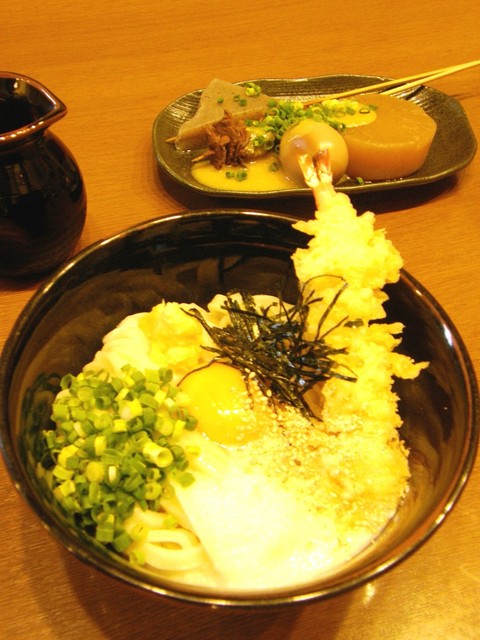
Approaching a small udon shop in Chuo Ward is a different ritual from walking into a Tokyo tasting counter. The signs are quieter, the rhythm is lunch-driven, and the room tells you quickly what matters: wheat, water, broth, and turnover. Saitama’s stronger casual restaurants often work this way, with narrow formats and precise expectations rather than elaborate ceremony. Ono Udon belongs to that category, a compact Sanuki-leaning udon address where texture is the argument.
Sanuki udon has always been a cuisine of restraint. Its reputation rests less on garnish than on noodle structure: chew, elasticity, surface, and the way a dipping sauce or broth frames the wheat. In the Kanto dining conversation, that matters because udon has to compete with soba, ramen, and commuter-town lunch formats that prize speed. A shop selected for Tabelog Udon EAST 100 in 2020, 2022, and 2024 is not being rewarded for spectacle; it is being recognized for consistency within a tightly judged noodle category.
Sanuki method in a commuter-city udon culture
Saitama’s noodle culture does not behave like a single school. Musashino udon has its own local weight, built around firm wheat noodles and dipping formats across the wider region. Sanuki udon brings a different reference point, associated with Kagawa and with a more direct focus on handmade noodles, toppings, and dipping sauce. Ono Udon’s positioning is useful because it shows how imported regional technique can become part of a suburban Kanto lunch circuit without losing its identity.
That ingredient story begins with wheat rather than luxury. Udon at this level depends on gluten development, hydration, resting, and cutting; mistakes show quickly because the noodle is not hidden beneath a heavy sauce. Firmness is not an adjective here but the central metric. When a shop foregrounds handmade Sanuki-style noodles, it is making a claim about process: the flour has to carry the bowl, and the sauce has to sharpen rather than smother it.
The Tabelog Udon EAST 100 selection is a useful signal because the category is narrow. It separates specialists from general Japanese restaurants serving udon as one item among many. For travelers, that distinction matters. A low-cost lunch counter with category recognition can be a sharper expression of place than a polished dining room, particularly in cities where everyday food formats have deep local loyalty.
Within Saitama, the comparison set is broad. Musashino Udon Fujiwara Kitayono honten sits in a similar everyday udon price band, while Shokujidokoro Tarafuku reads more as a casual meal stop than a single-category specialist. Kago Yasumi occupies another approachable noodle bracket, and Toyo Zushi shows how quickly the city’s price tier changes once the format shifts toward sushi. Ono Udon’s relevance is that it stays in the inexpensive noodle lane while carrying repeated category recognition.
What the format tells you before the first bowl
Small Japanese noodle shops often communicate their priorities through constraints. Counter seats, table seats, a no-smoking room, and a lunch-focused cadence all point toward a meal designed around concentration rather than lingering. The cooking is not theatrical in the omakase sense. The performance is in repetition: dough made to behave the same way, sauce balanced to the same line, service paced for diners who know what they came for.
This is also why Saitama rewards visitors who look beyond the obvious Tokyo day-trip orbit. The city’s food map is not only about destination dining; it is a web of bakeries, patisseries, noodle counters, and compact specialists that locals use with confidence. For a broader read on the city, Our full Saitama restaurants guide gives the restaurant frame, while Our full Saitama hotels guide, Our full Saitama bars guide, Our full Saitama wineries guide, and Our full Saitama experiences guide place the meal in a wider travel plan.
The surrounding Saitama list is useful for understanding appetite rather than hierarchy. Acacier Kitaurawa honten and Acacier Urawa ten speak to the city’s patisserie side. Bagel Shop vivant, Aki Foods, and Beach Story show how compact specialist formats shape everyday eating here. Against that background, an udon shop with repeated Udon EAST 100 recognition reads as part of a local pattern: focused operators, narrow menus, modest rooms, and food that depends on repeat customers.
How to read Ono Udon against Japan's casual specialists
Japan’s casual dining strength lies in the seriousness applied to formats that outsiders sometimes treat as simple. Curry counters, onigiri shops, sake bars, grilled-beef specialists, and udon rooms all share a discipline: a short promise executed with little padding. That is why a Saitama udon meal can sit naturally in the same editorial conversation as [Curry Senmon Ten] Maruyama Kyoju. in Sapporo, Onigiri Time in Pasadena, or Jōdo Saké Bar in Los Angeles. The link is not cuisine; it is format discipline.
For travelers moving through Japan, that discipline can be more revealing than another long menu. -Grilled beef Sukiyaki- KAMAKURA TANUKIAN 鎌倉 たぬき庵 in Kamakura. 鮪と炭火焼き うお炭 秋葉原店 in Tokyo.cafe in Osaka.know in Kumamoto, and (Shoku) Vietnam in Kawasaki all point to how specific formats define dining decisions across cities. The restaurant’s place in that map is clear: go for a noodle specialist, not a broad Japanese restaurant, and judge the meal by wheat texture, sauce balance, and the confidence of a short-form lunch service.
The practical takeaway is simple. This is a focused Saitama udon stop with recognized category credentials, a modest spend, and a room scaled for a direct meal. It suits diners who care about noodle craft and regional technique more than ceremony. In a city where many strong meals live outside luxury dining, that is exactly the point.
Comparable Spots, Quickly
Comparable venues at a glance for context.
| Venue | Cuisine | Price | Notes |
|---|---|---|---|
| Ono UdonThis venue — the venue you are viewing | Traditional Sanuki Udon | $ | Not listed |
| Ramen Jiro Oomiya kouen ekimae ten | Jiro-style Ramen Shop | $ | Omiya Koen |
| Ramen Jiro Koshigaya ten | Jiro-style Ramen Shop | $ | Koshigaya |
| Noroshi Honten | Tsukemen / Ramen | $ | Kita Ward, Saitama City |
| かねかつ | Traditional Shoyu Ramen & Abura Soba | $$ | 北浦和 (Kita-Urawa) |
| Inakaya Irori | Traditional Japanese Izakaya with Irori Hearth | $$ | Urawa-ku |
Recognition history
Dated appearances from independent guides and award organizations, with the underlying list record or original source where available.
Tabelog 100 #98 · No. 98
Tabelog · Tabelog 100 - Udon - EAST - 2024












At a Glance
- Solo
- Casual Hangout
- After Work
- Standalone
Current opening hours
- Monday
- 11 AM–3 PM
- Tuesday
- 11 AM–3 PM
- Wednesday
- Closed
- Thursday
- 11 AM–3 PM
- Friday
- 11 AM–3 PM
- Saturday
- 11 AM–3 PM
- Sunday
- Closed
Hours can change for holidays and private events. Last verified .