Our verdict
One Green Table occupies a residential address on Defreggerstraße in Innsbruck, sitting within a city that punches above its Alpine weight when it comes to considered, produce-led dining. The restaurant's name signals an ethos before you've read a word of the menu: a single focal point, a commitment to the plate over the spectacle. For Innsbruck's more deliberate dining scene, it represents the quieter, less theatrical end of the spectrum.

Pearl is the En Primeur Club membership app, where members save venues, book tables and use the concierge.

A Single Point of Focus in Innsbruck's Dining Scene
Innsbruck does not announce its restaurants loudly. The city's dining culture runs quieter than Vienna or Salzburg, built around neighbourhood addresses rather than grand boulevard positions. Defreggerstraße 21, a residential street in the eastern reaches of the city centre, is exactly the kind of address you'd expect for a restaurant named One Green Table: deliberate, unhurried, and unlikely to be stumbled upon. The name itself frames the proposition before you've seen a menu or pulled back a chair. One table, one focus, one meal at a time.
That framing matters in a city where the serious dining options have multiplied in recent years. Innsbruck's upper tier now includes venues ranging from the technically ambitious creative cooking at Oniriq to the seasonal classical register of Das Schindler, and the more accessible international programming of lichtblick. One Green Table, by its name and its residential positioning, reads as something different: a smaller, more intimate format in a city where the premium dining conversation has largely been dominated by the theatrics of the mountain-adjacent luxury market.
Where Innsbruck Sits in the Austrian Dining Conversation
To understand what One Green Table means in context, it helps to understand what Innsbruck is not. The Austrian fine dining axis runs through Vienna, where Steirereck im Stadtpark anchors the country's critical credibility, and through the western Alpine corridor, where restaurants like Griggeler Stuba in Lech and Gourmetrestaurant Tannenhof in Sankt Anton am Arlberg serve a clientele drawn partly by ski season spending. Innsbruck sits between these poles, neither a capital with institutional critical weight nor a resort town with captive high-net-worth visitors. That in-between status has historically kept the city's restaurants from attracting the same level of international attention as, say, Obauer in Werfen or Döllerer in Golling an der Salzach.
The result is a dining scene that operates with more local accountability than tourist-facing pressure. Restaurants on streets like Defreggerstraße are cooking, primarily, for the people who live in the city and come back repeatedly. That changes the calculus. Seasonal consistency and honest pricing matter more than single-visit spectacle. It also means that the city's quieter addresses often deliver better value relative to their craft than comparable venues in Vienna or Salzburg, where location premiums and destination-visitor margins inflate the price-to-quality ratio.
The Progression at the Table
A restaurant called One Green Table makes a structural promise: the meal is the event. This is not a venue built around a wine list performance or a celebrity chef arrival. The architecture of eating here, whatever form the menu takes on any given evening, is centred on what arrives sequentially at the table. That kind of format, common across the quieter end of central European dining, asks the kitchen to carry the full weight of the experience across a progression of courses rather than distributing it across theatre, service choreography, and decor.
The progression model has become the dominant format at this level across Austria. From the herb-led seasonal sequences at Kräuterreich by Vitus Winkler in Sankt Veit im Pongau to the product-driven cooking at Ois in Neufelden, Austrian restaurants at this tier increasingly let the meal build its own logic across the table rather than front-loading with grand presentations. One Green Table's name suggests it belongs to this tradition: the green signals produce-consciousness, the single table signals focus, and together they sketch the outline of a meal that earns its length through accumulation rather than individual set pieces.
For comparative reference, the creative multi-course format has been refined internationally at venues like Atomix in New York City, where each course arrives with written context, or at Le Bernardin in New York City, where the progression is built entirely around one protein category across dozens of preparations. Austrian counterparts tend to work differently: the seasonal availability of the Alps and the surrounding valleys provides a natural arc, moving from forage to harvest to preservation as the year turns.
The Innsbruck Neighbourhood Context
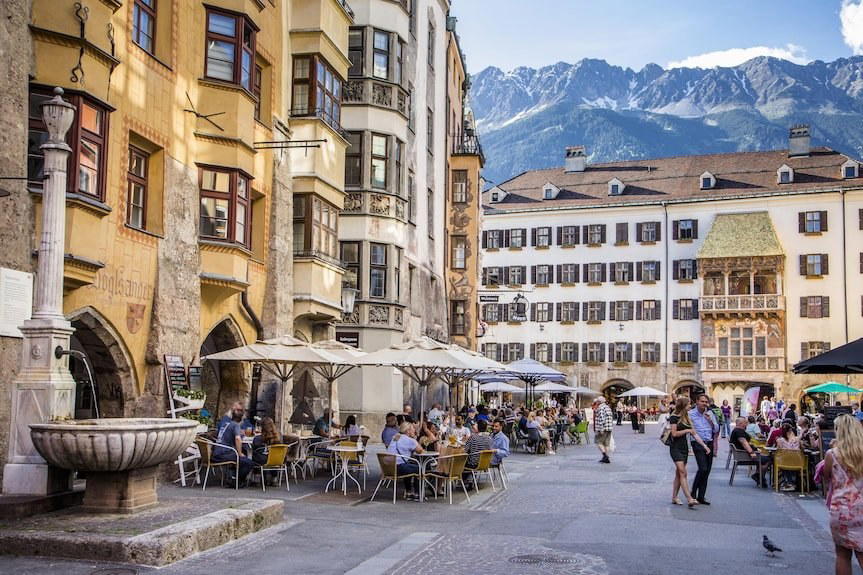
Defreggerstraße sits east of the old town, in a part of Innsbruck that reads as genuinely residential rather than tourist-adjacent. For anyone coming in from outside the city, the nearby options for the area include Al Fred and B-West, which anchor a more casual end of the local eating spectrum, and Bistro Gourmand, which occupies a middle register of French-inflected neighbourhood cooking. Arzler Alm sits higher on the hillside above the city, offering a different register entirely, anchored in traditional Tyrolean formats. Bonsai extends Innsbruck's reach into Japanese-influenced territory.
One Green Table, by its positioning on a quieter street, draws the kind of visitor who comes prepared: someone who has looked it up, made a reservation with some lead time, and arrived with expectations calibrated to the format rather than the address. That self-selecting crowd tends to produce a particular room temperature, quieter and more focused than tourist-driven dining rooms, where the conversation at other tables rarely intrudes on your own.
Planning a Visit
Innsbruck is most easily reached by train from Munich (approximately two hours), Vienna (four and a half hours), or Zurich (two and a half hours), making it viable as a single-destination evening or an extension of a broader Austrian or Bavarian itinerary. The city's compact size means that Defreggerstraße is within comfortable reach of the main station and the central hotel cluster. Given the format One Green Table implies, booking ahead is the appropriate approach: restaurants of this type and scale in Austrian cities of Innsbruck's size typically operate on a reservation-only or near-reservation-only basis, and walk-in availability on the day is unlikely for evening service. For a broader orientation to the city's eating and drinking options, the full Innsbruck restaurants guide covers the range from casual neighbourhood addresses to the more formally structured end of the spectrum. For western Austria's wider fine dining circuit, Ikarus in Salzburg and Restaurant 141 by Joachim Jaud in Mieming, just outside the city, offer useful reference points for how the regional kitchen is operating at its more ambitious end. Landhaus Bacher in Mautern an der Donau represents the Wachau tradition, which provides yet another angle on Austrian produce-led cooking for those building a longer itinerary.
Frequently asked questions
Would One Green Table be comfortable with kids?
The format at Defreggerstraße 21 is structured around a sequenced, reservation-led meal in a residential Innsbruck setting. That kind of pacing and focus tends to work best for adults rather than families with young children. If you are travelling with kids, a more informal address in Innsbruck's centre would be a better fit.
What kind of setting is One Green Table?
The address on Defreggerstraße places One Green Table in a genuinely residential part of Innsbruck, east of the old town and away from the tourist-facing centre. In a city without Michelin-starred restaurants, this is the kind of address where the room itself makes a statement through restraint rather than spectacle. Expect an intimate space built around the meal rather than around ambient noise or crowd energy.
What do people recommend at One Green Table?
The name and positioning signal a produce-driven, sequenced format, which is the approach that defines this tier of Austrian dining. At this kind of address in Innsbruck, the kitchen, not the guest, sets the progression.
Is One Green Table worth visiting specifically from Munich or Zurich for a dinner reservation?
Innsbruck sits roughly two hours by train from Munich and two and a half from Zurich, which makes a dinner-focused day trip or overnight stay viable. One Green Table's residential address and single-table format position it as the kind of Innsbruck destination that rewards the trip rather than fills a gap in an itinerary. That said, no third-party awards are currently documented for the venue, so the decision rests on the format itself rather than critical consensus.
Accolades, Compared
Comparable venues nearby, for context on price, style, and recognition.
| Venue | Cuisine | Price | Notes |
|---|---|---|---|
| one_green tableThis venue (the venue you are viewing) | Communal Vegan Tasting Menu | Not listed | Not listed |
| weitsicht Restaurant | Modern Tyrolean Fusion with Global Influences | $30–50 | Innsbruck City Center |
| Kostbar | Regional Austrian Cafe | $10–20 | Mutters |
| D-Werk | Modern Street Food Döner | $10–20 | Innrain |
| Himalayan Nepali Kitchen | Authentic Nepali | $20–30 | Innsbruck City Center |
| Marktschiff | Seafood & Mediterranean | $30–50 | Markthalle |
Continue exploring
More in Innsbruck
Restaurants in Innsbruck
All restaurants in Innsbruck →
Bars in Innsbruck
All bars in Innsbruck →

Details
- Intimate
- Cozy
- Modern
- Special Occasion
- Group Dining
- Local Sourcing
- Organic
- Tasting Menu
- Set Menu
- Vegan Options
- Vegetarian Friendly
Current opening hours
- Monday
- Closed
- Tuesday
- 7–10 PM
- Wednesday
- 7–10 PM
- Thursday
- 7–10 PM
- Friday
- 7–10 PM
- Saturday
- 7–10 PM
- Sunday
- Closed
Hours can change for holidays and private events. Hours as of .
Intimate and social atmosphere centered around a single communal table with a focus on sustainable, plant-based cuisine.