
A compact Higashiyama okonomiyaki address with 22 seats, counter cooking, oden and teppanyaki alongside the griddle work. Its value lies in the gap between price and recognition: a JPY 1,000–1,999 average spend, repeat Tabelog 100 Okonomiyaki selections, and a location close enough to Shichijo to make it useful before or after east-side Kyoto sightseeing.
Pearl is the En Primeur Club membership app — saves, bookings, and concierge access live there. Same editors, same standards.
- Address
- 京都府京都市東山区大和大路通り塩小路下ル上池田町546
- Phone
- +81755512026
- Website
- tabelog.com
 Saves & bookings on Pearl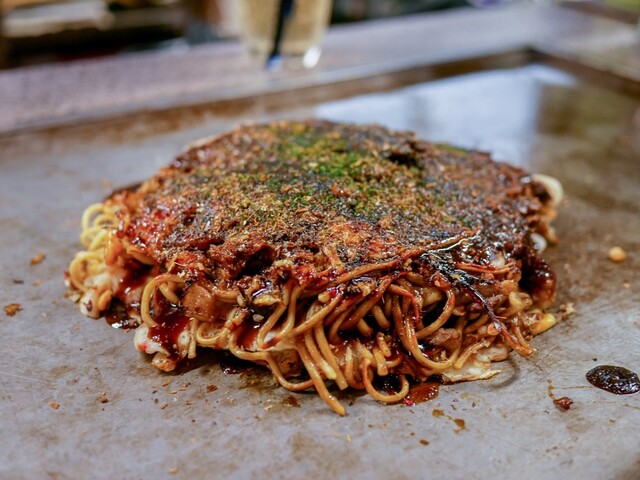
Yamatooji-dori south of Shichijo feels different from Kyoto’s temple approaches: less curated, more residential, with low buildings, small shopfronts and a neighbourhood rhythm that eats close to home. That setting matters for okonomiyaki. The dish is not for hushed ceremony; it belongs to hotplates, batter, cabbage, sauce, steam and cooks who know when a pancake has set without drying out. Okonomiyaki Yoshino fits that register: a house-restaurant format where the room is small, the griddle central, and the price closer to everyday Kyoto than to the city’s kaiseki economy.
For travellers who associate Kyoto dining with formal counters and seasonal menus, okonomiyaki is a useful correction. Kansai’s griddle culture is casual, not careless; it rewards timing, heat control and texture as much as costlier formats. Here, the appeal is value rather than spectacle: okonomiyaki, oden and teppanyaki in a 22-seat room, with a JPY 1,000–1,999 average spend and recognition on the Tabelog 100 Okonomiyaki list in 2025 after earlier selections in 2018, 2019, 2022, 2023 and 2024. That combination is narrow: inexpensive by Kyoto standards, yet visible within a national ranking for a specific comfort-food genre.
Kyoto value measured on the griddle, not by ceremony
Kyoto’s restaurant hierarchy often pushes visitors toward precision dining: set-course counters, tea-driven sweets, polished French-Japanese rooms and reservation-led Japanese restaurants. Okonomiyaki works by another logic. It is communal, direct and heat-led, and the price ceiling changes the decision. A table can eat here for a fraction of a formal Kyoto dinner while still choosing a place repeatedly selected for a category-specific Tabelog 100 list.
The useful comparison is with Kyoto’s mid- and low-price food circuit, not luxury dining. Shimizu Ippouen Cafe Kyoto honten sits in a similar JPY 1,000–1,999 bracket, centred on tea and cafe culture. Baiko Do is cheaper, in the sub-JPY 999 range, and follows a snack-and-sweets rhythm. Warajiya moves higher, at JPY 6,000–7,999 for dinner and JPY 4,000–4,999 for lunch. Against that spread, the griddle house offers strong return: hot food, seated service, a recognized okonomiyaki category, and enough menu breadth for families or friends without becoming a large-format restaurant.
The room reinforces the value. Six counter seats give solo diners and pairs a view into the cooking, while tables handle small groups. The maximum seated party size is 22, which effectively means the restaurant is the room; no anonymous overflow space softens demand. That scale is part of the appeal, but timing matters. The format suits a deliberate meal rather than a casual detour when every seat is taken.
Okonomiyaki, oden and teppanyaki in a city better known for restraint
Kyoto is often described through restraint, seasonality and temple-side quiet, but its everyday food is broader. Griddle cooking gives the city a warmer, more conversational register. Okonomiyaki brings batter and cabbage to direct heat; teppanyaki extends the same surface to other ingredients; oden adds simmered comfort rather than grill intensity. The trio suits a small house-style dining room because it gives guests different speeds of eating: something cooked on the hotplate, something from the simmering pot, something to share.
That breadth makes this a practical Kyoto address for mixed appetites. The category is okonomiyaki, but the experience is not limited to one pancake order. Sake and shochu are listed, take-out is available, children are welcome, and the space is non-smoking. None of this turns the restaurant into a polished international concept, which is the point. It remains a compact local format with enough flexibility for travellers wanting an unfussy meal after a day around the east side.
Recognition should be read correctly. Tabelog 100 is not a luxury ranking; it is a category list, and for okonomiyaki that distinction is useful. It rewards a style often left out of Michelin-led itineraries and helps identify shops where a modest bill does not mean an interchangeable meal. Okonomiyaki Yoshino’s repeat selections across multiple years are a stronger signal than a single viral mention. The Tabelog score listed at 3.65 adds another data point, though category recognition is the more meaningful trust signal for a specialist griddle restaurant.
How to fit it into a Kyoto day without overplanning dinner
The location works particularly well for Higashiyama and Shichijo itineraries. The nearest station is Shichijo, with the restaurant listed 473 metres from the station, about seven minutes on foot. It is also about 15 minutes east from JR Kyoto Station and about five minutes from the Sanjusangendo-mae bus stop, making it more useful than many neighbourhood restaurants for visitors moving between Kyoto Station, Sanjusangendo and the east-side museum-and-temple corridor.
Hours concentrate the week into Thursday through Sunday, 11:00 AM to 9:00 PM, with last order at 8:30 PM; Monday to Wednesday are closed. Reservations are available, and matter more than the casual price suggests. A 22-seat room repeatedly selected for a national okonomiyaki list can fill quickly at normal meal times. Payment is practical: credit cards, electronic money and QR code payments are not accepted, so plan cash as well as timing. Five parking spaces are listed in the monthly lot in front with the Yoshino sign at the back, an unusually useful detail for a small Kyoto restaurant, though rail or bus remains cleaner for many visitors.
For a broader Kyoto food plan, pair this griddle meal with other low-ceremony stops rather than stacking it against a formal tasting menu. EP Club’s Kyoto restaurant coverage includes 3TOKU6MI Shijo karasuma ten, 551蓬莱, [ki:], Abbesses and Aburi Mochi Honke Nemoto Kazariya. For city-wide planning, use Our full Kyoto restaurants guide, then cross-reference Our full Kyoto hotels guide, Our full Kyoto bars guide, Our full Kyoto wineries guide and Our full Kyoto experiences guide. Related Japan and overseas listings include -Grilled beef Sukiyaki- KAMAKURA TANUKIAN 鎌倉 たぬき庵 in Kamakura. 鮪と炭火焼き うお炭 秋葉原店 in Tokyo.cafe in Osaka.know in Kumamoto, (Shoku) Vietnam in Kawasaki, [Curry Senmon Ten] Maruyama Kyoju. in Sapporo, Jōdo Saké Bar in Los Angeles and Onigiri Time in Pasadena.
Awards and Standing
Nearby venues at a similar price tier for orientation.
| Venue | Cuisine | Price | Notes |
|---|---|---|---|
| Okonomiyaki YoshinoThis venue — the venue you are viewing | Traditional Okonomiyaki & Teppanyaki | $ | Not listed |
| Amaguri no Shinise Hayashi Mansho Do Honten | Traditional Japanese chestnut sweets & cafe | $ | Nakagyō |
| Fruit Parlour Yaoiso | Japanese fruit parlor & dessert café | $ | Shimogyō |
| Rokuyosha Chika ten | Traditional Kyoto kissaten & coffee bar | $ | Nakagyō |
| Flip up! | Kyoto bakery & bagel shop | $ | Nakagyō |
| Honke Daiichi Asahi Honten | Classic Kyoto ramen shop | $ | Shimogyō |
Recognition history
Dated appearances from independent guides and award organizations, with the underlying list record or original source where available.
Tabelog 100 #52 · No. 52
Tabelog · Tabelog 100 - Okonomiyaki - 2025
Continue exploring
More in Kyoto
Restaurants in Kyoto
Browse all →
Bars in Kyoto
Browse all →
Hotels in Kyoto
Browse all →
Wineries in Kyoto
Browse all →
At a Glance
- Cozy
- Classic
- Lively
- Intimate
- Casual Hangout
- Family
- Group Dining
- Solo
- After Work
- Chefs Counter
- Open Kitchen
- Standalone
- Sake Program
- Beer Program