
Tabelog 100 #54
Our verdict
Aburi Mochi Honke Nemoto Kazariya belongs to Kyoto’s older sweet-shop culture, where shrine approaches, tea breaks, and compact wagashi formats carry more weight than restaurant theatre. Its Tabelog 100 selection for Japanese traditional sweets and sweets-cafe categories places it among the city’s serious addresses for traditional confectionery rather than the dessert course of a larger meal.

Pearl is the En Primeur Club membership app — saves, bookings, and concierge access live there. Same editors, same standards.
- Address
- 96 Murasakino Imamiyacho, Kita Ward, Kyoto, 603-8243, Japan
- Phone
- +81 75-491-9402
- Hours
- Mon–Tue 10 AM–5 PMWed 9 AM–5 PMThu ClosedFri–Sun 10 AM–5 PM
- Website
- aquadina.com
- Directions
- Get directions
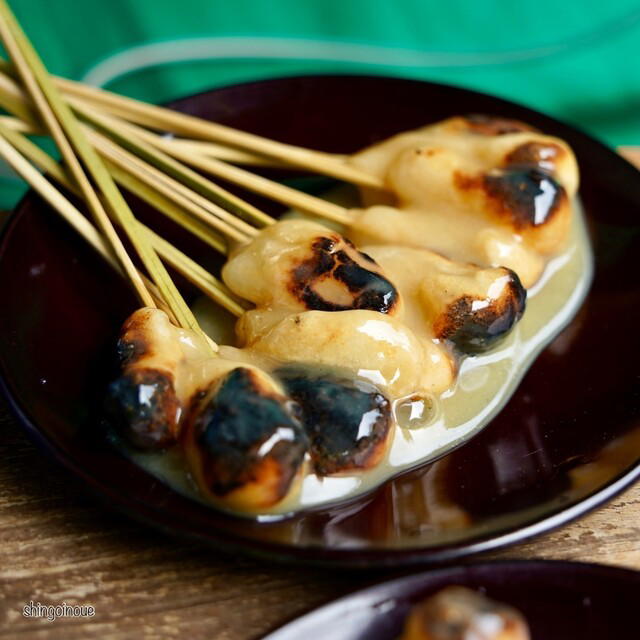
The menu
What to order
- Aburi Mochi (grilled skewered rice cakes with sweet white miso sauce)
Approaching Imamiya Shrine, Kyoto shifts into a slower register: stone, timber, shrine gates, and the low ritual of stopping for sweets before or after worship. This is the proper context for aburi mochi, not as a plated dessert with chefly explanation, but as a local habit tied to a shrine approach and a narrow style of wagashi service. Aburi Mochi Honke Nemoto Kazariya sits inside that world, where the room, the sweet, and the act of pausing are part of the same cultural form.
Kyoto’s dining reputation often gets flattened into kaiseki counters and temple-adjacent vegetarian cooking, but its sweet shops tell a different story. Wagashi in the city is not merely decorative; it is seasonal, ceremonial, and often tied to specific neighbourhood movements. Around Murasakino and Kita Ward, the rhythm is less downtown polish than pilgrimage geography. The point is not variety. The point is repetition, lineage, and a format that has survived because it answers a simple local need: a short, affordable stop around a meaningful place.
Aburi mochi belongs to shrine culture, not dessert culture
Aburi mochi is easy to misunderstand if judged by the standards of a restaurant menu. It is a focused sweet format, closer to a ritual snack than a pastry-counter selection. That makes it different from central Kyoto cafés built around seasonal parfaits, and different again from formal wagashi houses designed for tea ceremony orders. Here, the value lies in specificity: one tradition, one setting, one reason to make the trip north.
The Tabelog 100 selection for Japanese traditional sweets and Japanese sweets cafés in WEST 2023 gives the address a useful external signal, especially in a category where international awards rarely map cleanly onto local quality. The same recognition also places it in a competitive set that includes dedicated confectionery shops rather than full-service restaurants. In Kyoto terms, that distinction matters. A diner comparing this stop with 3TOKU6MI Shijo karasuma ten, Abbesses, or Aca 1° (Japanese Kaiseki) is comparing different uses of the city, not merely different cuisines.
The nearest peer context is Ichiwa Ichimonjiya Wasuke, another Kyoto aburi mochi specialist in the same low-cost band. That pairing shows why this corner of the city remains compelling: two houses can work within the same narrow tradition and still make the visit feel rooted in place rather than interchangeable. By contrast, Wagashi Mise Seiyo operates in a higher spend category, which changes the expectation from quick shrine-side sweet to a more deliberate confectionery purchase.
Kyoto's sweet-shop map rewards detours north
Many visitors build Kyoto around Higashiyama, Gion, Arashiyama, and the station corridor. Murasakino asks for a different itinerary. It sits outside the easiest tourism loop, and that distance protects the character of the stop. The reward is not secrecy; it is context. A sweet eaten near a shrine approach carries a different meaning from the same category consumed between shopping blocks downtown.
This is where Kyoto’s food geography becomes useful. The city’s serious dining is not concentrated in one entertainment district. Soba, kaiseki, kissaten culture, wagashi, counter cooking, and temple-adjacent vegetarian traditions are scattered across neighbourhoods with distinct purposes. A meal at [ki:] or a casual stop at 551蓬莱 occupies another part of the city’s appetite. Aburi mochi near Imamiya Shrine belongs to the Kyoto of errands, prayers, and pauses.
The format also resists the escalation that defines much premium travel dining. There is no need to turn every Kyoto food stop into a reservation trophy. Some of the city’s sharper experiences are compact, inexpensive, and tied to a single inherited idea. That does not make them lesser. It makes them harder to compare with the tasting-menu economy, where price, duration, and scarcity often dominate the conversation.
How to place it in a Kyoto itinerary
This is a precision stop rather than an anchor meal. It makes sense when the day already points toward Kita Ward, Daitokuji, or the northern temple circuit, and it is less convincing as a standalone dash from the station area. The better strategy is to let the neighbourhood shape the schedule: temple visits first, then sweets, or sweets as the small punctuation after the shrine.
Because the service style is closer to a traditional sweets café with take-out available than to a full restaurant, expectations should stay disciplined. Do not arrive looking for a broad menu, chef biography, wine pairing, or the performance codes of Kyoto fine dining. The pleasure is cultural compression: a narrow sweet tradition, a shrine-side setting, and a form of hospitality that does not need to explain itself at length.
For readers building a broader Kyoto plan, the useful move is contrast. Pair this kind of stop with a formal dinner, a soba lunch, or a contemporary counter to understand how wide the city’s food culture runs. The full Kyoto restaurants guide is the practical starting point, while the city’s wider travel frame sits in the Kyoto hotels guide, Kyoto bars guide, Kyoto wineries guide, and Kyoto experiences guide.
Japan’s casual and specialist food culture also rewards looking beyond the obvious city names. Kyoto visitors mapping onward routes can compare how focused formats behave elsewhere, from -Grilled beef Sukiyaki- KAMAKURA TANUKIAN 鎌倉 たぬき庵 in Kamakura and. 鮪と炭火焼き うお炭 秋葉原店 in Tokyo to.cafe in Osaka.know in Kumamoto, (Shoku) Vietnam in Kawasaki, and [Curry Senmon Ten] Maruyama Kyoju. in Sapporo. Abroad, the same editorial lesson applies to Japanese formats adapted for American cities, including Jōdo Saké Bar in Los Angeles and Onigiri Time in Pasadena.
The verdict is clear enough without overstatement: Aburi Mochi Honke Nemoto Kazariya is for travelers who want Kyoto’s food culture at shrine scale. Its importance lies in the way it preserves a narrow local ritual, not in luxury signals or menu breadth. Build it into the right northern itinerary and it becomes one of the city’s cleaner arguments for why small, old food traditions still matter.
Frequently asked questions
What are the opening hours for Aburi Mochi Honke Nemoto Kazariya?
Hours at Aburi Mochi Honke Nemoto Kazariya: Mon: 10 AM–5 PM; Tue: 10 AM–5 PM; Wed: 9 AM–5 PM; Thu: Closed; Fri: 10 AM–5 PM; Sat: 10 AM–5 PM; Sun: 10 AM–5 PM.
What should I budget for a meal at Aburi Mochi Honke Nemoto Kazariya?
Pricing at Aburi Mochi Honke Nemoto Kazariya is listed as - JPY 999.
Where is Aburi Mochi Honke Nemoto Kazariya in Kyoto?
Aburi Mochi Honke Nemoto Kazariya is located in Kyoto.
What is Aburi Mochi Honke Nemoto Kazariya known for?
Aburi Mochi Honke Nemoto Kazariya is primarily known for its core concept and execution in Kyoto.
Budget Reality Check
Comparable venues to calibrate price, style, and recognition.
| Venue | Cuisine | Price | Awards | Notes |
|---|---|---|---|---|
| Aburi Mochi Honke Nemoto KazariyaThis venue — the venue you are viewing | Traditional Kyoto Japanese sweets (Aburi Mochi) | $1–10 | Tabelog 100 #54 | Not listed |
| YUMMY | Izakaya | Not listed | Tabelog 100 #56 | Nakagyō, Izakaya |
| Henkotsu | Traditional Kyoto Izakaya & Oden | $20–30 | Tabelog 100 #87 | Shimogyō, Traditional Kyoto Izakaya & Oden |
| Kamo Mitarashi Chaya | Traditional Japanese sweets café & mitarashi dango shop | $1–10 | Tabelog 100 #27 | Sakyō, Traditional Japanese sweets café & mitarashi dango shop |
| Kameya Yoshinaga | Traditional Kyoto Wagashi (Japanese Sweets) | $10–20 | Tabelog 100 #15 | Nakagyō, Traditional Kyoto Wagashi (Japanese Sweets) |
| Daigokuden Honpo Rokkaku ten | Japanese Sweets Cafe | $10–20 | Tabelog 100 #77 | Nakagyō, Japanese Sweets Cafe |
Recognition history
Dated appearances from independent guides and award organizations, with the underlying list record or original source where available.
Tabelog 100 #54 · No. 54
Tabelog · Tabelog 100 - Japanese traditional sweets / Japanese sweets cafe - WEST - 2023
Continue exploring
More in Kyoto
Restaurants in Kyoto
Browse all →
Bars in Kyoto
Browse all →
Hotels in Kyoto
Browse all →
Wineries in Kyoto
Browse all →
Details
- Classic
- Cozy
- Well Known
- Rustic
- Quiet
- Solo
- Family
- Casual Hangout
- Courtyard
- Historic Building
- Standalone
- Garden
- A La Carte
- Tea
Current opening hours
- Monday
- 10 AM–5 PM
- Tuesday
- 10 AM–5 PM
- Wednesday
- 9 AM–5 PM
- Thursday
- Closed
- Friday
- 10 AM–5 PM
- Saturday
- 10 AM–5 PM
- Sunday
- 10 AM–5 PM
Hours can change for holidays and private events. Last verified .
A small, traditional Kyoto tea-house with tatami rooms and views onto an inner courtyard, creating a quiet, nostalgic atmosphere that feels like stepping into a period drama.