
Tabelog 100 #20
Our verdict
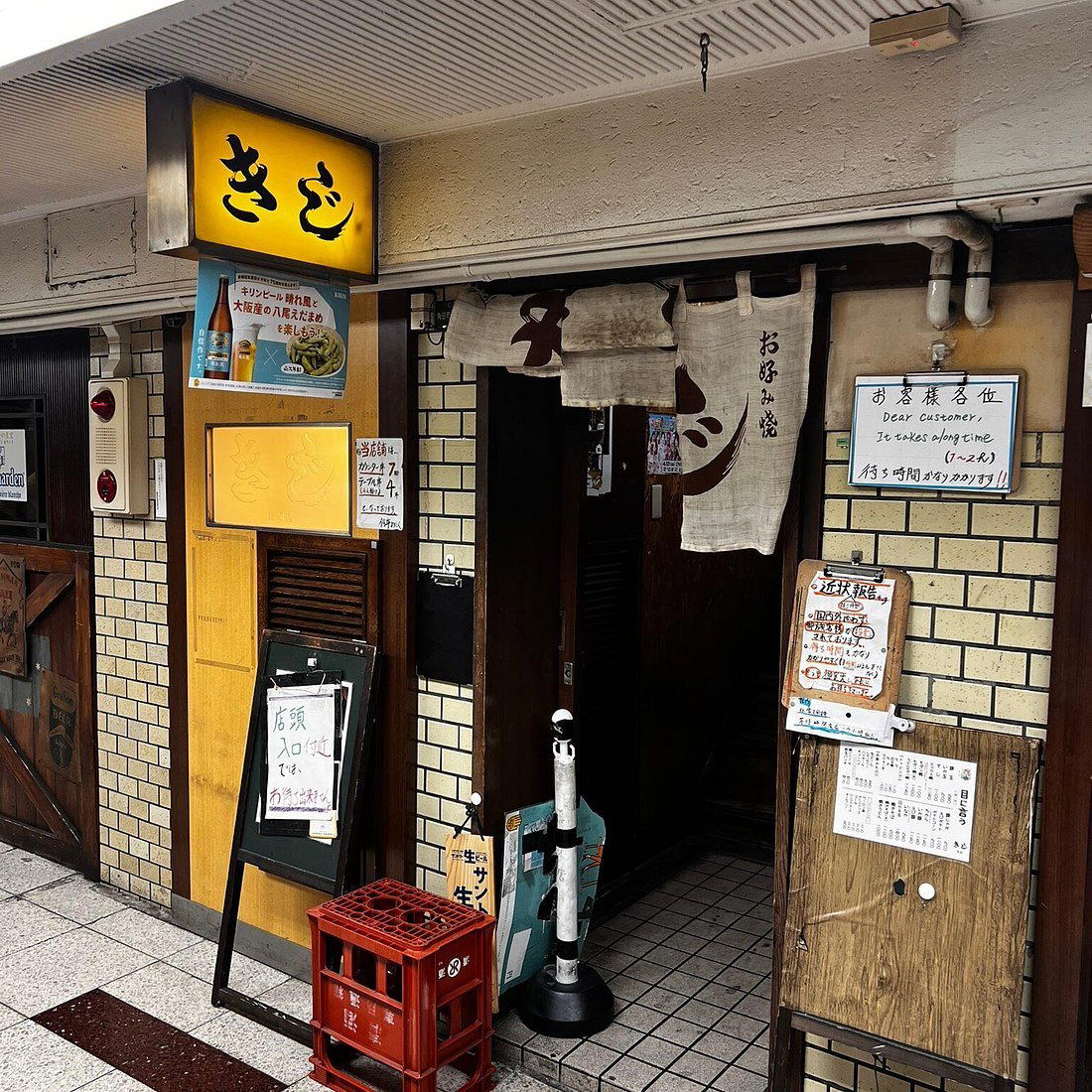
Okonomiyaki Kiji operates from the basement level of Osaka's Umeda Sky Building, placing one of the city's most discussed okonomiyaki counters inside a landmark modernist structure. The format is tight, the focus absolute: Osaka-style savory pancakes cooked on an iron teppan griddle, served without ceremony or distraction. For visitors building an itinerary around Kansai's food traditions, it anchors the casual end of a serious dining city.

Pearl is the En Primeur Club membership app, where members save venues, book tables and use the concierge.
The menu
What to order
- Modan-yaki
- Buta-tama
- Shrimp and pork okonomiyaki
Below the Sky, On the Griddle: Osaka's Okonomiyaki Tradition and Where Kiji Fits
Osaka has a deserved reputation as Japan's kitchen city, a place where eating is taken seriously at every price point and every format. Within that spectrum, okonomiyaki occupies a particular position: neither the refined edge of kaiseki nor the spectacle of a tasting counter, but a deeply ingrained civic food with its own technique, its own regional argument with Hiroshima, and its own set of practitioners who have spent careers perfecting what looks, to the uninitiated, like a simple batter-bound pancake. The city's leading okonomiyaki specialists operate at the intersection of craft and familiarity, a register that rewards patience and repetition more than novelty.
Okonomiyaki Kiji sits inside the basement level of the Umeda Sky Building, one of Osaka's more architecturally ambitious structures in the Kita Ward district of Oyodonaka. The building itself is a 1993 Hiroshi Hara design, known for its twin towers connected at the summit by a floating garden observatory. Most visitors arrive for the view; a portion arrive specifically for the basement, where a cluster of restaurants including Kiji operate in a retro-styled corridor meant to evoke the postwar food alleys that defined Osaka's urban eating culture in the Showa era. The physical context matters: you descend into something that feels deliberately separated from the contemporary city above, which calibrates expectations before any food arrives.
The Menu as Argument: What Osaka-Style Okonomiyaki Actually Means
Okonomiyaki is sometimes described to outsiders as a savory pancake, which is accurate as far as it goes and misleading in what it omits. The Osaka version, which Kiji represents, is built on a batter mixed directly with cabbage, egg, and a chosen protein, then cooked as a unified whole on a flat iron griddle. This contrasts with the Hiroshima approach, where the layers are assembled sequentially and noodles are incorporated as a structural element. The distinction is not cosmetic; it reflects genuinely different ideas about texture, density, and the role of each ingredient. Osaka practitioners tend to favor a lighter, airier result, where the cabbage volume is high enough to prevent the batter from reading as heavy.
The condiment architecture on an okonomiyaki plate is its own subject. Okonomiyaki sauce, Japanese mayonnaise, dried bonito flakes, and aonori (dried green seaweed) are the standard quartet, and the proportions applied by the cook rather than the diner are where individual style becomes visible. At a counter-level specialist like Kiji, these finishing decisions are the equivalent of seasoning choices at a serious kitchen: made with intention and not negotiable mid-service. The bonito flakes, responding to heat, move on the surface in a way that has become one of the visual signatures of the dish across Japan, though it is worth noting that the movement is a function of thin slicing and convection, not any property unique to any single establishment.
Kiji's menu, appropriately, keeps its focus narrow. The okonomiyaki format is the core proposition, with protein variations allowing for pork, seafood, and combination options in the tradition of Osaka-style preparation. This narrowness is an editorial statement in itself: a restaurant that does one thing and does not expand into adjacent formats is making a claim about where its quality lies. Compare this to the broader izakaya model, where okonomiyaki might appear as one item among thirty. At Kiji, the menu architecture forces the diner to engage with the dish rather than treat it as an incidental order.
Positioning Within Osaka's Casual Dining Tier
Osaka's dining scene spans a considerable range, from the multi-Michelin-starred kaiseki of restaurants like HAJIME in Osaka and the refined Japanese cooking of Ajikitcho Bunbuan, through mid-tier specialists, down to the counter-format casual restaurants where Kiji operates. This lowest tier is not a lesser tier in Osaka's framework; the city's food culture explicitly validates the neighborhood specialist, the family-run counter, the place that has been doing the same thing for decades without ambition to expand or diversify. Kiji operates in that tradition, though its placement inside a landmark building rather than a street-front shophouse gives it a slightly different profile than a pure neighborhood institution.
For visitors building a multi-day Kansai itinerary, Kiji anchors the casual end of a spectrum that might also include French-influenced omakase dining at Calendrier, contemporary courses at Aka to Shiro, or the broader Osaka restaurant coverage in our full Osaka Shi restaurants guide. Beyond the city, the Kansai region's serious dining extends to Gion Sasaki in Kyoto and the Nara-based akordu in Nara, with the broader Japanese dining conversation also touching Harutaka in Tokyo and Goh in Fukuoka. Kiji's appeal is specific and different from all of these: it is not about discovery or prestige, but about eating something regionally specific in a setting that has absorbed decades of that regional tradition.
The Umeda Sky Building location also means Kiji draws a mix of tourists and Osaka residents, which affects the pacing of service and the ambient noise level during peak hours. Lunchtime and early evening slots are the busiest, consistent with how okonomiyaki functions in Osaka's daily rhythm: it is rarely a late-night meal in the way ramen might be, and more commonly a midday or early-dinner proposition. Arriving outside standard meal peaks, particularly mid-afternoon on weekdays, is the more reliable way to experience the counter without a significant wait.
The Umeda and Kita Ward area, where the Sky Building sits, is also home to other notable Osaka dining, including Ajihei Sonezaki and the contemporary options at Az. For a sense of how a Western-rooted fine dining counter at the opposite end of the format spectrum operates, the contrast with Le Bernardin in New York City or the communal tasting format of Lazy Bear in San Francisco is instructive.
Planning Your Visit
Kiji is located at 1 Chome-1-90 Oyodonaka, Kita Ward, Osaka, in the basement level (B1F) of the Umeda Sky Building. The building is accessible from Osaka's Umeda station cluster, with several subway and JR lines within walking distance, making it logistically direct from most Osaka city-center hotels. Walk-in dining is the typical mode for this format, though waits during peak meal periods are a documented characteristic of the busier sessions.
Frequently asked questions
Where exactly is Okonomiyaki Kiji?
Okonomiyaki Kiji is located at Japan, 〒531-0076 Osaka, Kita Ward, Oyodonaka, 1 Chome−1−90 梅田スカイビル B1F, Osaka Shi.
Why is Okonomiyaki Kiji located in the basement of the Umeda Sky Building?
The basement level of the Umeda Sky Building in Oyodonaka, Kita Ward, was designed to recreate the atmosphere of Osaka's postwar Showa-era food alleys, a deliberate curatorial decision rather than a standard retail tenancy. Kiji's placement within that environment aligns with its counter format and teppan-griddle focus, both of which are period-authentic to that dining tradition. For visitors approaching from Osaka or Umeda stations, the building is accessible on foot and the basement functions as a self-contained dining district.
What's the signature dish at Okonomiyaki Kiji?
Kiji specializes in Osaka-style okonomiyaki: batter and cabbage combined with a protein of choice, cooked as a unified whole on a flat iron teppan griddle rather than layered in the Hiroshima method. The cooking happens at the counter, which means the dish arrives at the table in the condition it left the griddle. This is the format Osaka has defended as the standard for decades.
Should I book Okonomiyaki Kiji in advance?
Confirmed booking policy details are not available, but Kiji operates in a counter format typical of Osaka's okonomiyaki specialists, where walk-in queues are the norm rather than reservation systems. The Umeda Sky Building basement location draws both local regulars and visitors from the adjacent transport hub, so arriving at off-peak hours reduces wait times.
What's the signature at Okonomiyaki Kiji?
Kiji's defining proposition is Osaka-style okonomiyaki cooked on a teppan griddle at a casual counter in the basement of the Umeda Sky Building, Kita Ward. The Osaka method mixes all ingredients into the batter before cooking, producing a cohesive pancake distinct from the layered Hiroshima style. That distinction is the restaurant's entire argument.
Is Okonomiyaki Kiji good for vegetarians?
Osaka-style okonomiyaki can in principle be made without meat or seafood, but standard preparations at specialist counters typically include dashi-based batter, which is not vegetarian by strict definitions. Contacting Kiji directly before visiting is the clearest way to confirm available options.
Does Okonomiyaki Kiji justify its prices?
Verified pricing is not available, but as a general reference, Osaka-style okonomiyaki at specialist counters in the city typically sits in the ¥1,000–¥2,500 per dish range, placing this category well below Osaka's kaiseki tier. Kiji's location inside the Umeda Sky Building adds access to one of Kita Ward's more architecturally notable settings without a corresponding premium dining format. The value argument rests on the quality of the griddle work rather than the setting.
A Credentials Check
Comparable venues nearby, for context on price, style, and recognition.
| Venue | Cuisine | Price | Awards | Notes |
|---|---|---|---|---|
| Okonomiyaki KijiThis venue (the venue you are viewing) | Osaka-Style Okonomiyaki | $10–20 | Tabelog 100 #20 | Not listed |
| Feu 北新地 | japanese | Not listed | Not listed | Kita |
| お好み・鉄板焼 堀川 | Okonomiyaki & Teppanyaki | $30–50 | Not listed | Kita |
| Yakiniku Masachan | Traditional Yakiniku & Horumon | $50–100 | Not listed | Nishinari |
| Konishi | Kappo | $100–150 | Michelin Plate | Kita |
| Ajihei Sonezaki | Live Fugu & Crab Kaiseki | $150–200 | Not listed | Kita |
Recognition history
Dated appearances from independent guides and award organizations, with the underlying list record or original source where available.
Tabelog 100 #20 · No. 20
Tabelog · Tabelog 100 - Okonomiyaki - 2025
Continue exploring
More in Osaka
Restaurants in Osaka
All restaurants in Osaka →
Bars in Osaka
All bars in Osaka →
Hotels in Osaka
All hotels in Osaka →
Wineries in Osaka
Browse all →
Details
- Cozy
- Lively
- Casual Hangout
- Solo
- Open Kitchen
- Sake Program
- A La Carte
- Counter Dining
Current opening hours
- Monday
- 11:30 AM–9 PM
- Tuesday
- 11:30 AM–9 PM
- Wednesday
- 11:30 AM–9 PM
- Thursday
- Closed
- Friday
- 11:30 AM–9 PM
- Saturday
- 11:30 AM–9 PM
- Sunday
- 11:30 AM–9 PM
Hours can change for holidays and private events. Hours as of .