Our verdict
Dotonbori Kukuru occupies a first-floor address on one of Osaka's most concentrated strips of street-level eating, where the pace of the neighbourhood shapes every meal. The address places it inside the dense Dotonbori dining corridor in Chuo Ward, a stretch where ingredient provenance and production craft tend to matter more to serious diners than ambient theatre. For visitors calibrating their Osaka itinerary, it represents one reference point in a ward with considerable range.

Pearl is the En Primeur Club membership app — saves, bookings, and concierge access live there. Same editors, same standards.
- Address
- Japan, 〒542-0071 Osaka, Chuo Ward, Dotonbori, 1 Chome−10−5 白亜ビル 1階
- Phone
- +81 6 6212 7381
- Hours
- Mon–Fri 11 AM–9 PMSat–Sun 10 AM–9 PM
- Website
- dotonbori-kukuru.com
- Directions
- Get directions
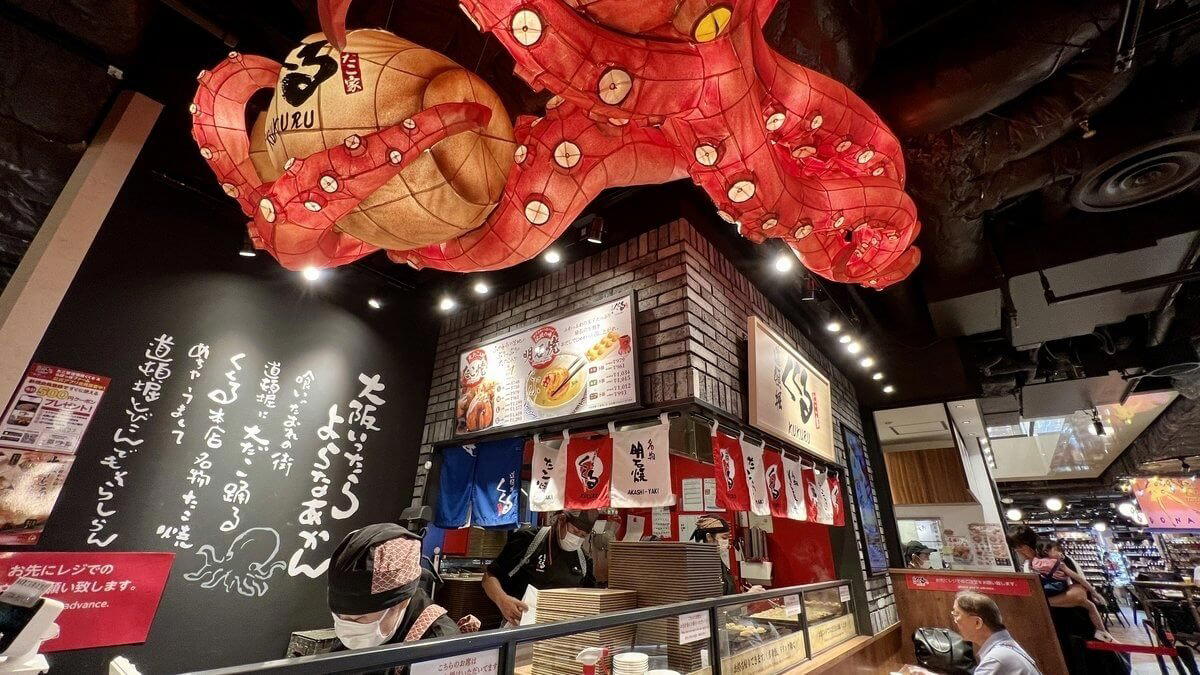
The menu
What to order
- Takoyaki with Giant Octopus Pieces
- Akashiyaki
Dotonbori's Ground Floor: What the Address Signals
Dotonbori is not a quiet neighbourhood. The Shiroa Building's ground floor, where Dotonbori Kukuru is located, sits at the 1-chome end of the strip — a position that places it in the densest concentration of food and drink the ward offers. In a neighbourhood where foot traffic is a constant, the question worth asking is not whether a place is busy, but whether it has a reason to be busy beyond location alone.
Osaka's broader culinary reputation rests on a concept the city itself popularised: kuidaore, the idea of eating until you are ruined financially and physically by the pleasure of it. This is not a marketing invention. It reflects a genuine civic orientation toward provisioning, sourcing, and consumption that predates the modern restaurant industry. Dotonbori, as the commercial and entertainment heart of the city, has long been where that orientation finds its most concentrated expression. Stands and counters here compete on ingredient specificity and production method in ways that would seem excessive elsewhere.
The Ingredient Logic of Osaka's Dotonbori
In Japan's food culture, the question of where something comes from carries more weight than it does in most Western dining contexts. Provenance is not a marketing add-on; it is the primary organising principle of serious eating. This is true at the kaiseki level — where kitchens like Ajikitcho Bunbuan and Ajihei Sonezaki calibrate menus around seasonal sourcing from named producers, but it also operates at the street level, where the most frequented counters tend to anchor their offer around a single ingredient category handled with precision.
The Dotonbori stretch specifically has a history of venues building reputations around a defined product: takoyaki producers who age their dashi base and source octopus from particular coastal fisheries; kushikatsu kitchens whose oil temperature management and breadcrumb sourcing are taken as seriously as any fine-dining technique. Aka to Shiro and Calendrier represent different registers of this same instinct in Osaka's wider Chuo Ward dining scene, each anchoring around a defined ingredient logic rather than stylistic breadth. The street-level counters of Dotonbori are, in this sense, the ground-floor expression of the same philosophy.
At this level of the market, the sourcing conversation tends to be implicit rather than announced. Menus do not always list producer names, but regulars understand which counters have held relationships with specific suppliers over time and which are rotating based on cost. That distinction is often what separates the addresses worth returning to from those worth visiting once for the spectacle.
Placing Dotonbori Kukuru in the Ward's Dining Range
Osaka Shi's Chuo Ward contains one of the most compressed ranges of dining in Japan, running from Michelin-decorated kaiseki rooms to standing counters with sub-thousand-yen portions. HAJIME in Osaka represents the far upper end of that range, with three Michelin stars and a format that has nothing in common with a Dotonbori street counter except the city they share. Understanding where a given address sits within that range is the first step in deciding whether it matches what you are looking for on a specific visit.
Dotonbori Kukuru's Chuo Ward placement makes it accessible from most central Osaka hotels, and the neighbourhood's dense transit connections mean it is a reasonable stop before or after visits elsewhere in the ward. For visitors mapping a day that includes multiple eating stops, the strip's concentration is a practical advantage: you can cover considerable culinary range within walking distance, which is how most serious eaters use this part of the city.
The comparison set worth holding in mind here is not the high-format kaiseki of Kyoto's Gion Sasaki or the technically exacting omakase counters found at Tokyo venues like Harutaka. It is, instead, the specific tier of Osaka eating where ingredient quality and production discipline show up in a format that does not require advance booking weeks out or a formal dress consideration. That tier has its own internal hierarchy, and position within it matters.
What the Dotonbori Setting Demands of Any Address Here
Operating in Dotonbori means operating in permanent comparison. Every visitor arriving on the strip has walked past multiple alternatives before stopping, and every local who chooses a specific counter over its neighbours a few metres away has made a considered decision. The neighbourhood does not protect weak operators; the density of choice means churn is fast. Addresses that hold positions on the strip tend to do so because their ingredient offer, production method, or format consistency has given repeat visitors a reason to return rather than rotate.
This dynamic makes the Dotonbori strip a useful test case for thinking about how street-level food culture in Japan sustains quality. Unlike the protected environments of a hotel dining room or a booking-only kaiseki kitchen, a Dotonbori address must perform without controlled conditions. The oil has to be right, the supply chain has to be consistent, and the throughput has to be managed without quality degrading across a full service. That is a different set of operational pressures than those facing venues like Az or the controlled-format counters elsewhere in Osaka Shi.
For context on how Osaka's food culture compares regionally, the kaiseki traditions of Nara and the produce-driven intensity of Fukuoka's Goh both reflect different expressions of the same Japan-wide sourcing instinct. Further afield, the technical rigour visible at Le Bernardin in New York City or the community-sourcing model at Lazy Bear in San Francisco suggest that ingredient provenance as a primary organising principle is not uniquely Japanese, but Japan's street-level execution of it remains among the most consistent anywhere.
Planning Your Visit
Dotonbori Kukuru is located at 1 Chome-10-5 Dotonbori, Chuo Ward, on the ground floor of the Shiroa Building, a position that is walkable from Namba Station and directly on the main strip. As with most Dotonbori addresses, the practical approach is to visit during off-peak hours if queue management matters to you; the strip draws significant foot traffic across most of the day and into the late evening. For a fuller view of what Chuo Ward's dining scene offers at every format level, the EP Club Osaka Shi restaurants guide maps the range from standing counters to Michelin-decorated rooms. Additional regional reference points include Abon in Ashiya, affetto akita in Akita, Aji Arai in Oita, Ajidocoro in Yubari District, and Akakichi in Imabari for context on how Japan's regional food culture operates outside the main urban centres.
Frequently asked questions
Where is Dotonbori Kukuru in Osaka Shi?
Dotonbori Kukuru is located at Japan, 〒542-0071 Osaka, Chuo Ward, Dotonbori, 1 Chome−10−5 白亜ビル 1階, Osaka Shi.
Where exactly is Dotonbori Kukuru located within Osaka Shi, and how easy is it to reach?
Dotonbori Kukuru occupies the ground floor of the Shiroa Building at 1 Chome-10-5 Dotonbori, Chuo Ward, Osaka Shi. The address sits on the canal-side strip within walking distance of Namba Station, making it accessible from multiple subway lines without requiring a transfer. In a corridor this dense, the street-level frontage is itself a navigation marker.
What do regulars order at Dotonbori Kukuru?
Dotonbori addresses that build repeat trade typically anchor around one item executed with consistency rather than range. Given the venue's ground-floor position at 1 Chome-10-5 Dotonbori in Chuo Ward, a high-throughput format is likely, which points toward a focused menu rather than a broad one. Confirming specific dishes is best done on arrival or by checking current listings at the venue directly.
Do I need a reservation for Dotonbori Kukuru?
Street-level counters along the Dotonbori strip in Chuo Ward operate predominantly on a walk-in basis, and Dotonbori Kukuru's ground-floor address at the Shiroa Building fits that pattern. Queues on the canal-side strip are common during peak evening hours, particularly on weekends, so arriving before the main dinner surge generally secures faster entry. No reservation contact details are currently listed.
What do critics highlight about Dotonbori Kukuru?
Critical focus in the Dotonbori corridor tends to land on production consistency and ingredient sourcing rather than atmosphere or service, given the density of competition on the strip. Dotonbori Kukuru's position in Chuo Ward places it in direct comparison with a range of well-established counters, meaning any sustained positive attention reflects execution rather than location advantage alone. No formal awards or publication citations are currently recorded.
Side-by-Side Snapshot
Comparable venues nearby, for context on price, style, and recognition.
| Venue | Cuisine | Price | Awards | Notes |
|---|---|---|---|---|
| Dotonbori KukuruThis venue — the venue you are viewing | Osaka-Style Takoyaki | $10–20 | Not listed | Not listed |
| 鮨 三心 | Edomae Omakase Sushi | $200–300 | 1 Michelin Star · La Liste Top Restaurants | Chūō |
| Moeyo Mensuke Ramen | Duck & Shellfish Ramen | $10–20 | Tabelog 100 #71 | Fukushima |
| 台処 かみ谷 | Modern Japanese Izakaya | $50–100 | Michelin Bib Gourmand | Nishi |
| Gojoya | Creative Fusion Kushikatsu | $30–50 | Michelin Bib Gourmand | Chūō |
| 澤田 | Traditional Japanese Kaiseki | Not listed | Not listed | Fukushima |
Continue exploring
More in Osaka
Restaurants in Osaka
Browse all →




Bars in Osaka
Browse all →


Hotels in Osaka
Browse all →



Wineries in Osaka
Browse all →
Details
- Lively
- Well Known
- Energetic
- Casual Hangout
- Late Night
- Standalone
- Street Scene
- A La Carte
Current opening hours
- Monday
- 11 AM–9 PM
- Tuesday
- 11 AM–9 PM
- Wednesday
- 11 AM–9 PM
- Thursday
- 11 AM–9 PM
- Friday
- 11 AM–9 PM
- Saturday
- 10 AM–9 PM
- Sunday
- 10 AM–9 PM
Hours can change for holidays and private events. Last verified .
Casual, bustling street food spot in lively Dotonbori with a lively atmosphere focused on freshly made takoyaki.