Niurou mian guan zi

Michelin Bib Gourmand
Our verdict
A Taiwanese beef noodle shop in Busan's Suyeong-gu district, Niurou mian guan zi holds back-to-back Michelin Bib Gourmand recognition for 2024 and 2025, placing it among the city's most decorated value-tier dining options. The kitchen delivers a cuisine rare in South Korea, sitting at the ₩ price tier alongside Busan's local staples like dwaeji-gukbap and naengmyeon.

Pearl is the En Primeur Club membership app, where members save venues, book tables and use the concierge.
The menu
What to order
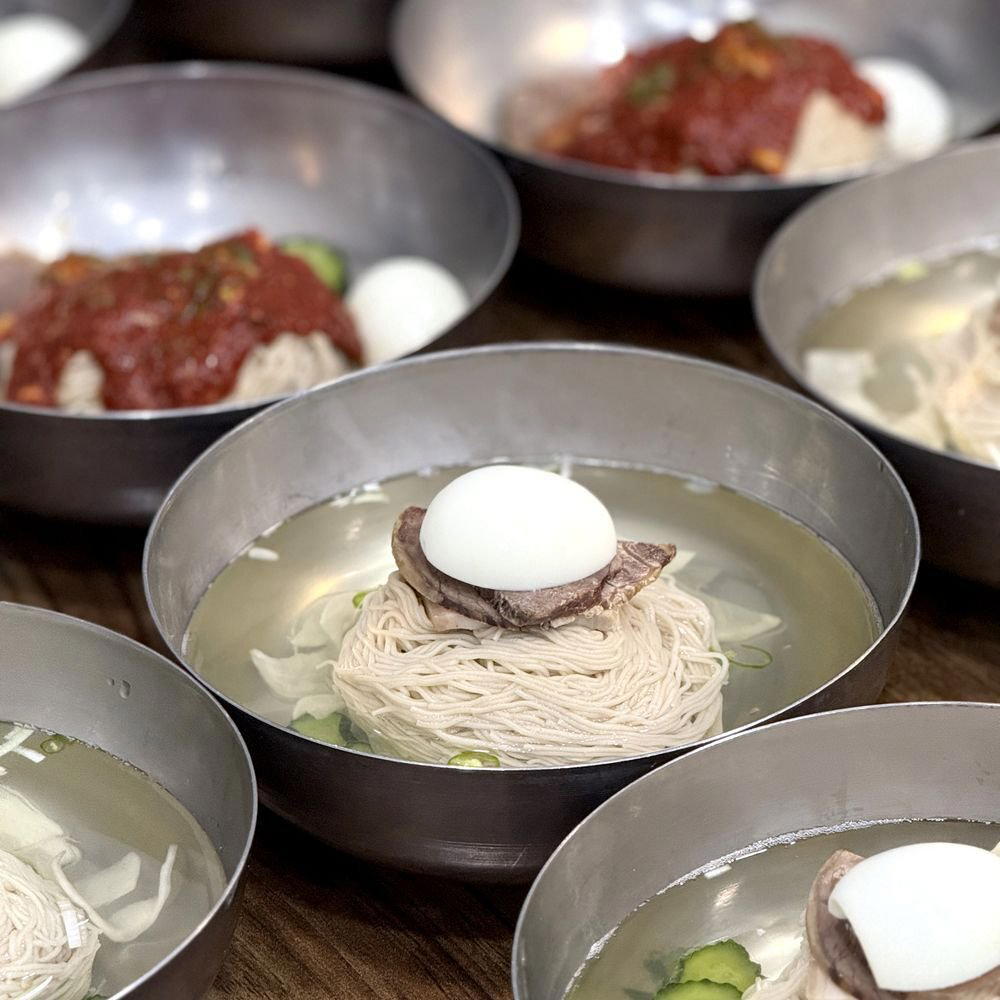
- Braised beef noodle soup
- Spicy wontons
Taiwanese Beef Noodles in a Korean Port City
Busan's dining map is built on native Korean comfort formats: the fatty pork bone broth of dwaeji-gukbap, the cold buckwheat of naengmyeon, the raw fish counters that line the harbour markets. Against that context, a Taiwanese beef noodle shop in Suyeong-gu registers as a genuine outlier. The city's appetite for non-Korean Asian cuisines has grown steadily over the past decade, but Taiwanese cooking remains at the periphery rather than the centre of that expansion. Japanese formats dominate the import end of the market, as venues like Mori demonstrate at the ₩₩₩ tier; Taiwanese kitchens at serious, award-recognised quality are scarce.
Niurou mian guan zi sits in that gap. Tucked into a ground-floor unit in the Donghwa Mansion building on Suyeong-ro, it has none of the visibility of Busan's major dining corridors. The address places it firmly in residential Suyeong-gu rather than in the Haeundae or Nampo-dong zones where most food tourism concentrates. That positioning is part of the story: the venue earns its recognition through the food rather than through foot traffic or neighbourhood cachet.
What Michelin's Bib Gourmand Actually Signals Here
The Bib Gourmand designation, awarded in both 2024 and 2025, identifies restaurants offering quality meals at prices below the starred tier. In Busan's Michelin guide context, that means the kitchen is cooking at a level Michelin's inspectors consider worthy of attention, while keeping the price point accessible. With a ₩ price range, Niurou mian guan zi sits in the same cost bracket as the city's local one-dish institutions, places like 100.1. Pyeongnaeng, where the proposition is a single disciplined format executed to a high standard rather than a multi-course dining programme.
Back-to-back Bib Gourmand years carry a specific implication: the consistency is not accidental. A single-year recognition can reflect a strong moment or a newly opened kitchen catching an inspector on a good visit. Two consecutive years suggests the kitchen has maintained its standard through a full operational cycle. For a venue in a cuisine category with almost no direct Busan competition, that sustained recognition becomes the most reliable quality signal available.
By comparison, Palate operates in the contemporary Korean format at ₩₩, and Born and Bred anchors the steakhouse end at ₩₩₩₩. The Taiwanese beef noodle kitchen fits an entirely different part of the city's dining spectrum: single-dish, high-repetition, value-driven, and built around a cuisine tradition that has no meaningful peer group locally.
The Flavour Architecture of Taiwanese Beef Noodles
To understand what Niurou mian guan zi is cooking, it helps to understand the dish itself before the venue. Taiwanese beef noodle soup is one of the most contested comfort dishes in Chinese culinary tradition. The dominant style, the red-braised variant known as hong shao, builds a broth from soy, doubanjiang (fermented broad bean and chilli paste), rice wine, and a long-cooked beef stock that collapses the collagen in shank or tendon cuts into a glossy, deeply savoury base.
Here is where the editorial angle of this piece becomes relevant. Doubanjiang is the same fermented chilli base that anchors Sichuan cooking, and the ma-la spectrum familiar from Sichuan cuisine, the layered interplay of numbing Sichuan pepper and various grades of chilli heat, is not entirely absent from Taiwanese beef noodle traditions, though it manifests differently. In Taiwanese red-braised broth, the heat is deeper and slower than the front-of-mouth burn of ma-la dishes; the fermentation in doubanjiang adds a complexity that straight dried chilli cannot replicate. The numbing quality associated with hua jiao (Sichuan pepper) appears in some Taiwanese interpretations as a background note rather than the dominant characteristic it carries in Chongqing or Chengdu kitchens. The result is a broth with structural similarities to Sichuan flavour logic but a different register: warmer, more rounded, less aggressive at the front of the palate.
Noodle choice also matters in this tradition. Taiwanese beef noodle shops typically favour thick, hand-pulled or machine-cut wheat noodles with enough body to hold up in a heavy broth. The cut of beef, often shank or a shank-and-tendon combination, provides both gelatinous texture from long braising and a specific mineral depth that lighter cuts do not deliver. The garnish question, whether to finish with pickled mustard greens, fresh coriander, or scallion, divides Taiwanese regional approaches and represents one of the few areas where a skilled kitchen can signal its regional orientation through a small decision.
Taiwanese beef noodle traditions exist at a sophisticated level in their home market. For comparison, venues in Taipei like Fujin Tree Taiwanese Cuisine, Golden Formosa, and Mipon each take different positions within the Taiwanese dining tradition. Niurou mian guan zi operates in a market where the reference points for the cuisine are absent, which means Michelin's recognition carries additional weight as a calibration tool.
Suyeong-gu and the Practical Reality
Suyeong-gu is a residential district in Busan's eastern zone, less trafficked by visitors than Haeundae to the north or the old city centre to the west. Finding the venue requires some navigation: the Donghwa Mansion address on Suyeong-ro 388beon-gil is a residential apartment building, and the restaurant occupies unit 107 on the ground floor. This is a format common across Korean cities, where strong kitchens operate from building-base units with minimal exterior signage rather than purpose-built restaurant premises. The low overhead of that format is part of what makes the ₩ price point possible at Bib Gourmand quality.
Tables tend to turn quickly in this format; the risk is queue time at peak hours rather than unavailability weeks in advance. Weekend lunch is typically the most competitive window at this category of restaurant in Korean cities. Visiting on a weekday or arriving at an off-peak hour reduces wait time meaningfully.
For visitors building a Busan itinerary around the city's Michelin-recognised dining, the Suyeong-gu location pairs logically with a broader exploration of the eastern districts. Bao Haus represents another non-Korean Asian format recognised in the city's dining scene. For Busan's broader options across all categories, our full Busan restaurants guide covers the range, while the Busan hotels guide, bars guide, wineries guide, and experiences guide cover the rest of the city's infrastructure.
For context on how South Korea's Michelin scene develops across other cities and formats, Mingles in Seoul, Gaon, and Kwon Sook Soo each operate at the higher end of the Korean capital's spectrum. Baegyangsa Temple in Jangseong-gun and The Flying Hog in Seogwipo illustrate how Michelin's Korea coverage extends well beyond the major cities.
Frequently asked questions
How much does it cost to eat at Niurou mian guan zi?
Pricing at Niurou mian guan zi is listed as ₩.
How do I find Niurou mian guan zi?
Niurou mian guan zi is located at South Korea, Busan, Suyeong-gu, Suyeong-ro 388beon-gil, 25-4, 동화맨션, 1층 107호, Busan.
What's Niurou mian guan zi known for in terms of accolades?
Niurou mian guan zi has received recognition including: Michelin Bib Gourmand (2025); Michelin Bib Gourmand (2024).
What should I order at Niurou mian guan zi?
The venue's identity is built entirely around Taiwanese beef noodle soup, a dish with a long tradition on the island rooted in braised beef, wheat noodles, and a broth that typically carries soy, spice, and rendered fat. Given that the Michelin Bib Gourmand has recognised this kitchen in both 2024 and 2025, the core bowl is the logical anchor of any visit.
What's the cuisine at Niurou mian guan zi?
How hard is it to get a table at Niurou mian guan zi?
Suyeong-gu draws fewer tourists than Haeundae or Busan's city centre, which works in the diner's favour. That said, back-to-back Bib Gourmand recognition in 2024 and 2025 tends to compress walk-in availability at small neighbourhood spots in Korean cities, particularly at lunch. No reservation system or phone contact is listed publicly, so arriving early or off-peak is the most reliable approach.
The Quick Read
| Venue | Cuisine | Price | Awards | Notes |
|---|---|---|---|---|
| Niurou mian guan ziThis venue (the venue you are viewing) | Taiwanese Beef Noodle Soup | $10–20 | Michelin Bib Gourmand | Not listed |
| Palate | Contemporary French with Korean Fusion | $150–200 | 1 Michelin Star · La Liste Top Restaurants | Contemporary |
| Mori | Japanese Kaiseki | $200–300 | 1 Michelin Star | Japanese |
| Born and Bred | Modern Hanwoo Beef Omakase Steakhouse | $100–150 | Michelin Plate · World's 50 Best #51 | Steakhouse |
| 100.1. Pyeongnaeng | Pyongyang-style Naengmyeon | $10–20 | Michelin Bib Gourmand | Naengmyeon |
| Anmok | Modern Korean Dwaeji-Gukbap | $10–20 | Michelin Bib Gourmand | Dwaeji-gukbap |
Recognition history
Dated appearances from independent guides and award organizations, with the underlying list record or original source where available.
Michelin Bib Gourmand
Michelin
Full recognition history (2 entries)
Michelin Bib Gourmand
Michelin