
A Michelin-starred Taiwanese restaurant on the third floor of a Zhongshan District building, Mipon earns its star through disciplined, ingredient-led cooking rooted in traditional technique. The kitchen's stewed Chinese cabbage with fish skin and honey mustard-glazed ribs with black jujube dates signal a menu that respects classical Taiwanese flavour structures without drift into fusion. Lunch and dinner service run daily, with earlier weekend evening sittings from 5:30 PM.
Pearl is the En Primeur Club membership app — saves, bookings, and concierge access live there. Same editors, same standards.
- Address
- 104, Taiwan, Taipei City, Zhongshan District, Lequn 2nd Rd, 55號3F
- Phone
- +886 2 7722 3391
- Website
- grandmayfull.com
- Directions
- Get directions
 Saves & bookings on Pearl
Third Floor, Zhongshan District: What the Address Signals
Taipei's mid-range to premium Taiwanese dining scene has quietly reorganised itself over the past decade. The city's Michelin guide, now in its sixth edition, has increasingly validated restaurants that work within classical Taiwanese idioms rather than reaching toward French or Japanese hybridity. Mipon, on the third floor of a residential-commercial block on Lequn 2nd Road in Zhongshan District, sits squarely in that category: a Michelin one-star restaurant with a menu structured around the foundational techniques of Taiwanese home and banquet cooking.
The address deserves a moment's consideration. Zhongshan District in northern Taipei carries a particular character, less conspicuous than the gloss of Da'an or the density of Xinyi, but home to a long-established layer of serious Taiwanese restaurants that have built reputations on repeat local custom rather than tourist foot traffic. This is the kind of neighbourhood where a third-floor dining room above street level is a normal arrangement, not an affectation. The climb signals something: this restaurant is not designed for passing trade.
The Kitchen's Lineage and What It Means for the Menu
Leadership transitions in long-running kitchens are a reliable indicator of institutional confidence. At Mipon, a promoted executive chef has handed primary kitchen duties to a long-standing protégé, a succession model common in the upper tier of Taiwanese restaurants, where cooking knowledge is transmitted through sustained mentorship rather than formal culinary school progression.
That culinary logic is worth examining in the context of Taiwanese cooking more broadly. Unlike the Cantonese-leaning haute cuisine found at places such as Golden Formosa or the indigenous-ingredient focus of Akame in Wutai Township, Mipon works within a tradition that fuses Fujianese technique, Japanese-era ingredient habits, and the specific produce networks of Taiwan's agricultural counties. Yilan, for instance, is referenced directly in Mipon's kitchen through the duck eggs used in a fried garnish on the stewed cabbage dish.
Roasting, Braising, and the Signature Dishes
The editorial angle around roasting and char-intensive technique is worth applying carefully here. Mipon's cooking is not char siu or Peking duck territory, the kitchen operates within Taiwanese rather than Cantonese roasting traditions, but the underlying logic of fire, fat, and time is present. The honey mustard-glazed ribs represent a distinct branch of Chinese roasting culture: a lacquered, twice-cooked style where the glaze is built from fermented and dried ingredients rather than the maltose-and-vinegar base familiar in Cantonese contexts. Black jujube dates in the sauce introduce a deep, fruit-forward acidity that functions as a counterweight to the richness of the pork, and the result sits closer to the braised-and-finished school of Taiwanese meat cookery than to the high-heat dry roasting of a Cantonese barbecue kitchen.
This distinction matters for a reader choosing between Taipei's premium Chinese-heritage restaurants. At the $$$$ tier, diners at Mountain and Sea House or the Cantonese rooms at Ming Fu are in a different culinary conversation. Mipon's $$$ pricing and Taiwanese framing place it in a more specific position: Michelin-recognised technique applied to familiar dishes.
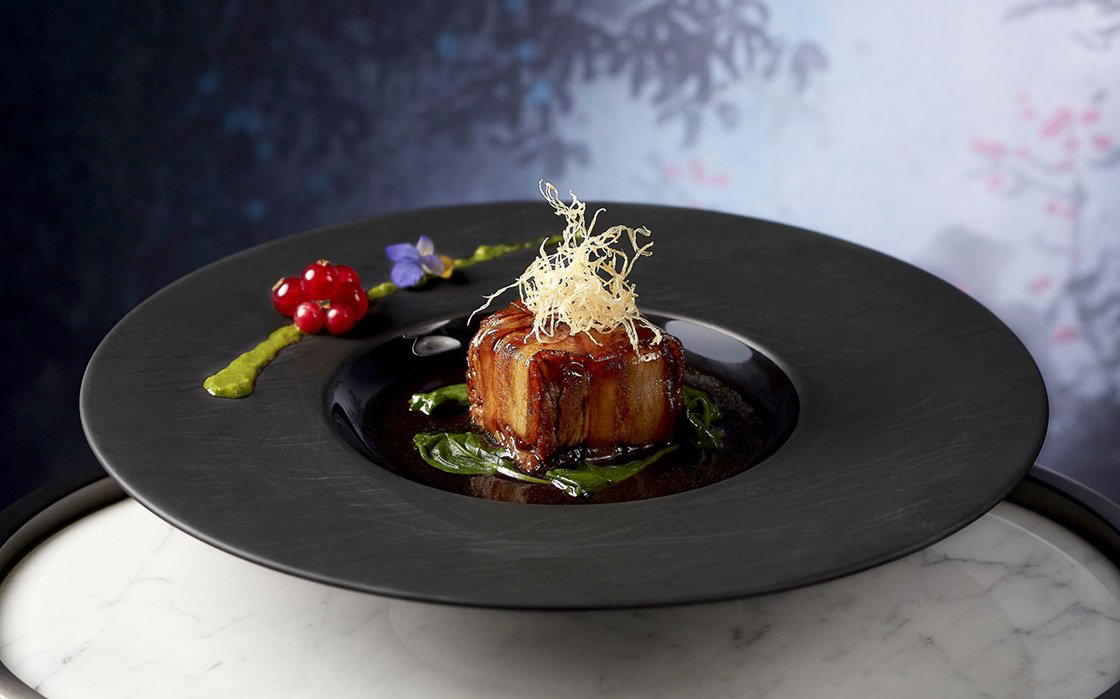
The stewed Chinese cabbage with fish skin is the more structurally interesting dish of the two highlighted. Braised brassica is one of the more technically demanding vegetables in Chinese cooking precisely because it is so familiar, there is no novelty to hide behind. The fish skin element introduces a collagen-rich layer that enriches the braising liquid and gives the dish textural variation, while the duck-egg fried garnish on leading provides the crunch that prevents the whole plate from reading as monotonous. It is a dish organised around contrast: soft and crisp, sea and land, restrained and rich.
Mipon in the Taipei Michelin Context
Taipei's 2024 Michelin guide reflects a restaurant scene that has grown increasingly confident in its Taiwanese identity. The one-star category now includes a wider range of cuisine types and price points than in the guide's earlier editions, but the underlying selection logic favours consistency and technique over novelty.
For context within the Taipei dining map, Mipon occupies a different register from the city's upper-end contemporary operations. Restaurants such as logy (Modern European, Asian Contemporary, $$$$) or Taïrroir (Taiwanese/French, $$$$) are working within a global fine-dining framework where internationalist influence is central to the proposition. Mipon's position is the inverse: the Michelin star validates a restaurant that is, in format and spirit, committed to a domestic tradition. That is a smaller and harder category to win recognition in, because the reference set for the judges is every grandmother's kitchen and every night market stall that has ever made a version of the same dish.
Comparison with other Michelin-acknowledged Taiwanese specialists across the island is also instructive. JL Studio in Taichung works with Peranakan-Taiwanese fusion; YUENJI in Taichung operates in a Taiwanese contemporary register; GEN in Kaohsiung takes a different regional approach. Mipon's Taipei positioning, with its Zhongshan neighbourhood address and banquet-adjacent cooking style, represents a specific strand of the island's premium dining evolution. The diaspora parallel is worth noting: 886 in New York City has made a case for Taiwanese cooking on an international stage, but Mipon's project is the opposite, making the case at home, with no need for translation.
comparable set and Where Mipon Sits
Within Taipei's Taiwanese restaurant category specifically, a few peer venues help triangulate Mipon's position. Shin Yeh Taiwanese Signature is a long-running institution that occupies a slightly different register, more banquet-oriented and historically associated with formal celebratory dining. Fujin Tree Taiwanese Cuisine and Champagne in Songshan leans into a more contemporary presentation of Taiwanese ingredients, with a wine program that signals a different target audience. Mipon sits between these poles: more technically disciplined than a casual Taiwanese restaurant, less Westernised in its idiom than a contemporary fusion operation, and operating at a price point that makes a Michelin star an active competitive asset rather than a luxury premium marker.
For those exploring wider Taiwan dining beyond Taipei, A Cun Beef Soup in Tainan and A Fung's Harmony Cuisine in Kaohsiung represent southern Taiwan's parallel investment in regional cooking identity, each working within quite different culinary traditions. The broader EP Club Taiwan coverage also includes Volando Urai Spring Spa and Resort in Wulai District, which adds a resort-dining dimension to the island's culinary geography.
Service Hours and Planning
Mipon runs lunch from 11:30 AM to 2:30 PM and dinner from 6:00 PM to 9:30 PM Monday through Friday. On weekends, the dinner sitting begins slightly earlier, at 5:30 PM. The double-service daily format, without a mid-week closure, is relatively uncommon at this tier in Taipei, where many Michelin-starred operations take at least one full day off. For planning purposes, this makes Mipon more accessible than several peer restaurants in terms of scheduling flexibility.
Zhongshan District is well-served by Taipei's MRT network. Lequn 2nd Road is accessible from Jiannan Road Station on the Wenhu line, which connects to the main Taipei MRT system at Zhongshan Junior High School Station. The third-floor location means the entrance requires some orientation on arrival, but this is standard for mid-rise dining in this part of the city.
Know Before You Go
- Address: 3F, 55 Lequn 2nd Road, Zhongshan District, Taipei 104, Taiwan
- Lunch: Monday to Sunday, 11:30 AM – 2:30 PM
- Dinner (Mon–Fri): 6:00 PM – 9:30 PM
- Dinner (Sat–Sun): 5:30 PM – 9:30 PM
- Price range: $$$
- Awards: Michelin One Star (2024) 3 from 1,780 reviews
- Cuisine: Taiwanese
- 10-hour roasted beef
- stewed Chinese cabbage with fish skin
- 3 cup octopus
- egg rolls stuffed with eel
- honey mustard-glazed ribs
- fried dough with almond milk
Awards and Standing
Comparable venues nearby, for context on price, style, and recognition.
| Venue | Cuisine | Price | Awards | Notes |
|---|---|---|---|---|
| MiponThis venue — the venue you are viewing | Refined Taiwanese Home-Style Cuisine | $$$ | Michelin 1 Star | Not listed |
| Shin Yeh Taiwanese Signature | Taiwanese Signature Cuisine | $$$ | Michelin 1 Star | Xikang |
| Fujin Tree Taiwanese Cuisine & Champagne (Songshan) | Modern Taiwanese Cuisine with Champagne Pairings | $$$ | Michelin 1 Star | Zhonghua |
| Ming Fu | Traditional Taiwanese Seafood | $$$ | Michelin 1 Star | Heng'an |
| Ban Bo | Modern Taiwanese Fine Dining | $$$$ | Michelin 1 Star | Xikang |
| Hosu | Modern Taiwanese Contemporary | $$$$ | Michelin 1 Star | Dunhuang |
Recognition history
Dated appearances from independent guides and award organizations, with the underlying list record or original source where available.
Michelin 1 Star
Michelin
Michelin 1 Star
Michelin
Michelin 1 Star
Michelin
Continue exploring
More in Taipei
Restaurants in Taipei
Browse all →
Bars in Taipei
Browse all →
Hotels in Taipei
Browse all →

Wineries in Taipei
Browse all →
At a Glance
- Elegant
- Sophisticated
- Classic
- Business Dinner
- Group Dining
- Celebration
- Special Occasion
- Family
- Hotel Restaurant
- Private Dining
- Open Kitchen
- Local Sourcing
Current opening hours
- Monday
- 11:30 AM–2:30 PM, 6–9:30 PM
- Tuesday
- 11:30 AM–2:30 PM, 6–9:30 PM
- Wednesday
- 11:30 AM–2:30 PM, 6–9:30 PM
- Thursday
- 11:30 AM–2:30 PM, 6–9:30 PM
- Friday
- 11:30 AM–2:30 PM, 6–9:30 PM
- Saturday
- 11:30 AM–2:30 PM, 5:30–9:30 PM
- Sunday
- 11:30 AM–2:30 PM, 5:30–9:30 PM
Hours can change for holidays and private events. Last verified .
Grand, luxurious interior with beautiful chandeliers and gold accents; clean and bright dining space with an upscale hotel setting that feels immaculate and well-appointed.