Google: 4.7 · 3 reviews
100.1.Pyeongnaeng
.png)
A Michelin Bib Gourmand recipient in both 2024 and 2025, 100.1.Pyeongnaeng brings naengmyeon — the cold noodle tradition rooted in North Korea's Pyongyang — to Busan's Suyeong-gu district at a price point that keeps the discipline of the dish ahead of any prestige markup. For a city whose noodle culture runs deep, this address represents the category at its most focused.
 Discover on Pearl
Pearl is the En Primeur Club membership app — saves, bookings, and concierge access live there. Same editors, same standards.
Cold Noodles in a Port City: The Naengmyeon Tradition in Busan
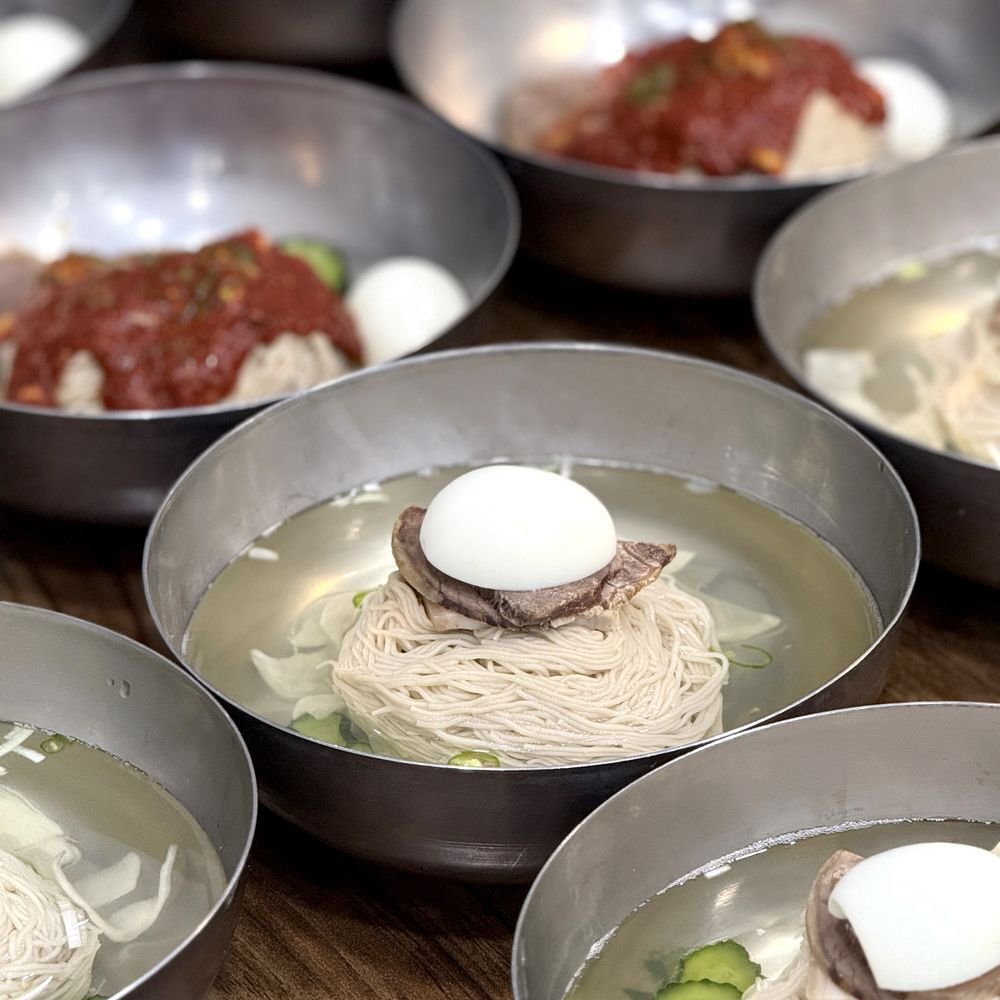
In South Korea, naengmyeon occupies a category of its own. It is not simply a noodle dish — it is a centuries-old preparation tied to the cold winters of Pyongyang, carried south by refugees during the Korean War, and now practiced with near-ritualistic seriousness across the peninsula. The bowl arrives chilled, sometimes resting in a pool of frozen broth, built around thin buckwheat or starch noodles that resist the teeth in a way no other Korean noodle does. Getting that texture right — the slight chew, the cold shock of the broth, the acid-sweet balance of the dongchimi or mul naengmyeon base , is a technical problem that has kept generations of cooks occupied. Busan, a city whose food identity leans heavily into seafood and pork bone soups, maintains its own naengmyeon tradition alongside those anchors, and a handful of addresses take the form as seriously as the Pyongyang-lineage restaurants of Seoul.
100.1.Pyeongnaeng sits inside that serious tier. Located in Suyeong-gu, a district east of the city centre that sits between the beaches of Gwangalli and the residential density further inland, the restaurant has earned Michelin's Bib Gourmand designation in consecutive years , 2024 and 2025 , a signal from inspectors that the kitchen delivers cooking of genuine quality at a price point that does not require financial planning. The single ₩ price tier places it among the most accessible entries in Busan's Michelin-recognised set, well below the contemporary and Japanese counters at ₩₩ and above that cluster in the city's smarter dining districts.
What the Bib Gourmand Designation Actually Signals
Michelin's Bib Gourmand category was designed specifically to surface restaurants that do not fit the fine-dining template but maintain a standard the Guide considers worth directing readers toward. Across the Korean Michelin editions, that has historically meant hearty, specialist, often single-dish restaurants where the craft is entirely concentrated in one preparation and the margin for error is therefore zero. There is nowhere to hide in a naengmyeon restaurant. The noodles, the broth, and the garnish are the whole proposition, and consecutive Bib Gourmand recognition in 2024 and 2025 suggests that the kitchen at 100.1.Pyeongnaeng has held its line on those fundamentals through a period of significant cost pressure in Korean hospitality. For comparison, Busan's starred restaurants , Palate at the contemporary end and Mori on the Japanese side , operate in a different mode entirely, where tasting menus and high-touch service justify multiple price tiers above what 100.1.Pyeongnaeng charges. The naengmyeon counter exists in a separate competitive set, one where Seoul benchmarks like Bongmilga, Jinmi Pyeongyang Naengmyeon, and Jungin Myeonok define what genuine mastery of the form looks like.
The Dish at the Centre
Naengmyeon comes in two principal variants across the peninsula. Mul naengmyeon , broth-based, cold, and typically garnished with sliced beef, cucumber, and a half-moon of hard-boiled egg , is the form most closely associated with Pyongyang tradition and the one that rewards the most scrutiny. Bibim naengmyeon, the dry spiced version, runs alongside it in most specialist restaurants. The quality markers that critics and regulars use to assess either version are specific: the elasticity of the noodles (handmade buckwheat noodles are denser and more demanding than machine-cut starch alternatives), the depth and clarity of the broth, and the calibration of the dongchimi fermentation that underpins the mul style. These are not variables that generalist kitchens tend to get right consistently, which is part of why Bib Gourmand recognition carries weight in this category , it implies the inspectors found the fundamentals in order on multiple unannounced visits.
Within Busan's naengmyeon sub-category, 100.1.Pyeongnaeng draws comparison to Buda Myeonoak and Damiok, both of which address the cold noodle tradition in the city. Each takes a slightly different approach to the balance between tradition and local adaptation, and together they represent the most coherent naengmyeon tier in Busan's dining scene.
Suyeong-gu: The Neighbourhood Context
Suyeong-gu is not where most international visitors to Busan start their eating. That gravitational pull tends to sit further north in Seomyeon, or south along the Haeundae beachfront corridor where hotels and higher-end restaurants cluster. Suyeong occupies a middle geography , residential and local in character, close to the Gwangalli waterfront without the tourist markup, and served by the Busan Metro's Line 2 at Gwangalli station and Line 3 connections at Suyeong station. The address on Namcheonbada-ro 10beon-gil places the restaurant within a quiet sub-district that rewards wandering after a meal rather than rushing back to the hotel strip. The neighbourhood's day-to-day character , market stalls, neighbourhood restaurants, the kind of foot traffic that keeps specialists viable , suits a single-dish restaurant in a way that a more tourist-facing location would not.
Planning a Visit
Naengmyeon restaurants in Korea typically draw their heaviest traffic at lunch, when the cold noodles serve as a restorative between morning activity and the afternoon. Arriving slightly before or after the midday peak , roughly 11:30 or after 13:30 , is standard practice at high-recognition specialist restaurants across the country. The single ₩ price tier means a meal here costs a fraction of what Busan's starred contemporaries charge: Born and Bred at the steakhouse end of the spectrum operates at ₩₩₩₩, four full price tiers above what 100.1.Pyeongnaeng asks. No phone or website is listed in available records, which suggests walk-in is the operative approach , consistent with how the majority of specialist naengmyeon restaurants across Korea manage their service. Bringing cash remains practical in this category, as smaller specialist restaurants in Korean cities do not always maintain card processing infrastructure to the same standard as higher-priced establishments.
For visitors building a broader picture of Busan's dining range, our full Busan restaurants guide maps the city across price tiers and cuisine types. Those extending their Korea itinerary should note that the naengmyeon tradition reaches its most concentrated expression in Seoul, where addresses like Bongmilga and Jinmi Pyeongyang Naengmyeon have drawn serious attention from the same Michelin inspectors who recognised 100.1.Pyeongnaeng. For context on what Korean fine dining looks like at the other end of the register, Mingles in Seoul, Gaon, and Kwon Sook Soo represent the tasting-menu and hanshik-refined tier. Busan's own wider offer , hotels, bars, experiences , is covered in our hotels guide, our bars guide, and our experiences guide. Wineries in the region are mapped at our Busan wineries page. For a broader Korean culinary reference across temple food and regional tradition, Baegyangsa Temple in Jangseong-gun and The Flying Hog in Seogwipo offer useful counterpoints.
Fast Comparison
A small peer set for context; details vary by what’s recorded in our database.
| Venue | Cuisine | Price | Awards | Notes |
|---|---|---|---|---|
| 100.1.Pyeongnaeng | Naengmyeon | ₩ | Bib Gourmand | This venue |
| Palate | Contemporary | ₩₩ | Michelin 1 Star | Contemporary, ₩₩ |
| Mori | Japanese | ₩₩₩ | Michelin 1 Star | Japanese, ₩₩₩ |
| Born and Bred | Steakhouse | ₩₩₩₩ | World's 50 Best | Steakhouse, ₩₩₩₩ |
| Anmok | Dwaeji-gukbap | ₩ | Dwaeji-gukbap, ₩ | |
| Bao Haus | Taiwanese | ₩ | Taiwanese, ₩ |

At a Glance
- Classic
- Casual Hangout