Michelin Plate
Our verdict
A Michelin Plate-recognised French restaurant in the historic Kabutocho financial district, Neki pairs a French-rooted but free-ranging kitchen with organic wines and a room dressed in wine bottles and album covers. The chef draws on Japanese ingredients, fermented vegetables, and Middle Eastern spices to produce modern cuisine that sits outside easy categorisation. Organic wine pairings are a natural fit for the relaxed, exploratory approach.

Pearl is the En Primeur Club membership app — saves, bookings, and concierge access live there. Same editors, same standards.
French Cooking in the Old Money Quarter
Kabutocho spent most of the twentieth century as Tokyo's financial centre, a grid of pre-war buildings and trading floors where brokers once set the price of Japanese equities. The district's recent rehabilitation — low-footprint bars, independent restaurants, design-minded tenants moving into the surviving Showa-era stock — has given Tokyo a neighbourhood that feels genuinely different from Roppongi or Ginza's polished restaurant corridors. Neki sits inside that shift, occupying a room in the Kabutocho Dai-4 Heiwa Building at 8-1 Nihonbashikabutocho, Chuo City, surrounded by the remnants of a district that still carries the atmosphere of its former life.
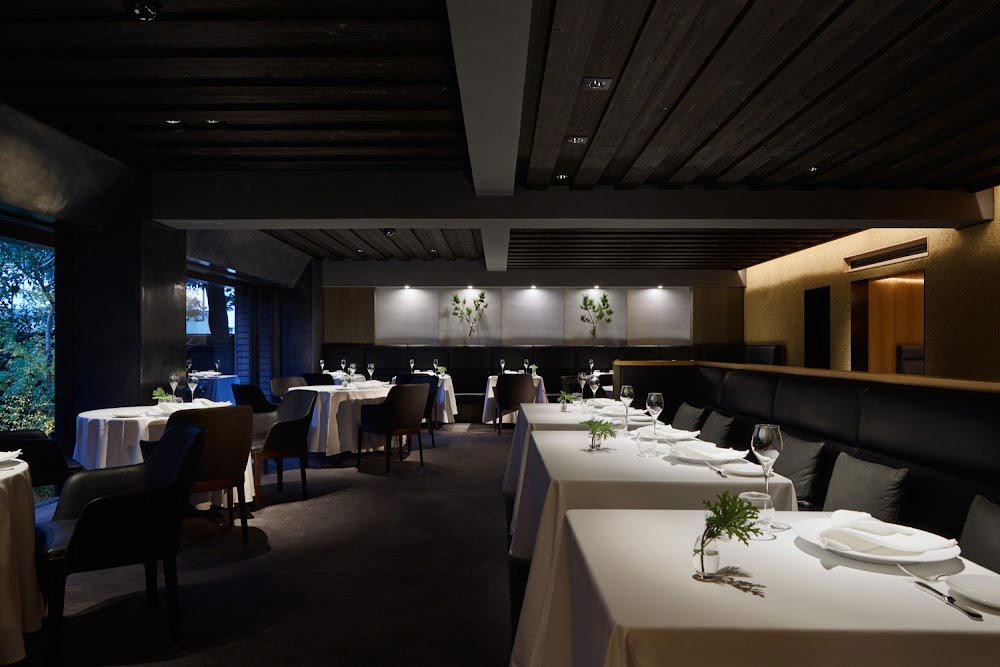
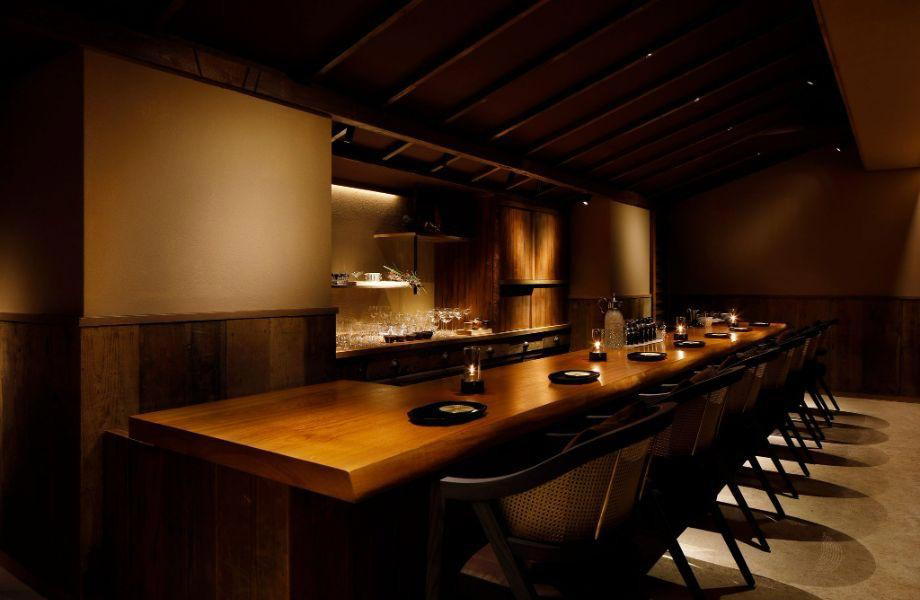
The room itself signals what kind of restaurant this is before a plate arrives. Wine bottles line the walls alongside album covers, and genre-less music runs in the background, not curated ambient sound, but something more personal and less predictable. In Paris, this kind of setting would belong to a neighbourhood bistrot de vins. In Tokyo, it reads as a deliberate stance: a counter-position to the high-ceremony French dining that has defined the city's top tier, represented by institutions like L'Effervescence, Sézanne, and ESqUISSE.
The Service Register at Neki
Tokyo's French restaurant scene has long leaned toward formal service choreography: the timed approach, the synchronised cover, the sommelier presenting each bottle with ceremony. That tradition remains intact at the multi-starred end of the market, places like Florilège or Château Restaurant Joël Robuchon operate within a format that treats precision as a form of hospitality. Neki reads the room differently. The atmosphere suggests that front-of-house interaction here is designed to feel conversational rather than procedural, the kind of service where the person guiding your wine choices is talking to you about what's in the glass, not reciting a rehearsed description of the producer's biodynamic certification.
That distinction matters more than it might initially appear. The organic wine list at Neki is not incidental decoration; it is integral to how the kitchen's flavours land. Modern cuisine built on fermented vegetables and Middle Eastern spices is asking a lot of conventional wine pairings, and the organic producers on the list, characteristically lower in manipulation, higher in textural interest, are better-suited to food that carries that kind of complexity. The service of those wines, done well, involves knowing when to explain and when to pour, and when the leading move is simply to let the combination do the work.
A Kitchen Without Fixed Coordinates
The Michelin Plate, awarded in the 2025 guide, recognises good cooking without placing Neki in the starred hierarchy occupied by Tokyo's most celebrated French tables. That positioning is accurate to what the restaurant is doing. The kitchen takes a French base as its starting point, classical technique, the logic of sauce and composition, and then moves freely from there. Japanese ingredients, fermented vegetables, and Middle Eastern spices are not foreign intrusions into the cooking; they function as the vocabulary the kitchen is most interested in speaking.
This approach connects Neki to a wider pattern in Tokyo's mid-market French dining, where the most interesting cooking is often happening below the starred tier. The rigidity that can accompany serious French cuisine, the obligation to a canon, the deference to a specific regional tradition, loosens considerably at the ¥¥¥ price point, and what fills that space at Neki is a kitchen that appears more interested in what Japanese fermentation technique and spice from the eastern Mediterranean can do together than in demonstrating classical fidelity.
It is a position that separates Neki from the Japanese-French fusion vocabulary that became clichéd in the 1990s. The integration here sounds more current: fermentation as a cooking logic rather than a marketing term, spice used for structural contrast rather than exoticism. For a sense of how French cuisine is evolving in a different Japanese context, HAJIME in Osaka offers a useful point of comparison, as does the approach taken at akordu in Nara, where European technique and local Japanese ingredients are held in productive tension.
Kabutocho as Context
The neighbourhood does real work in framing what Neki is. Tokyo's premium French dining corridor runs through Roppongi, Marunouchi, and parts of Aoyama. Kabutocho is none of those things. Its buildings are older, its streets less trafficked by tourists, its restaurant scene more recent and more provisional. A Michelin Plate recognition in this district carries a different weight than the same recognition in Ginza. It suggests a kitchen that earned attention by being good, not by operating in a high-visibility location where critics arrive as a matter of course.
For visitors planning a broader Tokyo eating agenda, Kabutocho rewards inclusion on a restaurant itinerary precisely because it doesn't overlap with the standard circuit. The area is a reasonable complement to the kind of formal kaiseki or high-end omakase experiences available elsewhere in the city, a different pace, a different price register, a different set of concerns in the kitchen. See our full Tokyo restaurants guide for a complete picture of where Neki sits within the city's wider dining geography, and our full Tokyo hotels guide for accommodation options near the financial district.
Beyond Tokyo, the pattern of French technique absorbing local ingredient logic appears across Japan's food cities. Gion Sasaki in Kyoto and Goh in Fukuoka work within Japanese culinary traditions rather than French ones, but the shared interest in seasonal Japanese produce and fermentation connects the conversations. Internationally, the question of how French cooking absorbs local influence while maintaining its structural logic is live in other markets too: Hotel de Ville Crissier in Crissier and Les Amis in Singapore represent different points on the same spectrum. Also worth exploring as Tokyo alternatives: 1000 in Yokohama and 6 in Okinawa for those extending their Japan itinerary, and our full Tokyo bars guide, our full Tokyo wineries guide, and our full Tokyo experiences guide for the rest of the city.
Know Before You Go
- Address: 8-1 Nihonbashikabutocho, Chuo City, Tokyo (Kabutocho Dai-4 Heiwa Building)
- Price range: ¥¥¥ (mid-range for Tokyo French dining)
- Recognition: Michelin Plate, 2025 Guide
- Cuisine: French-rooted modern cooking with Japanese ingredients, fermented vegetables, and Middle Eastern spices
- Wine programme: Organic wines; pairings are integral to the meal
- Atmosphere: Casual; room decorated with wine bottles and album covers; genre-less music throughout
- Booking: Contact details not publicly listed; check current reservation channels before visiting
What is the signature dish at Neki?
No single dish is documented in the public record as a fixed signature, which is consistent with a kitchen that describes its approach as French-based but free-styled. The flavour profile that defines the cooking at Neki across its awards record and critical recognition involves the combination of fermented vegetables, Japanese seasonal produce, and Middle Eastern spices within a French structural framework, a combination that changes with season and sourcing rather than anchoring to one dish. The organic wine pairings are as much a defining characteristic of the experience as any individual plate. For the most current menu information, direct contact with the restaurant is the appropriate route.
Frequently asked questions
What does dinner at Neki typically cost?
Pricing at Neki is listed as ¥¥¥.
Is Neki Michelin-listed?
Neki has received recognition including: Michelin Plate (2025); A casual French restaurant with deep roots in Nihombashikabutocho. The interior is festooned with wine bottles and album covers; genre-less music plays in the background. The chef likes a French-based yet free-styled ….
What's the signature dish at Neki?
No fixed signature dish is documented, which reflects the kitchen's stated approach: French-based but free-styled, drawing on Japanese ingredients, fermented vegetables, and Middle Eastern spices depending on what the chef is working with at the time. The Michelin Plate recognition in the 2025 guide points to cooking that earns attention across the menu rather than resting on a single set piece. Regulars and organic wine drinkers tend to return for the overall register rather than one specific plate.
What type of food is Neki known for?
Where is Neki located?
Neki is located at Japan, 〒103-0026 Tokyo, Chuo City, Nihonbashikabutocho, 8−1 兜町第4平和ビル, Tokyo.
Cuisine and Recognition
| Venue | Cuisine | Price | Awards | Notes |
|---|---|---|---|---|
| NekiThis venue — the venue you are viewing | French-Japanese Fusion Bistro | $50–100 | Michelin Plate | Not listed |
| Harutaka | Edo-Style Omakase Sushi | $200–300 | 3 Michelin Stars · World's 50 Best #76 | Sushi |
| RyuGin | Modern Kaiseki | $500+ | 3 Michelin Stars · World's 50 Best #41 | Kaiseki, Japanese |
| L'Effervescence | Modern French with Japanese Influences | $200–300 | 3 Michelin Stars · World's 50 Best #69 | French |
| HOMMAGE | Modern French with Japanese Influences | $150–200 | 2 Michelin Stars · World's 50 Best #78 | Innovtive French, French |
| MAZ | Innovative Peruvian-Japanese Fusion | $150–200 | 2 Michelin Stars · World's 50 Best #28 | Innovative |
Recognition history
Dated appearances from independent guides and award organizations, with the underlying list record or original source where available.
Michelin Plate
Michelin
Full recognition history (2 entries)
Michelin Plate
Michelin