

Michelin Bib Gourmand · Tabelog 100 #74
Our verdict
A Michelin Bib Gourmand counter in Osaka's Kita Ward where ramen made from free-range chicken and guinea fowl broth meets house-made noodles and wagyu-stuffed wontons. Chef Mirko Carturan brings an outsider's precision to a deeply Kansai bowl, served across a counter framed by an earthen wall built by a traditional plasterer.

Pearl is the En Primeur Club membership app, where members save venues, book tables and use the concierge.
The menu
What to order
- Special Kiji Shoyu Ramen
- Special Iriko Shio Ramen
- Wagyu Wonton Ramen
- Pork Rice Bowl
An Earthen Wall and a Bowl That Earns Its Place in Osaka's Ramen Conversation
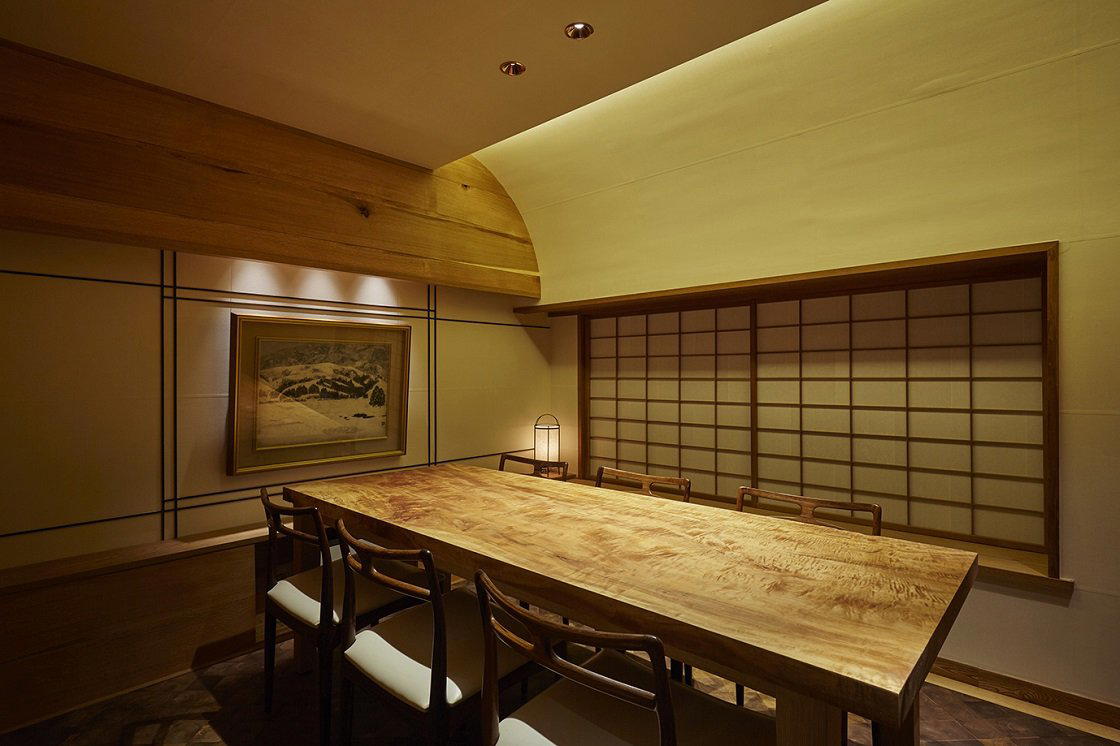
The counter at Mugito Mensuke in Toyosaki, Kita Ward, announces its intentions before the broth arrives. An earthen wall, finished by a traditional plasterer, lines the back of the counter space, and wooden trays of the kind found across old-school Japanese dining rooms sit in front of each diner. The room is not minimalist in the Tokyo sense, nor is it the chaotic, fluorescent-lit ramen shop that defines so much of the format's popular image. It occupies a space between those two poles: considered without being sterile, rooted in craft without being museum-like.
That positioning matters, because Osaka's ramen scene does not enjoy the same curatorial mythology as Tokyo's. Kanto's capital carries the weight of Sapporo miso lineages, Hakata tonkotsu imports, and the dense ecosystem of counter shops that have shaped how ramen is written about globally. Osaka, operating within the Kansai idiom, has historically been more interested in tare restraint, clarity of stock, and a subtlety that lets the base ingredient speak rather than accumulate. Mugito Mensuke's soup, built from free-range chicken and guinea fowl rather than pork bone, reads as a Kansai instinct rendered with unusual specificity. Poultry-based broths are lighter and more aromatic than tonkotsu, and the choice of guinea fowl in particular signals a willingness to reach beyond the conventional supply chain for a flavour profile that no standard recipe produces.
Where the Bowl Sits in the Kansai vs. Kanto Divide
The structural difference between Kansai and Kanto ramen is not simply a matter of taste preference. It reflects different culinary philosophies about what a bowl should prioritise. Kanto ramen, particularly in its shoyu and tsukemen variants, tends toward intensity: deep colour, assertive seasoning, fats that coat the palate. Kansai ramen more often emphasises the quality of a single primary ingredient, using seasoning to support rather than dominate. The chicken-and-guinea-fowl broth at Mugito Mensuke sits squarely in that Kansai logic. The decision to use free-range birds is not incidental; free-range poultry produces a more complex fat profile and a cleaner, less aggressive stock, which allows the noodle and the wonton to register as distinct elements rather than dissolving into a single loud flavour.
The noodles, produced on the premises, are another point worth attention. In-house noodle production in Osaka's mid-range ramen tier is less common than it is in specialist Tokyo shops, where noodle craft has become a competitive differentiator. Here it signals a degree of commitment that goes beyond sourcing: the texture, hydration, and cut of the noodle can be calibrated specifically to the broth's viscosity and the desired eating pace of the bowl. Michelin's Bib Gourmand recognition in both 2024 and 2025 suggests the calibration is working. The Bib Gourmand category, which rewards quality at accessible price points, is a useful indicator for ramen precisely because it filters for consistency and value rather than luxury format. At a ¥ price range, two consecutive awards represent a track record, not a single good year.
For comparison within Osaka's broader dining conversation, the city's highest-profile tables, Hajime, La Cime, Taian, Kashiwaya, operate at ¥¥¥ to ¥¥¥¥ and in entirely different categories. Within that cohort, the poultry-forward broth and the wagyu wonton component mark out a distinct identity. Wagyu stuffing in wontons is an indulgence that belongs more obviously to a kaiseki sensibility than to ramen's street-food heritage, and its inclusion here speaks to an ambition that pushes the bowl format without abandoning it.
The Chef and the Outsider's Angle
Chef Mirko Carturan is an unusual figure in this context. European-named chefs working within Japanese ramen's most traditional formats are rare, and the dynamic matters more for what it implies about craft than for any biographical narrative. The Michelin description emphasises a drive for improvement as the defining characteristic of the kitchen, which is the kind of language the guide uses when it wants to signal process discipline rather than personality. In ramen, that distinction is meaningful: the leading Osaka and Tokyo bowls are built on obsessive procedural consistency, not on individual expression. Carturan's approach to sourcing, with carefully selected free-range birds replacing the commodity poultry that supplies most ramen broths, fits that profile. For readers interested in how non-Japanese chefs engage with Japanese food traditions elsewhere in the country, Gion Sasaki in Kyoto and akordu in Nara offer different versions of that cross-cultural dynamic at the premium end of the market.
Osaka's Ramen in a Wider Japan Context
Ramen in Japan is tracked as seriously as any other dining category, and the regional map continues to shift. Tokyo's Afuri has taken its yuzu-inflected shio ramen from a single Ebisu counter to international outposts including Portland, demonstrating how far a clearly articulated bowl concept can travel. Fukuoka's tonkotsu identity, which you can trace through venues like Goh, remains the Kyushu default even as individual chefs push beyond it. Osaka sits between these poles geographically and conceptually, and the most interesting counters in the city are those that work from Kansai instincts rather than importing Kanto or Kyushu templates. Mugito Mensuke's poultry broth approach is native to that logic.
For a broader picture of what the city's restaurants are doing, our full Osaka restaurants guide maps the range from ramen counters to kaiseki rooms. Visitors planning around dining should also consider our full Osaka hotels guide, bars guide, and experiences guide. Diners travelling across the Kansai region can cross-reference with Harutaka in Tokyo and 1000 in Yokohama for context on how counter dining operates at different price points and formats across Japan.
What to Order
The wagyu wonton is the sharpest editorial answer to this question. It is the element that sits most uncomfortably within ramen convention and therefore reveals the most about what the kitchen is trying to do. A bowl that includes wagyu-stuffed dumplings at a ¥ price point is making a specific argument about ingredient ambition, and ordering it is the clearest way to evaluate whether that argument holds. The house-made noodles are the second signal: texturally, they should behave differently from sourced noodles in a bowl built around a delicate poultry broth, and the eating pace of the bowl depends on how well they hold against the soup's temperature and fat content. See also Kadoya Shokudo for a different approach to accessible Osaka bowl dining if you are building an itinerary across the city's counter scene.
Know Before You Go
- Address: 3 Chome-4-12 Toyosaki, Kita Ward, Osaka, 531-0072, Japan
- Price range: ¥ (accessible)
- Awards: Michelin Bib Gourmand 2024 and 2025
- Seating: Counter only, with earthen wall backdrop
- Hours: Confirm locally before visiting
- Booking: Check current availability directly with the venue
Frequently Asked Questions
at Mugito Mensuke?
Start with the wagyu wonton alongside whichever broth format the kitchen is running. The wontons are the most distinctive element on the menu, using a wagyu filling that sits well above the typical ramen add-on in both ingredient quality and price ambition. They work as a signal of the kitchen's intent: if you want to understand what Mugito Mensuke is arguing for within Osaka's ramen tier, the wonton is where that argument is most clearly stated. The house-made noodles, calibrated specifically to the free-range poultry broth, are the second thing to pay attention to. The bowl earns its consecutive Bib Gourmand awards through consistency across those components rather than through a single showpiece element.
Cuisine and Awards Snapshot
| Venue | Cuisine | Price | Awards | Notes |
|---|---|---|---|---|
| Mugito MensukeThis venue (the venue you are viewing) | Traditional Ramen | $10–20 | Michelin Bib Gourmand · Tabelog 100 #74 | Not listed |
| HAJIME | Avant-Garde Japanese Fine Dining | $300–500 | 3 Michelin Stars · World's 50 Best #83 | French, Innovative |
| La Cime | Modern French with Japanese Ingredients | $150–200 | 2 Michelin Stars · World's 50 Best #13 | French |
| Kashiwaya Osaka Senriyama | Seasonal Kaiseki Omakase | $200–300 | 3 Michelin Stars · La Liste Top Restaurants | Japanese |
| Taian | Traditional Japanese Kaiseki Omakase | $150–200 | 3 Michelin Stars · La Liste Top Restaurants | Kaiseki, Japanese |
| Fujiya 1935 | Modern Japanese with European influences | $100–150 | 2 Michelin Stars · La Liste Top Restaurants | Innovative |
Recognition history
Dated appearances from independent guides and award organizations, with the underlying list record or original source where available.
Michelin Bib Gourmand
Michelin
Tabelog 100 #74 · No. 74
Tabelog · Tabelog 100 - Ramen - OSAKA - 2025
Full recognition history (4 entries)
Michelin Bib Gourmand
Michelin
Michelin Bib Gourmand
Michelin
Continue exploring
More in Osaka
Restaurants in Osaka
All restaurants in Osaka →


Bars in Osaka
All bars in Osaka →



Hotels in Osaka
All hotels in Osaka →




Wineries in Osaka
Browse all →
Details
- Cozy
- Modern
- Casual
- Casual Hangout
- Solo
- Chefs Counter
- Open Kitchen
- Local Sourcing
- Counter Dining
- A La Carte
Current opening hours
- Monday
- 11 AM–3:30 PM
- Tuesday
- Closed
- Wednesday
- 11 AM–3:30 PM
- Thursday
- 11 AM–3:30 PM
- Friday
- 11 AM–3:30 PM
- Saturday
- 11 AM–4 PM
- Sunday
- 11 AM–4 PM
Hours can change for holidays and private events. Hours as of .
Simple yet contemporary interior with counter seating featuring an earthen wall made by a plasterer and wooden trays typical of Japanese restaurants; inviting aroma of simmering broth and freshly made noodles.