Mordi & Vai operates from Box 15 of Rome's Nuovo Mercato di Testaccio, serving the kind of Roman offal sandwiches and braised meat rolls that have sustained the Testaccio neighbourhood for generations. This is a daytime-only counter format, queue-dependent, cash-first, and entirely focused on a handful of dishes done with serious commitment. It belongs to a different Rome than the white-tablecloth dining rooms, and that contrast is precisely the point.
Pearl is the En Primeur Club membership app — saves, bookings, and concierge access live there. Same editors, same standards.
- Address
- Nuovo Mercato Comunale di Testaccio BOX 15, Via Beniamino Franklin, 12/E, 00153 Roma RM, Italy
- Phone
- +39 347 663 2731
- Website
- mordievai.it
- Directions
- Get directions
 Saves & bookings on Pearl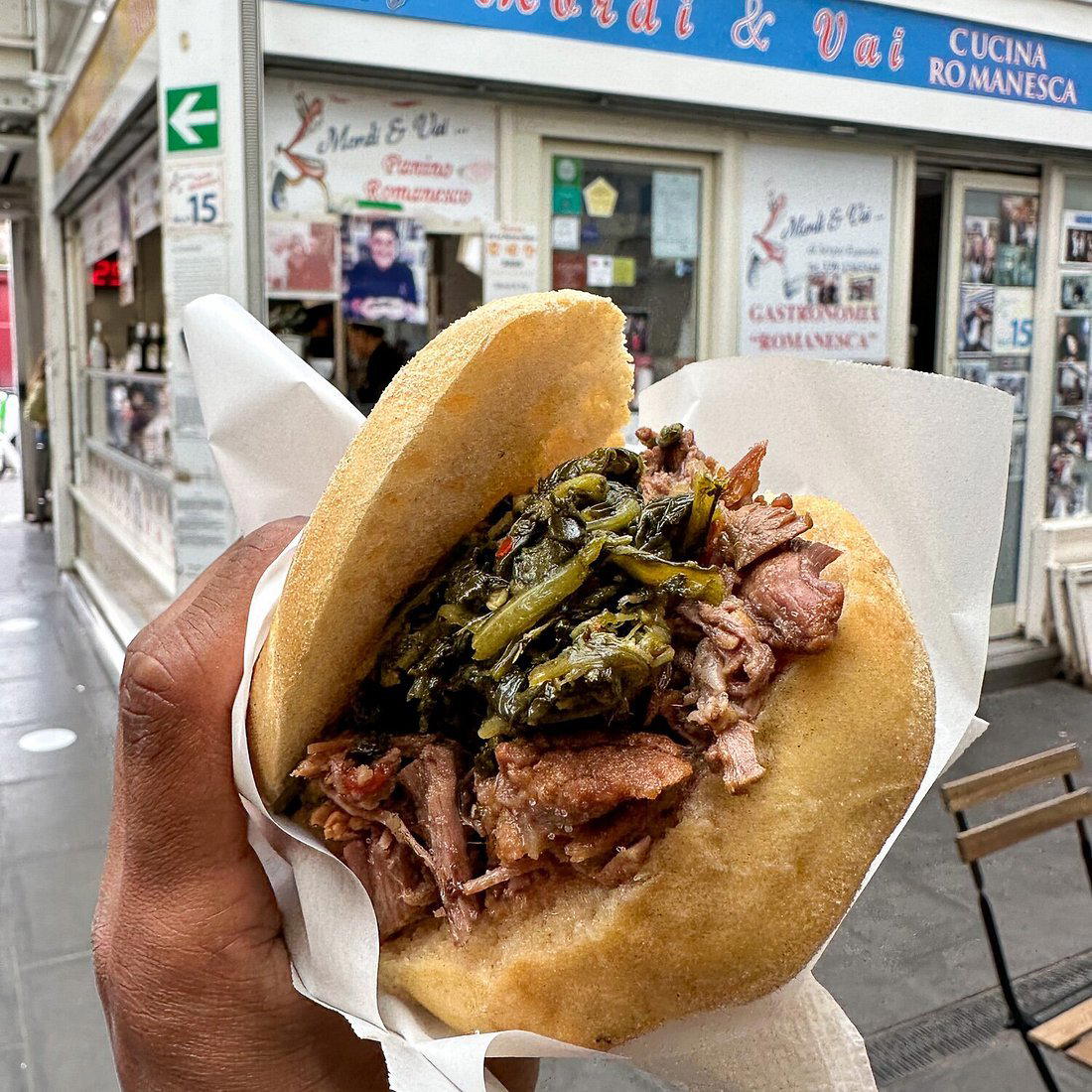
Where the Market Sets the Terms
Testaccio is the neighbourhood that Rome's food writers keep returning to as a reference point for what the city's cooking actually is, stripped of the tourist apparatus. The Nuovo Mercato Comunale di Testaccio, a covered, purpose-built market that replaced the old open-air stalls in 2012, houses produce vendors, cheese sellers, and a cluster of food counters that draw a genuinely mixed crowd: local workers on lunch breaks, residents doing their weekly shop, and food-aware visitors who have done their reading. Mordi & Vai operates from Box 15 inside that market, and its format is shaped almost entirely by the market's rhythms rather than the conventions of restaurant service.
The counter model here belongs to a broader Roman tradition of the gastronomia and rosticceria: places that cook a limited set of dishes to a high standard and sell them quickly, with no particular interest in extending your stay. In a city where evening dining increasingly maps onto a tiered system, from creative tasting menus at places like Il Pagliaccio and Enoteca La Torre to mid-range trattorie with printed wine lists, the market sandwich counter occupies an entirely different register. Understanding that register is the prerequisite for enjoying Mordi & Vai rather than being frustrated by it.
Daytime Only, by Design
The lunch-versus-dinner divide is not incidental at Mordi & Vai, it is the whole structure. The counter operates on market hours, which means mornings through early afternoon and nothing beyond. There is no dinner service to compare it to, no shift in atmosphere as the evening softens the crowd, no candlelight version of the same menu. What you get is the market at its peak: busy, purposeful, and focused on turnover.
This positions Mordi & Vai in a peer group that has almost nothing in common with Rome's formal dining tier. The comparison is not with La Pergola or Acquolina or the creative Italian houses that have built Rome's contemporary fine-dining reputation. It is with the handful of other serious daytime-only formats in the city, the kind of places where the quality ceiling is set by the sourcing and the cooking technique, not by the service choreography or the room design. Across Italy, this category has its own internal hierarchy, separate from the Michelin-tracked world of Osteria Francescana in Modena or Piazza Duomo in Alba.
What the daytime format demands of the kitchen is compression: a focused menu, correct timing, and no opportunity to recover from a mistake across multiple courses. The Roman sandwich tradition, particularly the version built around offal cuts like trippa, coda alla vaccinara, and nervetti, requires that the braises are started early and held correctly through the service window. The logistics of that approach are entirely legible in the Testaccio context, where the neighbourhood's historical identity as the site of Rome's slaughterhouse district makes the cooking a matter of local continuity rather than revival nostalgia.
The Testaccio Frame
Testaccio's food culture is often described in terms of its working-class origins, but what that actually means in practice is a set of techniques and ingredients, quinto quarto, the fifth quarter of the animal, that developed from economic necessity and became a culinary identity over several generations. The covered market is a relatively recent infrastructure, but the tradition it houses is not. Mordi & Vai operates within that continuity in a way that gives the counter its authority: the cooking is not presented as artisanal or revisionist, it is presented as the thing itself.
For visitors arriving from Rome's higher-end dining circuit, having come from Achilli al Parlamento or planning an evening at Il Pagliaccio, Mordi & Vai functions as a recalibration. The gap between a 300-euro tasting menu and a market sandwich is not just financial; it represents two entirely different theories about what dining is for. Both are legitimate within Rome's full range. The city supports Enoteca La Torre's refined ambitions and Mordi & Vai's unadorned efficiency simultaneously, and a serious engagement with Rome's food culture requires spending time at both ends of that spectrum.
Planning the Visit
Mordi & Vai is a walk-in counter with no reservations, which means timing is the primary logistical variable. Arriving at the Nuovo Mercato di Testaccio mid-morning, before the lunch queue builds, is the practical move. The market itself is on Via Beniamino Franklin in Testaccio, and Box 15 is signposted within the market hall. The format is standing or perching rather than seated dining, and the experience is calibrated accordingly: this is a midday stop, not an occasion.
Italian market dining at this level, counter-quality, ingredient-led, time-compressed, has international analogues in the formats celebrated at markets from Barcelona's Boqueria to San Francisco's Ferry Building (home to the kind of counter-led casualness that Lazy Bear in San Francisco explicitly contrasts against). But the Roman version carries a specificity of ingredients and technique that resists generic comparison. The quinto quarto tradition is not portable in the way that, say, pasta technique is. It is anchored to a particular set of sourcing relationships, a particular kitchen lineage, and a particular neighbourhood that has maintained its food identity through significant urban change.
For readers whose Italy itinerary includes the full range of the country's serious cooking, from Dal Pescatore in Runate to Uliassi in Senigallia to Reale in Castel di Sangro, the Testaccio market counter is a different kind of reference point, but not a lesser one. It tests whether you can read quality in a context that strips away the signals, the room, the service, the wine list, that fine dining uses to signal its intentions. At Mordi & Vai, the cooking has to do that work entirely on its own.
Cuisine Lens
Comparable venues nearby, for context on price, style, and recognition.
| Venue | Cuisine | Price | Notes |
|---|---|---|---|
| Mordi & VaiThis venue — the venue you are viewing | Roman Street Food Sandwiches | $ | Not listed |
| Ai Marmi | Roman-Style Pizza | $ | Trastevere |
| Tazza d'Oro | Traditional Italian Espresso & Coffee | $ | Colonna |
| Il Gelato di San Crispino | Artisanal Italian Gelato | $ | Centro |
| Ristorante dai Pupi | Sicilian Seafood | $$ | Campo Marzio |
| La Torricella - Ristorante | Traditional Roman Seafood | $$ | Testaccio |
Continue exploring
More in Rome
Restaurants in Rome
Browse all →
Bars in Rome
Browse all →
Hotels in Rome
Browse all →
Wineries in Rome
Browse all →
At a Glance
- Lively
- Rustic
- Casual Hangout
- Open Kitchen
Current opening hours
- Monday
- 10:15 AM–2:30 PM
- Tuesday
- 10 AM–2:30 PM
- Wednesday
- 10 AM–2:30 PM
- Thursday
- 10 AM–2:30 PM
- Friday
- 10 AM–3 PM
- Saturday
- 10 AM–3 PM
- Sunday
- Closed
Hours can change for holidays and private events. Last verified .