Michelin Bib Gourmand · Tabelog 100 #98
Our verdict
A second-generation Catalonian kitchen in Shibuya's Yoyogi neighbourhood, Los Reyes Magos earned a Michelin Bib Gourmand in 2024 for food that traces a direct line back to Barcelona. Sardine salads, dried cod with parsley sauce, and paella in well-worn pots anchor a menu priced at ¥¥, making it one of the more accessible entry points into serious Spanish cooking in Tokyo.

Pearl is the En Primeur Club membership app, where members save venues, book tables and use the concierge.
Catalonian Cooking in Tokyo: The Long Arc from Barcelona to Yoyogi
Spanish cuisine has found a durable foothold in Tokyo, but the city's Spanish restaurants do not all tell the same story. At the higher end of the spectrum, ENEKO Tokyo and ZURRIOLA operate with the formal ambition of destination dining, drawing on Basque technique and tasting-menu architecture. A tier down, and in some ways more interesting for what it preserves, sits Los Reyes Magos in Yoyogi, Shibuya. The restaurant represents something rarer than technical ambition: a generational transmission of Catalonian home cooking, carried intact from Barcelona to a mid-priced Tokyo dining room and recognised with a Michelin Bib Gourmand in 2024.
The distinction matters. Catalonian cuisine is not the same as generic Spanish cooking. It draws on a maritime tradition of salt-preserved fish, herb-driven sauces, and emulsified preparations that predate the modernist revolution by centuries. Dried cod with parsley sauce, for instance, belongs to the same culinary lineage as the great bacallà dishes of the Costa Daurada. When Los Reyes Magos puts that dish on its menu, it is not invoking a trend; it is maintaining a practice that the first-generation chef brought back from direct experience in Barcelona, and that Chef Valentin now carries forward.
What a Bib Gourmand Signals in This Context
The Michelin Bib Gourmand designation, awarded here in 2024, is worth pausing on. In Tokyo, a city with more Michelin-starred restaurants than any other, the Bib Gourmand category operates as a quality signal of a different kind: it identifies cooking that delivers at a price point the starred category does not require. Los Reyes Magos sits at ¥¥ on the price scale, placing it in a bracket accessible to a far wider audience than the ¥¥¥¥ tier occupied by peers like Harutaka, RyuGin, or L'Effervescence. The award effectively tells you that the cooking quality is not a function of a high budget; it is a function of accumulated craft. That distinction is what makes the Bib Gourmand a more useful signal here than a star would be.
For context on how Spanish cuisine prices across Tokyo, the rice-focused rooms at ARROCERÍA La Panza and Arrocería Sal y Amor occupy a comparable mid-range tier, with the paella as their anchor dish. At Los Reyes Magos, the paella also anchors the menu, but the surrounding dishes push the offer toward something more explicitly Catalonian rather than broadly Iberian.
The Role of Cured and Preserved Traditions in This Kitchen
Spain's charcuterie and preservation traditions form the structural backbone of many of its regional cuisines, and Catalonia is no exception. While the jamón traditions of Extremadura and Andalucía are the most internationally discussed, Catalonian curing culture runs parallel: homemade sausages, salt-preserved fish, and preparations that treat time as an ingredient are all characteristic of the region's food. At Los Reyes Magos, the homemade sausages on the menu reflect this logic directly. They are not an imported flourish; they represent a standard of regional craft that Catalonian cooking has practised for generations.
The dried cod with parsley sauce carries the same weight. Bacallà in Catalan cooking appears in dozens of forms, but the parsley sauce preparation is among the most traditional, requiring little more than quality sourcing, proper rehydration, and a sauce made from what the garden produces. That these dishes appear at a ¥¥ price point in Shibuya speaks to the kitchen's orientation toward craft over spectacle. The sardine salad with egg, described in the Michelin record as a dish that honours the memory of the couple who established the restaurant's culinary lineage, is perhaps the most direct expression of this: a simple preparation that trades on memory and precision rather than costly ingredients.
A Generational Handoff and What It Preserves
The structure of this restaurant is not common in Tokyo's foreign-cuisine dining scene. The founding generation brought Catalonian cooking to Yoyogi after direct experience in Barcelona, and Chef Valentin now carries that knowledge as a second-generation custodian. What makes this transfer legible, rather than merely sentimental, is the discipline of the menu itself. The dishes are not updated for Japanese palates or modernised for the current dining moment; they are maintained as a record of what Catalonian cooking looked like to the people who first brought it here. The well-worn pots mentioned in the Michelin annotation are evidence of this in material form: equipment that has accumulated use, not been replaced for appearance.
This kind of continuity is less common in Tokyo's Spanish dining sector than the city's overall depth of foreign-cuisine restaurants might suggest. The eman model, for instance, operates with a different generational logic. Further afield in Japan, akordu in Nara draws on Basque influence in a fine-dining context that sits at a significant price and format distance from Los Reyes Magos. The comparison clarifies what Los Reyes Magos is doing: it is a neighbourhood restaurant with a specific regional inheritance, not a destination concept.
Yoyogi and the Logic of the Location
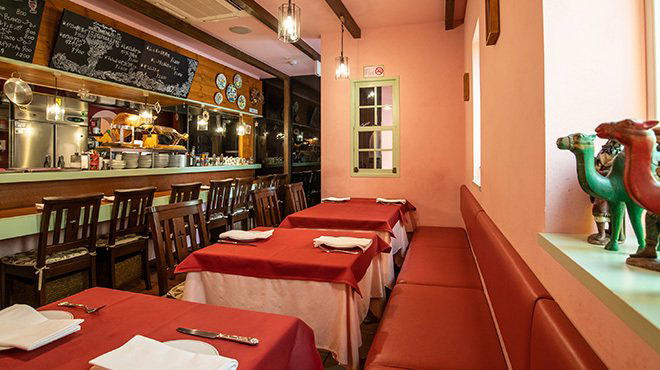
Yoyogi occupies a part of Shibuya that sits between the intensity of the central commercial district and the quieter residential streets to the west. It is not a neighbourhood associated with destination dining in the way that Ginza, Nishiazabu, or Shinjuku's food corridors are. A Spanish neighbourhood restaurant at ¥¥ fits this setting with some coherence.
For those building a wider picture of Tokyo's dining offer, our full Tokyo restaurants guide maps the city by cuisine, neighbourhood, and price tier. Spanish cooking specifically can also be found in adjacent formats through Arrocería Sal y Amor and ARROCERÍA La Panza. If the interest extends to Spanish cooking outside Japan, Arco by Paco Pérez in Gdańsk and BCN Taste & Tradition in Houston represent how Catalonian and Basque traditions travel across different international dining markets.
Planning a Visit
Los Reyes Magos is located at 5 Chome-55-7 Yoyogi, Shibuya, Tokyo 151-0053. At ¥¥ pricing with a Bib Gourmand, demand is real and the room is unlikely to be large; arriving with a reservation, or calling ahead, is advisable rather than optional. For those pairing the visit with a broader Shibuya itinerary, our Tokyo hotels guide, Tokyo bars guide, and Tokyo experiences guide cover the surrounding options in detail.
For comparative reference across Japan's Spanish and European dining spectrum, HAJIME in Osaka, Gion Sasaki in Kyoto, Goh in Fukuoka, 1000 in Yokohama, and 6 in Okinawa represent the range of what serious cooking looks like across the country at various price points and formats. Our Tokyo wineries guide is also available for those interested in the wine dimension of the city's food culture.
at Los Reyes Magos?
The Michelin record identifies three dishes that anchor the kitchen's Catalonian identity: the sardine and egg salad, the dried cod with parsley sauce, and the homemade sausages. Of these, the dried cod preparation is the most direct expression of Catalonian preservation tradition and the dish that most clearly distinguishes this kitchen from broader Spanish cooking in Tokyo. The paella, served in well-worn pots that signal long use, is the other obvious anchor. Given the ¥¥ price point, ordering across several dishes is practical, and the menu rewards that approach more than it does single-dish ordering.
Frequently asked questions
Who is the chef connected to Los Reyes Magos?
The chef associated with Los Reyes Magos is Valentin.
Does Los Reyes Magos have a Michelin star or similar recognition?
Los Reyes Magos has received recognition including: The second-generation chef passes on the Catalonian cuisine that the first-generation chef acquired in Barcelona. Salad of sardines and egg like grandma used to make honours the memory of this couple’s mentors. Dried cod and parsley sauce a….
What's the best thing to order at Los Reyes Magos?
The Michelin record singles out three dishes as anchors of the kitchen's Catalonian identity: the sardine and egg salad, dried cod with parsley sauce, and the paella, whose well-worn pots signal long-term demand. The homemade sausages round out the case for ordering across the charcuterie end of the menu. At ¥¥ pricing, the format rewards ordering several plates rather than anchoring to one.
Is Los Reyes Magos focused on a specific cuisine style?
Is Los Reyes Magos more mid-range or high-end?
Pricing at Los Reyes Magos is listed as ¥¥.
A Pricing-First Comparison
A quick peer check to anchor this venue’s price and recognition.
| Venue | Cuisine | Price | Awards | Notes |
|---|---|---|---|---|
| Los Reyes MagosThis venue (the venue you are viewing) | Authentic Catalan Spanish | $50–100 | Michelin Bib Gourmand · Tabelog 100 #98 | Not listed |
| Harutaka | Edo-Style Omakase Sushi | $200–300 | 3 Michelin Stars · World's 50 Best #76 | Sushi |
| RyuGin | Modern Kaiseki | $500+ | 3 Michelin Stars · World's 50 Best #41 | Kaiseki, Japanese |
| L'Effervescence | Modern French with Japanese Influences | $200–300 | 3 Michelin Stars · World's 50 Best #69 | French |
| HOMMAGE | Modern French with Japanese Influences | $150–200 | 2 Michelin Stars · World's 50 Best #78 | Innovtive French, French |
| MAZ | Innovative Peruvian-Japanese Fusion | $150–200 | 2 Michelin Stars · World's 50 Best #28 | Innovative |
Recognition history
Dated appearances from independent guides and award organizations, with the underlying list record or original source where available.
Michelin Bib Gourmand
Michelin
Tabelog 100 #98 · No. 98
Tabelog · Tabelog 100 - Spanish cuisine - 2026
Full recognition history (3 entries)
Michelin Bib Gourmand
Michelin