Our verdict
Located on Alameda Princesa Izabel in Curitiba's Mercês neighbourhood, Lisboa Gastronomia brings a Portuguese culinary sensibility to southern Brazil's most ingredient-conscious dining city. The address places it within reach of Curitiba's broader restaurant corridor, where European technique and locally sourced produce define the upper tier of the market.

Pearl is the En Primeur Club membership app, where members save venues, book tables and use the concierge.
The menu
What to order
- Bacalhau à Nata
- Bolinhos de Bacalhau
- Seafood Risotto
Portuguese Cooking in the South of Brazil
Curitiba's dining scene has spent the better part of two decades resolving a productive tension: how to honour the city's deep European immigrant heritage, German, Italian, Ukrainian, Polish, Portuguese, without letting that heritage calcify into nostalgia. The restaurants that have done this most convincingly are those that take Old World culinary frameworks seriously while insisting on Paraná-sourced materials. Lisboa Gastronomia, on Alameda Princesa Izabel in the Mercês district, occupies that intersection. The name signals the orientation plainly: Lisbon as reference point, Brazil as stage.
That dynamic is not unusual in Curitiba. What makes the city an interesting case study for the broader Brazil restaurant story is how its kitchens differ from the São Paulo model. Where D.O.M. in São Paulo built its reputation on Amazonian ingredients passed through French technique, and where Lasai in Rio de Janeiro leans into hyper-local sourcing as a near-ideological stance, Curitiba's better kitchens tend to operate with a quieter confidence, European forms, regional produce, less theatre. Lisboa Gastronomia fits that register.
The Mercês Address and What It Implies
Alameda Princesa Izabel is one of those Curitiba streets that rewards walking. The Mercês neighbourhood sits at a remove from the more heavily trafficked Batel and Bigorrilho restaurant corridors, which means the clientele at addresses here tends to be locally rooted rather than tourist-facing. For a restaurant with a Portuguese name and a neighbourhood-scale footprint, that is the right demographic. Portuguese cuisine in Brazil has always operated somewhere between the familiar and the foreign, common enough in cultural memory, distinct enough to feel considered on a menu.
The physical address, Alameda Princesa Izabel, 420, places Lisboa Gastronomia within easy reach of Curitiba's central axis, accessible by car and by the city's well-structured public transport network. Visitors staying in Batel or Centro can expect a short transfer. Curitiba is a city that rewards surface navigation; the urban planning is legible in a way that most Brazilian cities are not, and Mercês benefits from that logic.
Local Ingredients, European Framework
The editorial argument for restaurants like Lisboa Gastronomia is not sentimental. Portuguese cooking, built around bacalhau, slow braises, bread-thickened stews, and a structural reliance on olive oil, translates more naturally to southern Brazil than it might seem. Paraná produces some of Brazil's better cold-climate vegetables, and its meat supply is serious. The pinhão, the seed of the Araucária pine and one of the most distinctly southern Brazilian ingredients in existence, appears in kitchens across Curitiba during the cooler months, typically May through August, and speaks to a larder that has no equivalent elsewhere in the country.
That seasonal reality matters for how to approach Lisboa Gastronomia's offer. The intersection of Iberian technique, the patience of confits, the depth of salt-cured proteins, the acid work of good wine reductions, with Paraná's cool-climate produce creates a category of cooking that has its own internal logic. It is not fusion in the lazy sense. It is more like a culinary argument made through sourcing: that these methods and these ingredients belong together.
The broader Curitiba scene provides useful comparison points. Aizu demonstrates how Japanese-Brazilian synthesis can achieve precision at the higher end of the market. Barolo Curitiba holds the Italian-influenced wine-and-food position. Batel Grill and Calabouço Restaurante e Pizzaria anchor the more casual, high-volume tier. Badida Sete operates in a different register again. Lisboa Gastronomia's Portuguese focus gives it a distinct niche within a city that has space for that kind of specialisation, Curitiba's dining market is large enough to support depth across multiple European culinary traditions simultaneously.
For context on how other Brazilian cities handle the imported-method, local-ingredient question, Bistro Fitz Carraldo in Manaus and Cantina Pozzobon in Santa Maria represent similar attempts to reconcile European culinary inheritance with Brazilian geography. The results vary by region, but the ambition is consistent: technique as a tool, not a statement of identity.
Curitiba's Broader Dining Context
Southern Brazil's restaurant scene rarely receives the international attention it deserves, partly because São Paulo absorbs so much of the critical oxygen, and partly because Curitiba's restaurants have historically directed themselves at the local market rather than building media profiles. That insularity has a quality advantage: kitchens here tend to cook for return customers rather than first-time visitors, which places a premium on consistency and ingredient honesty over novelty. The comparison with Le Bernardin in New York City or Atomix in New York City is instructive not in terms of scale or ambition, but in terms of what a committed culinary framework looks like when a kitchen applies it with discipline over time.
Elsewhere in Brazil, the local-ingredients-through-imported-technique conversation produces some of the country's most interesting cooking. Casa da Flor Restaurante in Dourados, Aero Burguer e Grill in Santa Cruz Do Sul, and Arte e Café Imperial in Angra Dos Reis each move through the same tension from different regional starting points. The geography shapes the answer every time. In Curitiba's case, the cool climate, European settler history, and serious agricultural base make the Iberian culinary framework particularly coherent.
Planning Your Visit
Lisboa Gastronomia sits at Alameda Princesa Izabel, 420, in the Mercês neighbourhood of Curitiba. Price range, seating capacity, and dress code are similarly unconfirmed, though the Mercês address and Portuguese culinary framing suggest a mid-market to upper-mid positioning typical of the neighbourhood's restaurant tier. Visitors planning around Curitiba's cooler months, particularly June and July, when pinhão season peaks, will find the city's European-influenced kitchens at their most seasonally coherent. For a fuller picture of what Curitiba's restaurant scene offers across price points and styles, the EP Club Curitiba restaurants guide provides broader orientation. Additional reference points for Brazilian dining outside the city include Casa da Dika in Bragança, Casa da Picanha Penedo in Itatiaia, and Famosa Pizza in Ribeirão Preto.
Frequently asked questions
Where exactly is Lisboa Gastronomia?
Lisboa Gastronomia is located at Alameda Princesa Izabel, 420 - Mercês, Curitiba - PR, 80410-110, Brazil, Curitiba.
Is Lisboa Gastronomia a good option for exploring Portuguese cuisine in southern Brazil?
Curitiba sits within a broader southern Brazilian dining scene shaped by generations of European immigration, making it one of the more credible cities in the country for Iberian-rooted cooking. Lisboa Gastronomia occupies a specific address in Mercês, a Curitiba neighbourhood with residential character and a reputation for established, neighbourhood-anchored restaurants. For travellers whose itinerary skips São Paulo in favour of the south, the restaurant represents a considered stop within that regional context.
What dish is Lisboa Gastronomia famous for?
The restaurant's editorial identity centres on Portuguese cooking traditions, with bacalhau and slow-braised preparations forming the backbone of that tradition across Portugal and its diaspora restaurants. For the current menu, contacting the restaurant directly at Alameda Princesa Izabel, 420, Mercês, Curitiba, is the most reliable route.
Can I walk in to Lisboa Gastronomia?
Walk-in availability is not confirmed, as booking policies for Lisboa Gastronomia have not been publicly documented. Restaurants in Curitiba's Mercês neighbourhood that draw on a loyal local following tend to fill tables on weekends without much notice, so arriving without a reservation carries risk. The address is Alameda Princesa Izabel, 420, and reaching out directly before visiting is advisable.
Nearby-ish Comparables
Comparable venues nearby, for context on price, style, and recognition.
| Venue | Cuisine | Price | Notes |
|---|---|---|---|
| Lisboa GastronomiaThis venue (the venue you are viewing) | Traditional Portuguese | $50–100 | Not listed |
| Doppo Cucina | Authentic Italian Trattoria | $20–30 | Batel |
| Batel Grill | Brazilian Churrascaria with Japanese Buffet | $20–30 | Batel |
| Churrascaria Jardins Grill | Brazilian Churrascaria Rodízio with Japanese Influences | $30–50 | Rebouças |
| Poco Tapas | Molecular Spanish Tapas | $30–50 | Batel |
| Swadisht Traditional Indian Cuisine | Traditional Indian Cuisine | $30–50 | Batel |
Continue exploring
More in Curitiba

Details
- Romantic
- Cozy
- Elegant
- Intimate
- Quiet
- Date Night
- Special Occasion
- Standalone
- Corkage Allowed
- Byob
- A La Carte
- Wine
- Cachaça
- Pescatarian Friendly
Current opening hours
- Monday
- Closed
- Tuesday
- 7–11 PM
- Wednesday
- 7–11 PM
- Thursday
- 7–11 PM
- Friday
- 7–11 PM
- Saturday
- 7–11 PM
- Sunday
- 12–3 PM
Hours can change for holidays and private events. Hours as of .
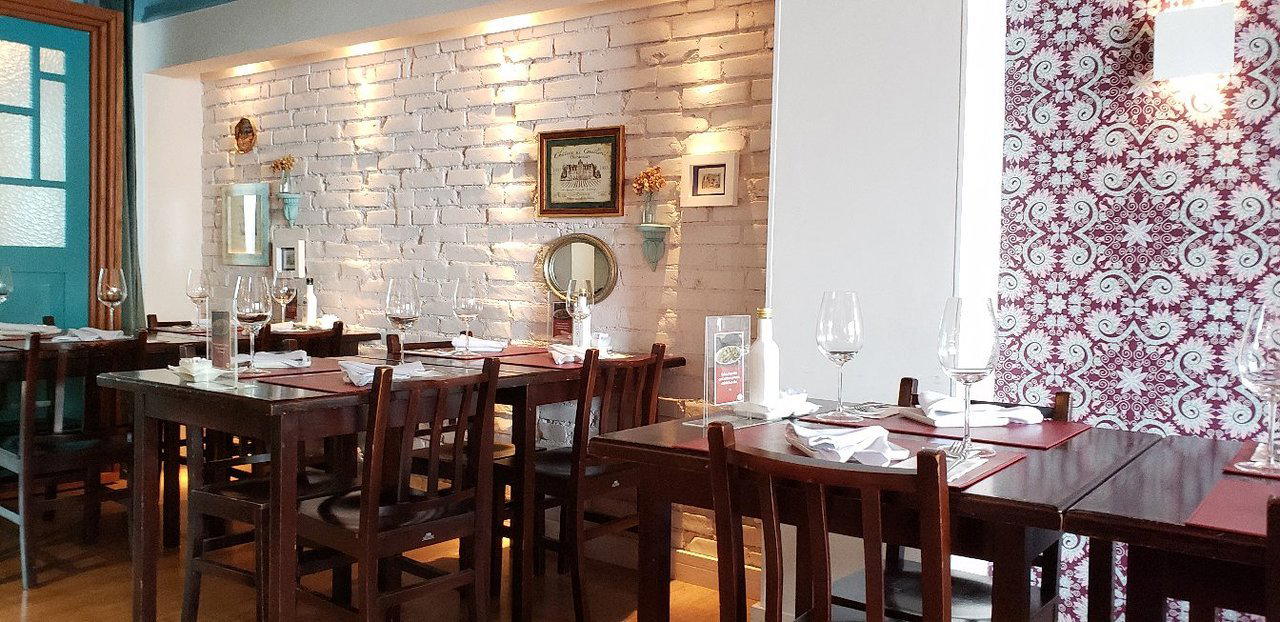
Beautifully decorated intimate space with discrete, cozy atmosphere and soft lighting that creates a refined yet comfortable dining environment.