
Kyu Yamu Tei Shimokita sou belongs to Tokyo’s serious curry conversation rather than the casual café circuit. The appeal is its compact Shimokitazawa format, curry and Indian-curry focus, 12-seat scale, and repeated Tabelog Curry 100 selections from 2018 through 2024, which place it among the city’s closely watched specialist rooms.
Pearl is the En Primeur Club membership app — saves, bookings, and concierge access live there. Same editors, same standards.
- Address
- Japan, 〒155-0032 Tokyo, Setagaya City, Daizawa, 5 Chome−29−9 ナイスビル 1階
- Phone
- +81 3-6450-8986
- Website
- twitter.com
 Saves & bookings on Pearl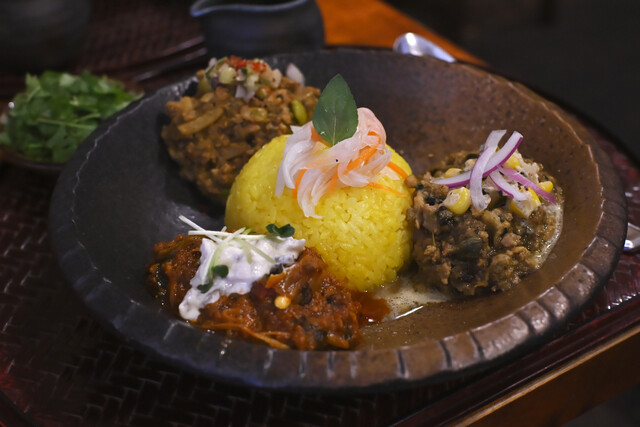
Shimokitazawa rewards small rooms that know exactly what they are. On its side streets, curry is less a convenience meal than a specialist format: compact counters, short menus, spice-led cooking, and regulars who treat lunch with the seriousness other cities reserve for tasting menus. Kyu Yamu Tei Shimokita sou fits that grammar. The room is small enough to change the pace before the first plate lands, with counter seating and two-seat tables giving curry the intimacy usually associated with ramen shops or wine bars.
Tokyo’s curry culture has several lanes: old-school yoshoku, South Asian restaurants, soup curry, and the newer spice-curry movement, where layering, texture, and aroma are the point rather than a side effect. This address sits in the curry and Indian-curry category, but its relevance comes from menu architecture as much as genre. In a city where curry can be an inexpensive office lunch or an obsessive destination, serious rooms distinguish themselves by narrowing choice. A concise format makes the kitchen argue through structure: rice, sauce, spice balance, garnish, and pacing must carry the meal without a long à la carte list.
Shimokitazawa curry, built for a short menu and a small room
The local context matters. Shimokitazawa has long favored independent dining rooms over grand theatre, and curry suits that scale. A 12-seat curry restaurant can work like a counter specialist: fast enough for a weekday meal, precise enough to justify crossing town, informal without feeling casual in ambition. That tension defines this part of Tokyo’s curry scene. The category is accessible on price, but better addresses are judged by repeatability and detail, not luxury cues.
Kyu Yamu Tei Shimokita sou has been selected for Tabelog Curry 100 across multiple years, including 2018, 2019, 2020, 2022, 2023, and the Tokyo Curry 100 list in 2024. That sequence is more useful than a single badge because curry in Tokyo is crowded and turnover constant. Repeated selection signals durable relevance in a category where diners can compare dozens of specialist shops across train lines. The Tabelog score of 3.80 adds another public indicator, but the stronger editorial signal is consistency across lists and years.
Within the comparison set, the pricing bracket aligns with Curry Spice Gelateria KALPASI rather than higher dinner-leaning neighborhood options such as spice kitchen moona or Nanban Tei Shimokitazawa ten. That clarifies the editorial decision: this is not for ceremony, private rooms, or a drawn-out evening. It is for diners who read curry as a technical format and want a compact expression of the genre in a neighborhood that suits it.
What the menu structure says about Tokyo's spice-curry turn
The menu’s significance is how it joins Tokyo’s broader shift from curry as comfort plate to curry as authored composition. Specialist curry rooms often avoid the sprawling menus of generalist restaurants and tighten the variables instead. The diner is meant to notice plate arrangement, how the curry style relates to Indian influence, and how much complexity can sit inside a relatively inexpensive meal. That is why curry in Tokyo now belongs in serious dining itineraries alongside sushi counters, yakitori rooms, and tonkatsu specialists, even when spend is radically different.
For readers mapping a Tokyo food day, the useful comparison is not fine dining. It is other narrow-format rooms where the category provides discipline. A yakitori counter such as 124. KAGURAZAKA (Yakitori) asks diners to read sequence and cut; a curry specialist asks them to read spice, rice, and structure. Tonkatsu at Katsuyoshi follows the same Tokyo logic: one genre, deep repetition, small differences that matter. The city’s serious eating culture often hides in these specialist lanes, and curry is one of the clearest ways to see it without a long reservation arc.
The absence of private rooms and private-use format also defines the experience. This is public, compact, and efficient by design. The kitchen is not mimicking a restaurant with broader hospitality infrastructure; it belongs to Tokyo dining where the room’s limits sharpen the meal. Non-smoking status and cashless payment acceptance widen practical access, but the identity remains specialist rather than general-purpose.
How to place it in a Tokyo itinerary
The strongest use case is a focused Shimokitazawa meal, not a long destination dinner. The neighborhood’s appeal is walking, browsing, and informal independent venues, so curry works naturally as the anchor rather than the whole plan. For a broader city map, Our full Tokyo restaurants guide gives the wider restaurant frame, while Our full Tokyo bars guide, Our full Tokyo hotels guide, Our full Tokyo wineries guide, and Our full Tokyo experiences guide help separate a curry-led afternoon from a full evening plan.
Readers comparing low-ceremony Tokyo meals might also look at 3 Chome no Curry Ya San, 12/10 Shinjuku ten, 2D Cafe, and. 鮪と炭火焼き うお炭 秋葉原店 for different expressions of the city’s casual dining range. Beyond Tokyo, the same specialist logic appears in scattered forms: [Curry Senmon Ten] Maruyama Kyoju. in Sapporo for curry focus, [ki:] in Kyoto for a narrower Kyoto lens, (Shoku) Vietnam in Kawasaki for regional Asian cooking, -Grilled beef Sukiyaki- KAMAKURA TANUKIAN 鎌倉 たぬき庵 in Kamakura for a different Japanese comfort register.cafe in Osaka, and.know in Kumamoto. For overseas Japanese-adjacent formats, Jōdo Saké Bar in Los Angeles and Onigiri Time in Pasadena show how tightly defined categories travel when the format is clear.
The editorial case for Kyu Yamu Tei Shimokita sou is simple: Tokyo curry is now deep enough to reward specialists, and this room has the recognition, scale, and category discipline to explain why. It is not a luxury signal. It is a precision signal, and in Tokyo that distinction matters.
A Quick Peer Check
Comparable venues for context, by category and price tier.
| Venue | Cuisine | Price | Notes |
|---|---|---|---|
| Kyu Yamu Tei Shimokita souThis venue — the venue you are viewing | Japanese Curry | $$ | Not listed |
| HIKINIKU TO COME (挽肉と米) | Japanese Hamburger Steak with Rice | $$ | Shibuya |
| 餃子歩兵 | Kyoto-style Gyoza | $$ | Ginza |
| Kajitsuen Riberu | Fruit Parlor | $$ | Meguro |
| En Dashi Ochazuke Lumine Shinjuku | Dashi Ochazuke | $$ | Shinjuku |
| Handmade buckwheat Matsunaga | Handmade Soba & Japanese Sake | $$ | Shibuya |
Recognition history
Dated appearances from independent guides and award organizations, with the underlying list record or original source where available.
Tabelog 100 #6 · No. 6
Tabelog · Tabelog 100 - Curry - TOKYO - 2024














At a Glance
- Cozy
- Trendy
- Intimate
- Solo
- Casual Hangout
- Standalone
- Street Scene
Current opening hours
- Monday
- 11 AM–3 PM, 6–9 PM
- Tuesday
- 11 AM–3 PM
- Wednesday
- 11 AM–3 PM, 6–9 PM
- Thursday
- 11 AM–3 PM, 6–9 PM
- Friday
- 11 AM–3 PM, 6–9 PM
- Saturday
- 11 AM–3:30 PM, 5:30–9 PM
- Sunday
- 11 AM–3:30 PM, 5:30–9 PM
Hours can change for holidays and private events. Last verified .
A cozy, hideout-like curry house in a renovated traditional home atmosphere with an intimate, sensory, spice-forward feel.