Our verdict
A yakiniku specialist in Hakone's Yumoto district devoted to Kobe beef, one of Japan's most tightly regulated premium proteins. The grilling format places the guest in direct contact with the ingredient, with minimal mediation between the cattle's provenance and the table. For visitors exploring the Hakone dining scene, it occupies a distinct position in the area's restaurant range.

Pearl is the En Primeur Club membership app, where members save venues, book tables and use the concierge.
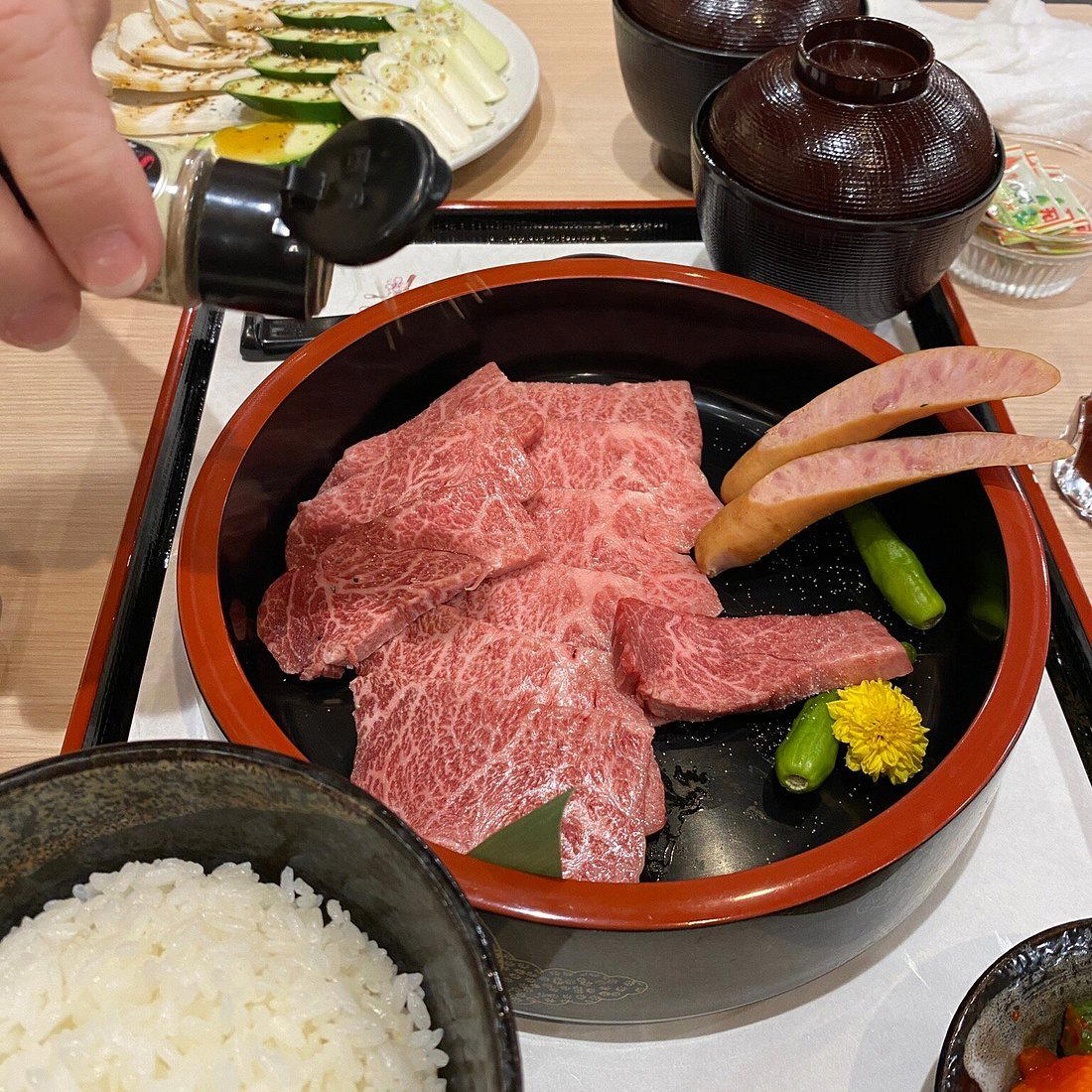
The menu
What to order
- Kobe Beef SPECIAL SET
- Japanese beef set meal
The Weight of the Grill: Kobe Beef Yakiniku in a Ryokan Town
Hakone Machi is not typically read as a destination for serious meat dining. The town's reputation runs toward kaiseki formality, mineral-rich onsen, and the kind of restorative quiet that draws visitors from Tokyo for the weekend. The ryokan corridor around Yumoto has, for generations, shaped a dining culture oriented toward dashi, tofu, and seasonal mountain vegetables. That makes the presence of a dedicated Kobe beef yakiniku restaurant in this neighbourhood worth pausing on. It speaks to a broader shift in how premium protein dining has spread beyond its traditional strongholds in Kobe, Osaka, and Tokyo's Nishi-Azabu.
KOBE BEEF YAKINIKU RESTAURANT-BAKATARE sits at 706 Yumoto, in the Ashigarashimo District, at the gateway end of Hakone where day-trippers and longer-stay guests converge before dispersing into the valley. The address places it within reach of visitors arriving by Romancecar from Shinjuku, a journey of roughly 85 minutes that positions Hakone firmly in the extended urban orbit of Tokyo. For that audience, the expectation of high-specification beef dining has become a baseline, not a novelty.
What Kobe Beef Actually Means at the Table
Kobe beef is one of the most specifically regulated premium proteins in Japan. The designation is not a loose geographic label but a set of interlocking requirements: the cattle must be Tajima-strain Japanese Black, born and raised in Hyogo Prefecture, slaughtered at designated processing facilities, and graded at a marbling score of BMS 6 or higher on the Japanese Beef Marbling Standard, with overall yield and quality grades meeting A4 or A5 thresholds. The certification process is administered by the Kobe Beef Marketing and Distribution Promotion Association, and the number of certified animals produced each year remains tightly capped relative to the volume of beef sold internationally under the Kobe name.
This distinction matters because the yakiniku format, where diners grill their own portions over a tabletop flame or charcoal source, is particularly transparent about what the ingredient actually is. Unlike a composed kaiseki course or a sauce-anchored Western preparation, yakiniku removes most of the intermediary technique. The fat content, the texture under heat, and the rate at which marbling renders are all visible in real time. At that level of ingredient scrutiny, the difference between genuine certified Kobe beef and lesser wagyu cuts becomes legible to any attentive diner, not just to specialists.
The yakiniku tradition itself traces back to the post-war period, when Korean-influenced tabletop grilling became embedded in Japanese food culture, particularly in the Kansai region. Over decades it evolved from informal neighbourhood grilling houses to a format now represented across multiple price tiers, from standing-room lunch counters to reservation-only private rooms serving A5 cuts in small, jeweller-precise portions. Hakone's version of that spectrum is naturally narrower than what you would find in Osaka or Tokyo, which makes a Kobe-designated specialist like Bakatare more differentiated within the local context.
Reading the Hakone Dining Environment
Hakone's restaurant range is shaped by its dual identity as a day-trip destination and a multi-night ryokan retreat. The latter category supports the most elaborately structured dining: kaiseki meals at properties like Gōra Kadan represent the formal end of the spectrum, where seasonal ingredients are presented through a succession of small courses in a format that can run two to three hours. At the opposite end of the register, Saien - Breakfast by Buddhist Monks offers a shojin ryori experience grounded in vegetable-forward temple cooking. The Fujiya, one of the region's oldest Western-style hotels, adds a historic dimension to the dining range. A dedicated Kobe beef yakiniku restaurant occupies a different register from all three: interactive rather than ceremonial, protein-centric rather than dashi-led, and built around a specific premium ingredient rather than a seasonal philosophy.
The comparison extends beyond Hakone. Across Japan, the question of how leading to present premier wagyu and Kobe-designated beef has generated distinct school of thought. At one end, high-end teppanyaki and kaiseki-adjacent preparations fold the ingredient into a broader compositional framework. At the other, yakiniku specialists argue that the grilling format is the most honest delivery mechanism, placing the quality of the beef front and centre without elaboration. You find that argument running through some of Japan's most referenced dining addresses, from HAJIME in Osaka to various beef-specialist counters that have appeared in the same cities as celebrated omakase rooms like Harutaka in Tokyo and Gion Sasaki in Kyoto.
Hakone's broader dining ecosystem includes other specialists worth considering alongside Bakatare. 強羅 鮨 represents the sushi end of the local premium dining range, and a fuller picture of what the area offers across categories is available in our full Hakone Machi restaurants guide. For travellers building a longer Japan itinerary around quality ingredients and regional specificity, the country's dining range at the precision end includes addresses like akordu in Nara, Goh in Fukuoka, and further afield, 一本杉川島製 in Nanao and 夕仙山乃 in Sapporo.
Planning Your Visit
Bakatare is located in Yumoto at the base of the Hakone valley, accessible directly from Hakone-Yumoto Station. The station itself sits at the end of the Odakyu line from Shinjuku and serves as the interchange point for the Hakone Tozan Railway that climbs into the mountains. For visitors staying further up the valley in Gōra or Miyagino, Yumoto is a logical stopping point on arrival or departure rather than a destination requiring a dedicated return trip. Given the limited venue-specific data available regarding hours, booking requirements, and current pricing, confirming details directly with the restaurant before visiting is advisable. The Yumoto area is most accessible in daylight hours when the full transport network is running, and weekend evenings in peak season, particularly during autumn foliage and cherry blossom periods, bring significantly heavier visitor volumes across the entire Hakone district. Those planning to combine a Kobe beef dinner with a broader Japan itinerary may also find relevant reference points in the international dining range: the rigour applied to premium ingredient sourcing at places like Le Bernardin in New York City or the ingredient transparency that defines Korean-rooted fine dining at Atomix in New York City offer a useful frame for thinking about how premium proteins perform when the format strips away most of the culinary elaboration.
Frequently asked questions
What's the address for KOBE BEEF YAKINIKU RESTAURANT-BAKATARE?
KOBE BEEF YAKINIKU RESTAURANT-BAKATARE is located at Japan, ã250-0311 Kanagawa, Ashigarashimo District, Hakone, Yumoto, 706 丸å¶ãã« 4é, Hakone Machi.
Is Bakatare in Hakone Yumoto worth visiting as a standalone dinner rather than eating at a ryokan?
Yumoto sits at the accessible base of the Hakone valley, directly off Hakone-Yumoto Station, meaning it is reachable without navigating the mountain transport network. For visitors staying at a ryokan that includes kaiseki dinner, Bakatare offers a contrasting option on a separate evening with a format centred on Kobe beef, one of Japan's most specifically credentialed proteins. It fills a gap in Hakone Machi's dining range, where serious meat-focused restaurants are not the norm.
What should I order at KOBE BEEF YAKINIKU RESTAURANT-BAKATARE?
The menu centres on Kobe beef, one of Japan's most tightly regulated premium proteins, distinguished by strict breed, feed, and marbling criteria. At a yakiniku format, the logical focus is the core cuts grilled tableside rather than supplementary dishes. Ordering around the beef itself rather than filling up on sides is the standard approach at this level of yakiniku in Japan.
Do they take walk-ins at KOBE BEEF YAKINIKU RESTAURANT-BAKATARE?
Bakatare is located in Yumoto at the base of the Hakone valley, a district that draws both day-trippers from Hakone-Yumoto Station and multi-night ryokan guests. Walk-in availability tends to be tighter during peak onsen travel periods. Contacting the venue directly before arrival is the practical step given Hakone's seasonal demand patterns.
What's the signature at KOBE BEEF YAKINIKU RESTAURANT-BAKATARE?
The defining proposition is Kobe beef served in a yakiniku format, which is a relatively rare combination given that Kobe beef more commonly appears in teppanyaki or kaiseki contexts across Japan. The yakiniku approach places the cooking directly in the diner's hands at the table grill, making the quality of the beef itself the central variable. In a town where kaiseki formality sets the default register for premium dining, this is a deliberately different format.
Cost and Credentials
Comparable venues nearby, for context on price, style, and recognition.
| Venue | Cuisine | Price | Awards | Notes |
|---|---|---|---|---|
| KOBE BEEF YAKINIKU RESTAURANT-BAKATAREThis venue (the venue you are viewing) | Kobe Beef Yakiniku | Not listed | Not listed | Not listed |
| Gōra Kadan | Kaiseki Japanese Cuisine | $500+ | Relais Chateaux Award | Gora, Traditional Kaiseki |
| å¼·ç¾ é®¨ | Seasonal Japanese Sushi | $100–150 | Not listed | Hakone Machi, Traditional Japanese Kaiseki |
| The Fujiya | Classical French | $100–150 | Tabelog 100 #11 | Hakone-machi, Classical French |
| Saien - Breakfast by Buddhist Monks | Shojin Ryori (Buddhist Vegetarian) | Not listed | Not listed | Miyanoshita, Shojin Ryori (Buddhist Vegetarian) |
| 久丹 | Modern kaiseki "Tokyo washoku" tasting menu | $300–500 | Black Pearl 1 Diamond | Shintomicho, Chuo, Modern kaiseki "Tokyo washoku" tasting menu |
Continue exploring
More in Hakone
Restaurants in Hakone
All restaurants in Hakone →
Bars in Hakone
Browse all →
Hotels in Hakone
All hotels in Hakone →
Wineries in Hakone
Browse all →
Details
- Elegant
- Intimate
- Date Night
- Special Occasion
- Sake Program
- A La Carte
- Beer Program
Current opening hours
- Monday
- 12–10 PM
- Tuesday
- 12–10 PM
- Wednesday
- 12–10 PM
- Thursday
- 12–10 PM
- Friday
- 12–10 PM
- Saturday
- 12–10 PM
- Sunday
- 12–10 PM
Hours can change for holidays and private events. Hours as of .
Attentive and friendly service in a welcoming atmosphere focused on premium grilling experience.