
A Michelin-starred kaiseki restaurant in Osaka's Nishi Ward, Ichiju Nisai Ueno Minoten draws its identity from the Minoh mountains rather than the city grid. The head chef structures his menu around seasonal cycles, with hassun platters garnished using leaves gathered from the mountainside and tempura fried to order in rice oil at a ground-floor counter.
Pearl is the En Primeur Club membership app — saves, bookings, and concierge access live there. Same editors, same standards.
- Address
- 1 Chome-13-3 Shinmachi, Nishi Ward, Osaka, 550-0013, Japan
- Phone
- +81 6-6543-6699
- Website
- shinmachiueno.jp
- Directions
- Get directions
 Saves & bookings on Pearl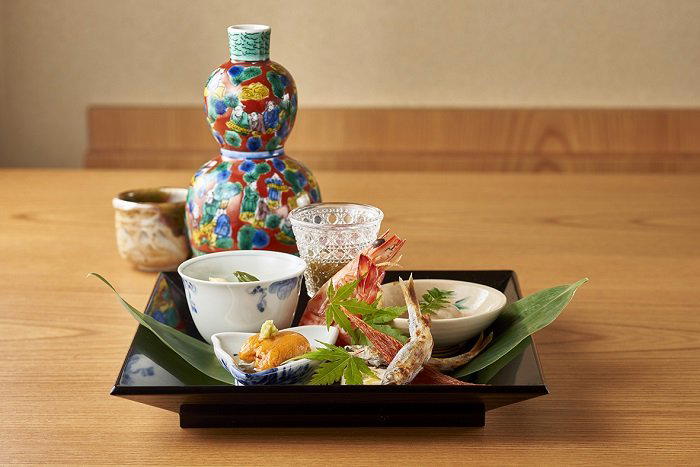
Where the Mountains Set the Menu
Osaka's dining identity has long been framed around abundance: Dotonbori excess, the teeming izakaya alleys of Shinsaibashi, the wholesale market energy of Kuromon. But a quieter current runs through the city's kaiseki rooms, one that draws its logic not from the street but from the watershed. At Ichiju Nisai Ueno Minoten, the Minoh mountains function less as backdrop than as supplier. Michelin's one-star recognition in 2024 marks the restaurant as a serious Osaka address for seasonal Japanese kaiseki. The restaurant sits at their foot, and the kitchen responds to them directly, with hassun platters garnished using leaves gathered from the mountainside and a menu that turns with the seasons at a pace the mountain determines.
That orientation places this restaurant inside a tradition that is easier to trace in Kyoto than in Osaka. Kyoto kaiseki has long insisted on its relationship to landscape, codifying seasonal transition through specific ingredients and presentation rituals. Osaka's kaiseki rooms have historically operated on slightly different terms, more pragmatic, more city-facing, closer to the merchant-class sensibility that shaped kuidaore culture. A restaurant in Nishi Ward that faces the hills and structures its menu around foraging is, in that context, a quiet argument about what Osaka fine dining can look like when it steps back from its own commercial appetite.
Osaka Between Two Poles
The Tokyo versus Kyoto framing gets most of the critical attention when Japan's high-end dining spectrum is discussed, but Osaka occupies a genuinely distinct position between them. Tokyo kaiseki at the summit tier, represented by counters like Myojaku and Azabu Kadowaki, tends toward precision and restraint shaped by metropolitan scale: the omakase as a tightly controlled performance, every variable managed. Kyoto, at places like Gion Sasaki, prioritises a different form of refinement, one rooted in ceremonial deference to ingredient and season, where the chef's role is often framed as custodian rather than creator.
Osaka's better kaiseki rooms borrow from both but answer to neither. The three-star benchmark here, Kashiwaya Osaka Senriyama, has built its reputation on a version of kaiseki that retains Osaka's directness while meeting Kyoto's seasonal seriousness. Taian, also three-starred, holds a similar position. Ichiju Nisai Ueno Minoten at one star and the same ¥¥¥ price point sits below that stratosphere but shares the same basic orientation: nature-forward, seasonally driven, resistant to the innovation-for-its-own-sake impulse that animates Osaka's French-influenced rooms. Hajime at ¥¥¥¥ and three stars, or La Cime at two stars, represent the city's appetite for technique and transformation. This restaurant is not in that conversation. It is, deliberately, elsewhere.
The Counter, the Oil, and the River
What distinguishes the experience at Ichiju Nisai Ueno Minoten from Osaka's more urban kaiseki rooms is partly structural. The restaurant offers a ground-floor counter specifically for tempura service, where a dedicated tempura master fries each piece individually to order. The oil used is rice oil, which produces a lighter, less fatty result than sesame or blended oils common elsewhere in the tradition. This is not a minor detail: tempura texture is almost entirely a function of batter thickness, temperature control, and oil composition. Rice oil's high smoke point and neutral profile allow the ingredient to read clearly through the coating rather than competing with it.
The hassun course, the seasonal arrangement course central to kaiseki structure, arrives on large platters using several small vessels, then finished with leaves gathered directly from the mountainside above. The murmuring of the Minoh River is audible from the dining room, which means the sensory environment is shaped as much by geography as by interior design. For Tokyo diners accustomed to counter dining inside dense urban blocks, or for Kyoto visitors used to the walled garden as the staging mechanism for seasonal feeling, this is a different register entirely. The wildness is not curated. It is simply present.
Reading the One-Star Signal
A Michelin one-star designation in Japan carries particular weight as a signal of category. At the three-star level in Osaka, the competitive set is small and well-documented. At one star, the map is considerably wider, ranging from highly technical French-Japanese fusion rooms to modest specialists in a single preparation. What Ichiju Nisai Ueno Minoten's one star communicates is membership in a broader cohort of serious, ingredient-focused Japanese restaurants that have met a consistent standard across multiple inspection cycles, without yet (or by deliberate choice) seeking the scale or profile that would position them for higher recognition.
That figure is neither low nor stratospheric, and the volume suggests a restaurant with a real, recurring audience rather than one sustained by novelty or hype. In Osaka's dining ecosystem, where competition across all price tiers is acute, holding that kind of steady audience at the ¥¥¥ level over time is its own form of credential. Peer venues in the ¥¥¥ tier at similar recognition levels include Miyamoto, Oimatsu Hisano, Tenjimbashi Aoki, and Yugen, each of which approaches Japanese tradition from a different angle. The Minoten approach, anchored to a specific geography rather than a technique or lineage, is the least common framing among them.
The Broader Kansai Frame
Placing the restaurant inside the wider Kansai dining circuit gives it sharper relief. Akordu in Nara represents a different project: Spanish-influenced, modern, using local Nara ingredients through a European lens. Across the water, Goh in Fukuoka works in a city whose food identity is as confident and distinct as Osaka's, though oriented toward different traditions. What the Minoh location adds to any Kansai itinerary is a specific type of visit that neither a Kyoto teahouse kaiseki experience nor an Osaka tasting menu in a converted machiya provides: a restaurant whose physical address is inseparable from its editorial logic.
For those also exploring Japan's coasts and peripheries, 6 in Okinawa and 1000 in Yokohama offer comparison points across entirely different ingredient and cultural registers. Harutaka in Tokyo anchors the premium end of the capital's seafood-centric counter dining. None of them share Minoten's specific axis: mountain, river, foraging, tempura counter, kaiseki structure. The combination is narrow enough to be a genuine category of one within Japan's starred restaurant universe.
Planning the Visit
The restaurant is located at 1 Chome-13-3 Shinmachi, Nishi Ward, Osaka, placing it in a relatively accessible western district of the city. The ¥¥¥ price tier positions the restaurant at a serious but not prohibitive level for Osaka, broadly comparable to mid-tier kaiseki rooms in Kyoto and below the ¥¥¥¥ pricing of the city's leading French-influenced tasting menu destinations.
Comparable Venues
Comparable venues nearby, for context on price, style, and recognition.
| Venue | Cuisine | Price | Awards | Notes |
|---|---|---|---|---|
| Ichiju Nisai Ueno MinotenThis venue — the venue you are viewing | Seasonal Japanese Kaiseki | $$$ | Michelin 1 Star | Not listed |
| Yunagibashi Takoyasu | Traditional Fugu (Pufferfish) | $$$ | Michelin 1 Star | Minato |
| Kaishoku Shimizu | Modern Kaiseki | $$$ | Michelin 1 Star | Kita |
| Iroha | Michelin-Starred Kappo Kaiseki | $$$$ | Michelin 1 Star | Kita |
| Sushi Hoshiyama | Edomae-Style Omakase Sushi | $$$$ | Michelin 1 Star | Kita |
| Matsuzushi | Edomae Sushi Omakase | $$$$ | Michelin 1 Star | Abeno |
Recognition history
Dated appearances from independent guides and award organizations, with the underlying list record or original source where available.
Michelin 1 Star
Michelin
Michelin 1 Star
Michelin
Continue exploring
More in Osaka
Restaurants in Osaka
Browse all →




Bars in Osaka
Browse all →

Hotels in Osaka
Browse all →




Wineries in Osaka
Browse all →
At a Glance
- Quiet
- Cozy
- Elegant
- Scenic
- Intimate
- Special Occasion
- Date Night
- Private Dining
- Sake Program
- Local Sourcing
- Street Scene
Current opening hours
- Monday
- 11:30 AM–2:30 PM, 6–11 PM
- Tuesday
- 11:30 AM–2:30 PM, 6–11 PM
- Wednesday
- 11:30 AM–2:30 PM, 6–11 PM
- Thursday
- 11:30 AM–2:30 PM, 6–11 PM
- Friday
- 11:30 AM–2:30 PM, 6–11 PM
- Saturday
- 11:30 AM–2:30 PM, 6–11 PM
- Sunday
- Closed
Hours can change for holidays and private events. Last verified .
Natural wood, simple ceramics, seasonal garnishes, and private tatami rooms create a warm, inviting, unassuming atmosphere with views of the Minō River and forested slopes.