1 Michelin Star
Our verdict
Yunagibashi Takoyasu holds a Michelin star (2024) and an Opinionated About Dining recommendation, operating from Minato Ward, a quieter district that sits outside Osaka's central dining corridor. Chef Hirokazu Igarashi runs a sushi counter open daily across a full 12–10 pm window, positioning the restaurant within the mid-to-upper tier of Osaka's growing omakase scene.

Pearl is the En Primeur Club membership app, where members save venues, book tables and use the concierge.
The menu
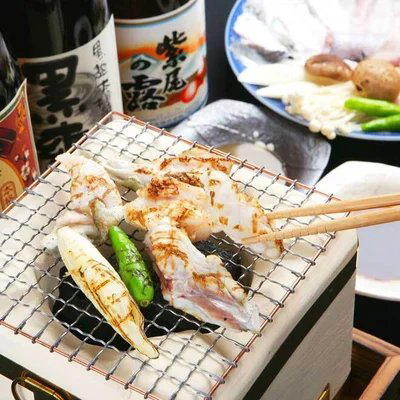
What to order
- Tessa
- Tecchiri
- Chiri nabe
- Teppi
- Zosui
Minato Ward and the Sushi Counter Beyond the Centre
Osaka's most-discussed sushi counters tend to cluster around Namba, Shinsaibashi, and the northern reaches of Umeda. Minato Ward sits south of that circuit, across the Aji River, in a residential stretch where the density of tourist foot traffic drops sharply. That geography says something about who eats at Yunagibashi Takoyasu and how they find it: not by walking past on the way somewhere else, but by looking specifically, and planning accordingly. In a city where the Michelin-recognised sushi scene continues to expand, Osaka now supports a range of starred counters from entry-level to multi-seat tasting formats, a one-star address in a ward like Minato carries a particular kind of credibility. It signals a place that earned recognition on its cooking, not on its postcode.
A Counter That Reads Its Own City
Osaka's relationship with sushi differs from Tokyo's. Where Tokyo's leading omakase counters have largely moved toward an austere, performance-focused model with short seatings and maximalist rice temperatures, Osaka has historically maintained a looser interpretation, more willing to incorporate the broader flavour preferences that define naniwa cooking, a tradition that prizes sweetness, richness, and a certain generosity of proportion. That tension between Edomae discipline and Osaka's own culinary instincts runs through the city's upper-tier sushi scene, and it's a productive one. Venues like Sushi Harasho, Matsuzushi, and Sushi Hoshiyama each negotiate that balance differently. Yunagibashi Takoyasu, under chef Hirokazu Igarashi, sits within that same negotiation, a Michelin-starred counter working within a city that has its own set of expectations about what a meal should feel like.
The daily operating hours, 12 pm to 10 pm, seven days a week, are worth noting as a marker of format. Omakase counters at the upper tier of the Tokyo market typically run tight, fixed seatings with rest periods between. For travellers, that accessibility is meaningful. It places Yunagibashi Takoyasu in the tier of Michelin-recognised counters where planning is rewarded but rigidity is not required.
The Opinionated About Dining Signal
Recognition from Opinionated About Dining, which published a Japan recommendation for the restaurant in 2023, operates on a different axis from Michelin. OAD rankings aggregate assessments from a self-selecting pool of frequent, high-volume diners rather than from anonymous inspectors working a fixed methodology. An OAD listing alongside a Michelin star suggests that Yunagibashi Takoyasu performs consistently for two distinct evaluative audiences: the institutional one concerned with technical execution and service calibration, and the practitioner-heavy one more focused on the cooking as a total experience. In a city with the counter density of Osaka, where starred addresses now number in the dozens across cuisine categories, that dual signal is worth more than either citation in isolation.
For comparison within Osaka's broader dining tier: venues such as Taian and Kashiwaya Senriyama operate at the ¥¥¥ price band with Michelin recognition in kaiseki and traditional Japanese formats. At the ¥¥¥¥ level, French-leaning addresses like Hajime, La Cime, and Fujiya 1935 occupy a different competitive set entirely. Yunagibashi Takoyasu's ¥¥¥ positioning in sushi places it in a tier where the value proposition is strong relative to what a similarly credentialed counter in Tokyo would cost. That gap, between Tokyo prices and Osaka quality at the one-star level, has been a consistent feature of Osaka's dining identity, and it remains one of the practical arguments for building a food itinerary around the city rather than the capital.
How the Counter Has Developed
The editorial angle here is not that Yunagibashi Takoyasu has reinvented itself spectacularly, but rather that Osaka's one-star sushi tier has matured around it. A decade ago, Michelin recognition in Osaka's sushi category was concentrated at a handful of addresses and carried almost automatic press attention. The 2024 star for Yunagibashi Takoyasu arrives in a more competitive environment, one where the inspectors have a wider field to assess, and where a star means something more specific about where a counter sits within the city's current range. The OAD recommendation in 2023 preceded the Michelin recognition by a year, which is a pattern worth noting: OAD's diner-led methodology sometimes surfaces quality ahead of institutional timelines, particularly at counters that operate outside the central neighbourhoods where inspectors concentrate their attention.
Chef Igarashi's position at Yunagibashi Takoyasu is that of a practitioner working within Osaka's evolving sushi identity rather than against it. The relevant story is less about individual reinvention and more about how the city's mid-upper sushi tier has gradually earned the kind of external credibility, dual-recognition, international diner attention, that used to require a Tokyo address. Counters like Sushi Murakami Jiro and Sushi Sanshin operate within the same expanding field. The Michelin Guide's increasing granularity in Osaka, distinguishing between counters by neighbourhood, format, and price point with more precision than in earlier editions, reflects that maturation.
Sushi in the Kansai Region: A Wider Picture
Travellers building a Japan itinerary around food often face a structural choice: anchor to Tokyo's density and depth, or move through the Kansai corridor and accept a different set of tradeoffs. The case for Kansai is partly economic, the ¥¥¥ tier buys more here, and partly experiential. Osaka sushi is not a lesser version of Tokyo sushi. It is a distinct tradition, one with its own pressing techniques, rice seasonings, and comfort with theatricality. Kyoto's kaiseki counters, such as Gion Sasaki, and Nara's more experimental formats, like akordu, complete a regional picture that rewards a slower itinerary rather than a single-city sprint.
Within Japan more broadly, Tokyo remains the reference point for sushi at the very highest level, addresses like Harutaka set a benchmark against which Osaka counters are often measured, fairly or not. Further south, Goh in Fukuoka represents a different regional interpretation of high-end Japanese cooking. And for those curious about how Japanese sushi culture travels, Sushi Shikon in Hong Kong and Shoukouwa in Singapore represent the export end of that tradition, technically precise, with Michelin recognition, but operating in a context that changes the meaning of the meal.
Planning Your Visit
Yunagibashi Takoyasu sits in Minato Ward at 1 Chome-15-5 Yunagi, Osaka, a residential address that requires intention to reach. The nearest public transport options connect to Osaka's wider subway network, though the ward's position south of the central loop means journey times from major hubs like Namba or Umeda run longer than they would to most starred counters. Build that into your timing. Hours: Monday through Sunday, 12 pm to 10 pm. Budget: ¥¥¥, in line with Osaka's mid-upper sushi tier, and typically more accessible than comparable starred counters in Tokyo. Reservations: Dress: No confirmed dress code, but the counter format and award profile suggest smart-casual at minimum.
For a fuller picture of what Osaka's dining scene offers across categories and price points, see our full Osaka restaurants guide. Planning around accommodation, drinking, or other experiences? Our Osaka hotels guide, Osaka bars guide, Osaka wineries guide, and Osaka experiences guide cover the rest. If your Japan plans extend beyond Osaka, 1000 in Yokohama and 6 in Okinawa are worth noting as you build out an itinerary.
What Dish Is Yunagibashi Takoyasu Famous For?
No specific signature dishes are confirmed in the available record, and inventing them would misrepresent the counter. What can be said with confidence is that the Michelin star and OAD recommendation point toward a kitchen operating at a consistent level within the sushi format, chef Hirokazu Igarashi's work across the daily service window has earned recognition from two distinct evaluative bodies. For dish-level specifics, the most reliable route is to contact the restaurant directly or consult recent diner reports from the OAD community, where the recommendation originated in 2023.
Frequently asked questions
Is Yunagibashi Takoyasu expensive?
Pricing at Yunagibashi Takoyasu is listed as ¥¥¥.
What part of town is Yunagibashi Takoyasu in?
Yunagibashi Takoyasu is located at 1 Chome-15-5 Yunagi, Minato Ward, Osaka, 552-0004, Japan, Osaka.
Does Yunagibashi Takoyasu have a Michelin star or similar recognition?
Yunagibashi Takoyasu has received recognition including: Michelin 1 Star (2024); Opinionated About Dining Top Restaurants in Japan Recommended (2023).
What dish is Yunagibashi Takoyasu famous for?
No specific signature piece has been confirmed in the public record for this counter. What the credentials do confirm is that Chef Hirokazu Igarashi's work earned a Michelin star in 2024 and an Opinionated About Dining Japan recommendation in 2023, both of which reflect consistent execution across the full sequence rather than a single standout dish. Osaka sushi counters in this tier typically foreground locally sourced and Kansai-inflected preparations, but specific menu items should be verified directly at time of booking.
What cuisine category does Yunagibashi Takoyasu fall under?
What are the operating hours at Yunagibashi Takoyasu?
Hours at Yunagibashi Takoyasu: Hours: Monday 12–10 pm Tuesday 12–10 pm Wednesday 12–10 pm Thursday 12–10 pm Friday 12–10 pm Saturday 12–10 pm Sunday 12–10 pm.
Who is the chef at Yunagibashi Takoyasu?
The chef associated with Yunagibashi Takoyasu is Hirokazu Igarashi.
Comparable Options
A compact comparison to help you place this venue among nearby peers.
| Venue | Cuisine | Price | Awards | Notes |
|---|---|---|---|---|
| Yunagibashi TakoyasuThis venue (the venue you are viewing) | Traditional Fugu (Pufferfish) | $200–300 | 1 Michelin Star | Not listed |
| HAJIME | Avant-Garde Japanese Fine Dining | $300–500 | 3 Michelin Stars · World's 50 Best #83 | French, Innovative |
| La Cime | Modern French with Japanese Ingredients | $150–200 | 2 Michelin Stars · World's 50 Best #13 | French |
| Kashiwaya Osaka Senriyama | Seasonal Kaiseki Omakase | $200–300 | 3 Michelin Stars · La Liste Top Restaurants | Japanese |
| Taian | Traditional Japanese Kaiseki Omakase | $150–200 | 3 Michelin Stars · La Liste Top Restaurants | Kaiseki, Japanese |
| Fujiya 1935 | Modern Japanese with European influences | $100–150 | 2 Michelin Stars · La Liste Top Restaurants | Innovative |
Recognition history
Dated appearances from independent guides and award organizations, with the underlying list record or original source where available.
Michelin 1 Star
Michelin
Opinionated About Dining Top Restaurants in Japan Recommended
Opinionated About Dining
Full recognition history (3 entries)
Opinionated About Dining Top Restaurants in Japan Recommended
Opinionated About Dining